
Revision summary
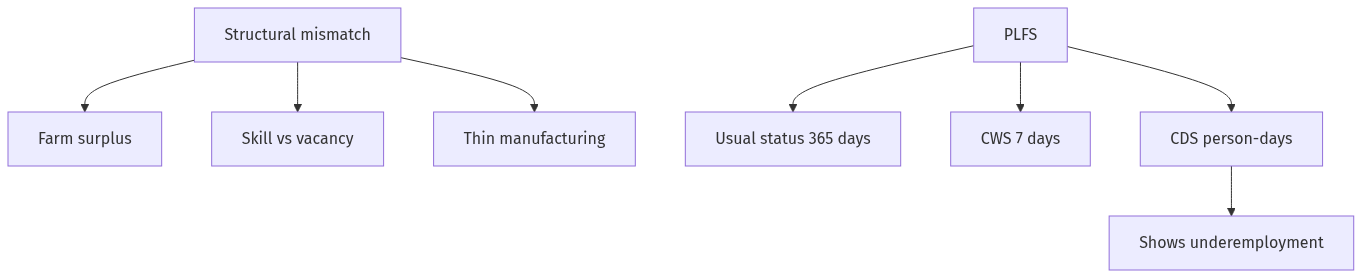
India’s unemployment is mostly structural: too many workers in low-productivity farm work, skills that do not match vacancies, and weak manufacturing absorption. PLFS usual status uses a 365-day reference and gives the lowest unemployment rate. Current Weekly Status uses seven days and is the main internationally comparable headline. Current Daily Status counts person-days and shows underemployment. Improvements are hours, gig codes, women’s time-use, district samples, and a vacancy module beside the household survey.
Model answer
Copper italics in this answer — like this — are the key facts. Each one is unpacked in the Facts & figures rail.
Introduction
India’s job problem is not mainly a short recession. It is a mismatch between what people can do, where they live, and what the economy hires. That is structural unemployment. The Periodic Labour Force Survey (PLFS) tries to count it with three clocks: a year, a week, and a day. The clock you choose changes the rate.
Body
Why most unemployment is structural
- Agriculture still holds a large workforce while its share of output is much smaller; people are not idle every day, but they are not in productive non-farm jobs.
- Education and skills do not match factory, logistics, and care vacancies; graduates wait while machine operators are scarce.
- Manufacturing has not absorbed labour at East Asian speed; services hire the English-and-urban slice first.
- Gender, caste, and region lock many into local, unpaid, or casual work; a vacancy in another State is not a real option without housing and safety.
- Cyclical slumps add a layer. They do not explain why the same mismatch returns in a boom. Disguised unemployment in the family farm is the rural face of the same structure.
Methodology in India
- After the old National Sample Survey employment rounds, PLFS (National Statistical Office) is the regular household survey.
- Usual status (principal + subsidiary): a person is a worker if they worked for a major part of the last 365 days, or had a subsidiary economic activity of at least 30 days. The unemployment rate on this basis is the lowest, because a few months of work in the year count.
- Current Weekly Status (CWS): activity in the last 7 days. A person who worked at least one hour in that week is employed. This sits between usual status and daily status and is now the headline international-style rate in PLFS annual and quarterly urban releases.
- Current Daily Status (CDS): person-days in the week; unemployment is counted in half-days. This rate is the highest because underemployment (a worker idle three days) shows up.
- Labour force is those employed plus those seeking or available. Not in labour force (studies, unpaid domestic work) is not unemployment. That distinction matters for women.
Suggested improvements
- Publish underemployment and hours as prominently as the unemployment rate; CDS-type person-days should not stay a specialist footnote.
- Count gig, platform, and unpaid family work with clearer codes so informality is not hidden as self-employment.
- Raise frequency and sample for backward districts; urban quarterly PLFS is not enough for rural structure.
- Add a job-vacancy and skill-mismatch module (what employers cannot fill) beside household status.
- Align a time-use slice with PLFS so women’s unpaid work is not read as voluntary withdrawal.
- Use administrative traces (EPFO, e-SHRAM, GST payroll) as complements, not as a replacement for a household survey that still sees the informal majority.
Flow diagram
Conclusion
- Most Indian unemployment is structural: farm surplus, skill mismatch, and a thin factory layer. PLFS usual status understates it; CWS is the weekly headline; CDS shows person-day slack. Measurement will improve when hours, gig work, women’s time-use, and vacancy data sit beside the single rate.
Quick related
Students also ask
-
Distinguish between 'care economy' and 'monetized economy'. How can care economy be brought into monetized economy through women empowerment?
Next question on this syllabus topic (2023 · Q12). View answer →
-
Why is the usual-status rate lower than CDS?
Because a person who worked part of the year is employed on usual status, while CDS still counts the idle days.
-
Is a homemaker counted as unemployed?
Not if she is not seeking or available for paid work. She is out of the labour force. Time-use surveys show the unpaid load separately.
Same topic · past papers
UPSC has asked this before
These previous-year questions sit on the same topic. Open one to practise the earlier ask.
More from this topic
Q17 · UPSC Mains 2026 · GS III · 15 marks · Solution
What are the challenges to solid waste management in India? Discuss the governmental policy framework on solid waste management. Discuss the success/failure cases of Delhi and Indore cities highlighting the salient features of their solid waste management initiatives.
Indian Economy
• Rapid urbanization has made solid waste management a critical environmental and public health crisis in India. • Key challenges include lack of source segregation, inadequate processing infrastructure, reliance on unprotected informal workers, and financially weak urban local bodies. • The policy framework relies on the SWM Rules 2016, Swachh Bharat Mission (Urban), and Plastic Waste Management Rules 2016. • Indore succeeded through 100% source segregation, zero dump-site remediation, and strict enforcement with digital monitoring. • Delhi failed due to overloaded legacy landfills (Ghazipur, Bhalswa), lack of decentralization, and fragmented municipal governance. • A successful transition requires moving to a circular economy focused on source segregation, decentralized processing, and polluter accountability.
Q16 · UPSC Mains 2026 · GS III · 15 marks · Solution
What is Agentic Artificial Intelligence (AI)? Explain its working. Describe its applications with suitable examples. Discuss the advantages, risks and challenges associated with agentic AI systems.
Indian Economy
Agentic Artificial Intelligence represents an advanced paradigm where AI systems operate with autonomy, setting goals and executing complex workflows without constant human prompts. Unlike traditional generative AI that merely responds to queries, agentic AI uses perception, planning, memory, and tool-use to achieve multi-step objectives. Its applications span across autonomous software engineering, supply chain optimization, and automated financial trading. While offering massive productivity gains and dynamic problem-solving, these systems pose significant risks including lack of transparency, alignment failures, security vulnerabilities, and ethical dilemmas. Governance frameworks and robust guardrails are essential to harness their potential safely.
Q15 · UPSC Mains 2026 · GS III · 15 marks · Solution
Mention salient features of 'Mission Drishti'. Discuss the imaging techniques used in the satellite launched on 3rd May 2026. Why is it being considered world's first satellite of its kind?
Indian Economy
Mission Drishti represents a major leap in India's space-based Earth observation capabilities, launched on 3rd May 2026. The mission employs advanced multi-spectral and hyperspectral imaging techniques to capture high-resolution data across various atmospheric and terrestrial layers. It is hailed as a global first due to its unique integration of real-time onboard edge computing with quantum encryption for secure data transmission. The satellite significantly enhances resource management, disaster response, and strategic surveillance. It aligns with India's policy of leveraging space technology for sustainable development and national security.