
Revision summary
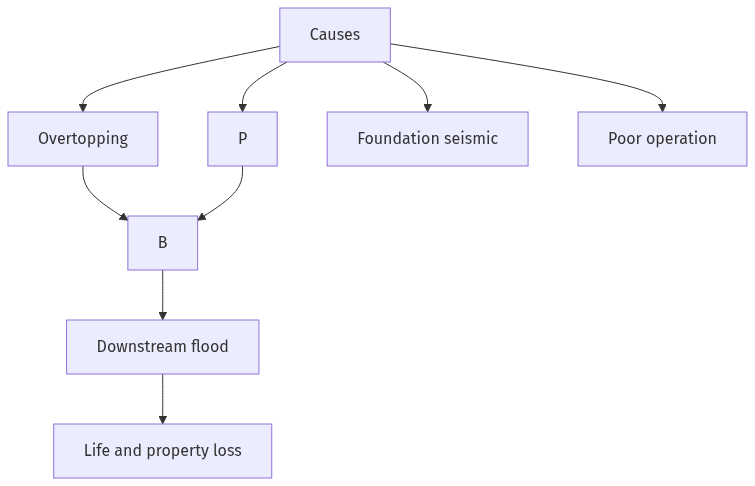
Common causes are overtopping in extreme rain, piping, foundation failure, design error, earthquakes, and gates that do not work. Banqiao in China in 1975 failed in typhoon rain; deaths were in the tens of thousands in a cascade of breaches. Machhu II at Morbi in 1979 failed in monsoon inflow; official deaths were in the low thousands. Teton 1976 and Panshet–Khadakwasla 1961 are other documented large failures. Downstream loss is huge because the reservoir empties as a sudden wave onto towns that grew below the dam.
Model answer
Copper italics in this answer — like this — are the key facts. Each one is unpacked in the Facts & figures rail.
Introduction
A large dam holds a reservoir against gravity. When the structure, the foundation, or the spillway fails, that water becomes a flood with almost no warning on the downstream side. The loss of life and property is therefore out of proportion to a normal river flood.
Body
Causes of dam failures
- Overtopping: the inflow from extreme rain or a failed upstream dam exceeds spillway capacity; water flows over an earth or rockfill crest and erodes it. This is among the most common causes worldwide.
- Piping and seepage: internal erosion through the embankment or along conduits opens a tunnel; the dam collapses inward.
- Foundation failure: weak, karst, or poorly grouted rock; settlement or sliding of the base.
- Structural and design faults: inadequate freeboard, poorly designed spillways, or materials that do not match the design.
- Seismic loading: shaking, liquefaction, or seiche in the reservoir; also induced seismicity in some large reservoirs.
- Operation and maintenance: gates that do not open, silted spillways, missing instrumentation, and flood forecasts that never reach the operator.
- Upstream cascade: one breach loads the next dam, as in some Chinese 1975 failures.
- Age and conflict damage are rarer Indian peacetime causes but matter in old masonry dams.
Two large failures
- Banqiao Dam, Henan, China, August 1975: Typhoon Nina dropped extreme rain; Banqiao and other dams in the Shimantan cascade overtopped and breached. Downstream plains flooded for many kilometres. Deaths ran into tens of thousands (official and later estimates differ; the event is among the deadliest dam disasters on record).
- Machhu II Dam, Morbi, Gujarat, 11 August 1979: an earthen dam on the Machhu river failed in extreme monsoon inflow; the wall of water hit Morbi town. Official deaths were in the low thousands; unofficial counts were higher. The cause combined hydrological load, embankment design, and insufficient spillway capacity.
(Other well-documented cases used in the same literature include Teton Dam, Idaho, United States, 1976, a piping/foundation failure, and the Panshet–Khadakwasla floods at Pune in 1961.)
Why downstream loss is colossal
- Stored potential energy is released in minutes, not days.
- Settlements below a dam often grew after the dam, in the false safety of a regulated river.
- Warning time is short; silt and debris raise the killing power of the wave.
Flow diagram
Conclusion
Dam failures come from overtopping, piping, foundations, design, seismic load and poor operation. Banqiao 1975 and Machhu II 1979 show how a breached reservoir becomes a night-time flood. Instrumentation, spillway capacity and downstream evacuation plans are the only honest mitigation.
Quick related
Students also ask
-
Most of the unemployment in India is structural in nature. Examine the methodology adopted to compute unemployment in the country and suggest improvements.
Next question on this syllabus topic (2023 · Q11). View answer →
-
Is overtopping only a monsoon problem?
It is most often a flood problem, but a blocked spillway or a cascade breach can overtop even when the local forecast was ordinary.
-
Why name foreign dams in an India paper?
Banqiao is the largest documented death toll. Machhu II is the large Indian monsoon-embankment case. Together they cover hydrology and design.
Same topic · past papers
UPSC has asked this before
These previous-year questions sit on the same topic. Open one to practise the earlier ask.
-
2022 · Q13 · GS III · 15 marks
What are the main bottlenecks in upstream and downstream process of marketing of agricultural products in India ? -
2021 · Q18 · GS III · 15 marks
Describe the various causes and the effects of landslides. Mention the important components of the National Landslide Risk Management Strategy.
More from this topic
Q17 · UPSC Mains 2026 · GS III · 15 marks · Solution
What are the challenges to solid waste management in India? Discuss the governmental policy framework on solid waste management. Discuss the success/failure cases of Delhi and Indore cities highlighting the salient features of their solid waste management initiatives.
Indian Economy
• Rapid urbanization has made solid waste management a critical environmental and public health crisis in India. • Key challenges include lack of source segregation, inadequate processing infrastructure, reliance on unprotected informal workers, and financially weak urban local bodies. • The policy framework relies on the SWM Rules 2016, Swachh Bharat Mission (Urban), and Plastic Waste Management Rules 2016. • Indore succeeded through 100% source segregation, zero dump-site remediation, and strict enforcement with digital monitoring. • Delhi failed due to overloaded legacy landfills (Ghazipur, Bhalswa), lack of decentralization, and fragmented municipal governance. • A successful transition requires moving to a circular economy focused on source segregation, decentralized processing, and polluter accountability.
Q16 · UPSC Mains 2026 · GS III · 15 marks · Solution
What is Agentic Artificial Intelligence (AI)? Explain its working. Describe its applications with suitable examples. Discuss the advantages, risks and challenges associated with agentic AI systems.
Indian Economy
Agentic Artificial Intelligence represents an advanced paradigm where AI systems operate with autonomy, setting goals and executing complex workflows without constant human prompts. Unlike traditional generative AI that merely responds to queries, agentic AI uses perception, planning, memory, and tool-use to achieve multi-step objectives. Its applications span across autonomous software engineering, supply chain optimization, and automated financial trading. While offering massive productivity gains and dynamic problem-solving, these systems pose significant risks including lack of transparency, alignment failures, security vulnerabilities, and ethical dilemmas. Governance frameworks and robust guardrails are essential to harness their potential safely.
Q15 · UPSC Mains 2026 · GS III · 15 marks · Solution
Mention salient features of 'Mission Drishti'. Discuss the imaging techniques used in the satellite launched on 3rd May 2026. Why is it being considered world's first satellite of its kind?
Indian Economy
Mission Drishti represents a major leap in India's space-based Earth observation capabilities, launched on 3rd May 2026. The mission employs advanced multi-spectral and hyperspectral imaging techniques to capture high-resolution data across various atmospheric and terrestrial layers. It is hailed as a global first due to its unique integration of real-time onboard edge computing with quantum encryption for secure data transmission. The satellite significantly enhances resource management, disaster response, and strategic surveillance. It aligns with India's policy of leveraging space technology for sustainable development and national security.