
Revision summary
The care economy is unpaid or underpaid household and person-care; the monetized economy is priced and counted work. Women do most unpaid care, which is a main reason for low female labour-force participation. Empowerment means recognise care, reduce it with water fuel and crèches, and redistribute it at home. Some care should become paid work: ASHA, Anganwadi, Palna crèches, eldercare, and protected domestic work. DAY-NRLM and asset rights help turn care skill into an enterprise, not only a double burden.
Model answer
Copper italics in this answer — like this — are the key facts. Each one is unpacked in the Facts & figures rail.
Introduction
- Much of what keeps a household alive is work without a wage: cooking, childcare, eldercare, fetching water. That is the care economy. The monetized economy is the part that passes through a price, a payroll, or a tax invoice. Women do most of the first and a smaller share of the second. Empowerment is the bridge if it recognises, reduces, and redistributes care, and if some care becomes paid decent work.
Body
Distinction
- Care economy: unpaid or underpaid services that reproduce labour — children, the sick, the old, the daily meal. It sits largely outside Gross Domestic Product as household production.
- Monetized economy: goods and services sold or paid by the State; counted in GDP, GST, and employment surveys when they are “economic activity”.
- The two are linked. Factories run because someone did unpaid care the night before. The Time Use Survey (2019) showed Indian women spending several hours more per day on unpaid domestic and care work than men.
Bringing care into the monetized economy through women empowerment
- Recognise: count unpaid care in satellite accounts and in policy, so a “low female labour-force participation” is not misread as idleness.
- Reduce: tap water, clean fuel (Pradhan Mantri Ujjwala Yojana), crèches, and time-saving infrastructure cut the unpaid load so women can take paid hours.
- Redistribute: paternity leave, cheaper quality childcare, and men sharing housework; without this, a job only double-burdens the woman.
- Monetize care jobs: pay and professionalise Anganwadi workers, Accredited Social Health Activists (ASHA), and mid-day-meal cooks; expand Palna / National Crèche and paid eldercare; bring domestic workers under labour codes and social security.
- Assets and organisation: Deendayal Antyodaya Yojana – National Rural Livelihoods Mission (DAY-NRLM) self-help groups, property rights, and skilling (including Skill India care-sector courses) turn unpaid skill into an enterprise or a wage.
- Public care infrastructure is itself a monetized sector: it raises GDP and women’s participation, which is the empowerment loop.
Caution
- Paying a woman to do the same isolated housework without rights is not empowerment. Monetization must mean wage, safety, and a career ladder, not a cheaper nanny class.
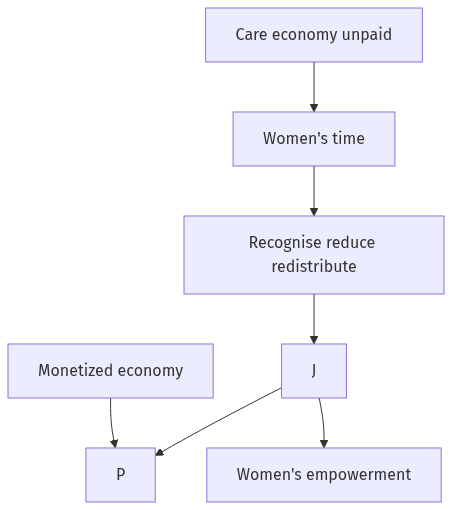
Flow diagram
Conclusion
The care economy is unpaid reproduction of people; the monetized economy is priced work. Women carry the first. Empowerment brings care into the second by cutting unpaid hours, sharing them, and turning care into paid public and private jobs with rights — Ujjwala, crèches, ASHA and Anganwadi pay, and NRLM are the Indian tools.
Quick related
Students also ask
-
Explain the changes in cropping pattern in India in the context of changes in consumption pattern and marketing conditions.
Next question on this syllabus topic (2023 · Q13). View answer →
-
If unpaid care is valuable, should it be added to GDP as is?
Satellite accounts should count it. Stuffing it into GDP without wages does not empower the woman who still has no income.
-
Is a paid domestic worker the same as empowerment?
Only if the job has a wage floor, hours, and social security. Otherwise one woman’s career rests on another woman’s unprotected labour.
Same topic · past papers
UPSC has asked this before
These previous-year questions sit on the same topic. Open one to practise the earlier ask.
More from this topic
Q17 · UPSC Mains 2026 · GS III · 15 marks · Solution
What are the challenges to solid waste management in India? Discuss the governmental policy framework on solid waste management. Discuss the success/failure cases of Delhi and Indore cities highlighting the salient features of their solid waste management initiatives.
Indian Economy
• Rapid urbanization has made solid waste management a critical environmental and public health crisis in India. • Key challenges include lack of source segregation, inadequate processing infrastructure, reliance on unprotected informal workers, and financially weak urban local bodies. • The policy framework relies on the SWM Rules 2016, Swachh Bharat Mission (Urban), and Plastic Waste Management Rules 2016. • Indore succeeded through 100% source segregation, zero dump-site remediation, and strict enforcement with digital monitoring. • Delhi failed due to overloaded legacy landfills (Ghazipur, Bhalswa), lack of decentralization, and fragmented municipal governance. • A successful transition requires moving to a circular economy focused on source segregation, decentralized processing, and polluter accountability.
Q16 · UPSC Mains 2026 · GS III · 15 marks · Solution
What is Agentic Artificial Intelligence (AI)? Explain its working. Describe its applications with suitable examples. Discuss the advantages, risks and challenges associated with agentic AI systems.
Indian Economy
Agentic Artificial Intelligence represents an advanced paradigm where AI systems operate with autonomy, setting goals and executing complex workflows without constant human prompts. Unlike traditional generative AI that merely responds to queries, agentic AI uses perception, planning, memory, and tool-use to achieve multi-step objectives. Its applications span across autonomous software engineering, supply chain optimization, and automated financial trading. While offering massive productivity gains and dynamic problem-solving, these systems pose significant risks including lack of transparency, alignment failures, security vulnerabilities, and ethical dilemmas. Governance frameworks and robust guardrails are essential to harness their potential safely.
Q15 · UPSC Mains 2026 · GS III · 15 marks · Solution
Mention salient features of 'Mission Drishti'. Discuss the imaging techniques used in the satellite launched on 3rd May 2026. Why is it being considered world's first satellite of its kind?
Indian Economy
Mission Drishti represents a major leap in India's space-based Earth observation capabilities, launched on 3rd May 2026. The mission employs advanced multi-spectral and hyperspectral imaging techniques to capture high-resolution data across various atmospheric and terrestrial layers. It is hailed as a global first due to its unique integration of real-time onboard edge computing with quantum encryption for secure data transmission. The satellite significantly enhances resource management, disaster response, and strategic surveillance. It aligns with India's policy of leveraging space technology for sustainable development and national security.