
Revision summary
AI is software that learns patterns and proposes an action; in clinics it is a narrow tool, not a general doctor. It helps diagnosis through imaging, pathology, ECG, and triage support. The clinician remains responsible for the call. Privacy threats are re-identification, extra training on records, breach, insurer misuse, and biased models. DPDP Act 2023, ABHA consent, and ethics rules must bind hospitals and vendors.
Model answer
Copper italics in this answer — like this — are the key facts. Each one is unpacked in the Facts & figures rail.
Introduction
Artificial Intelligence (AI) is software that finds patterns in data and proposes an action without being fully hand-coded for every case. In a clinic it can read a scan or a lab trail faster than a tired shift. The same data trail can expose a patient’s body and history if consent, storage and law are weak.
Body
What AI is
- AI includes machine learning (models trained on examples) and narrower expert rules.
- In medicine the useful form is usually a narrow tool: classify a chest X-ray, flag a diabetic retina photo, triage a symptom list — not a general doctor in a box.
- India already uses elements of this in public programmes (for example tuberculosis screening on X-rays and diabetic retinopathy pilots) under clinical oversight.
Help in clinical diagnosis
- Imaging: models highlight likely tumours, bleeds, TB cavities or fractures and queue the radiologist’s time.
- Pathology and labs: slide and ECG pattern recognition reduce missed calls on high volume.
- Triage and decision support: history plus vitals suggest a differential so a primary centre can refer earlier.
- Public health: outbreak and shortage signals from many clinics, if data are standardised.
- The clinician still owns the diagnosis. AI is a second reader and a speed tool, not a licence to skip examination.
Privacy threats
- Health data are sensitive: diagnosis, genetics, location of clinic visits, and Aadhaar-linked IDs can re-identify a person.
- Cloud vendors, device firms and hospital chains may train models on records beyond the purpose of care.
- Breach, sale, or employer and insurer misuse can deny a job or a policy.
- Bias in training data can mis-label women, poorer groups, or rare diseases, which is a clinical harm as well as a fairness harm.
- The Digital Personal Data Protection Act, 2023, Ayushman Bharat Health Account (ABHA) consent layers, and Indian Council of Medical Research ethics guidance are the present Indian frame. They work only if hospitals treat a model vendor as a data fiduciary, not as a free research partner.
Flow diagram
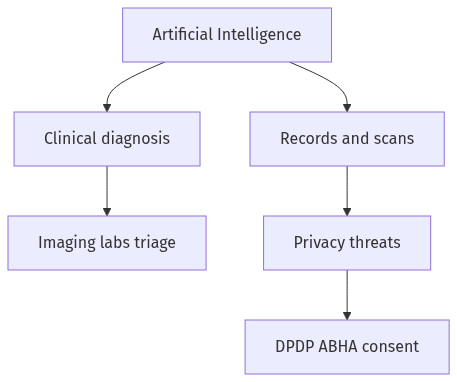
Conclusion
AI is pattern-finding software. In diagnosis it speeds imaging, labs and triage under a doctor’s responsibility. In healthcare it is a privacy threat unless purpose, consent, breach duty and the 2023 data law actually bind the hospital and the vendor.
Quick related
Students also ask
-
Discuss several ways in which microorganisms can help in meeting the current fuel shortage.
Next question on this syllabus topic (2023 · Q6). View answer →
-
Can AI replace the doctor in diagnosis?
No. It is a second reader. Law and ethics still put the licensed clinician in charge.
-
Is anonymised hospital data always safe to train on?
Not always. Imaging and sparse diagnoses can re-identify a person when linked with other files.
Same topic · past papers
UPSC has asked this before
These previous-year questions sit on the same topic. Open one to practise the earlier ask.
More from this topic
Q17 · UPSC Mains 2026 · GS III · 15 marks · Solution
What are the challenges to solid waste management in India? Discuss the governmental policy framework on solid waste management. Discuss the success/failure cases of Delhi and Indore cities highlighting the salient features of their solid waste management initiatives.
Indian Economy
• Rapid urbanization has made solid waste management a critical environmental and public health crisis in India. • Key challenges include lack of source segregation, inadequate processing infrastructure, reliance on unprotected informal workers, and financially weak urban local bodies. • The policy framework relies on the SWM Rules 2016, Swachh Bharat Mission (Urban), and Plastic Waste Management Rules 2016. • Indore succeeded through 100% source segregation, zero dump-site remediation, and strict enforcement with digital monitoring. • Delhi failed due to overloaded legacy landfills (Ghazipur, Bhalswa), lack of decentralization, and fragmented municipal governance. • A successful transition requires moving to a circular economy focused on source segregation, decentralized processing, and polluter accountability.
Q16 · UPSC Mains 2026 · GS III · 15 marks · Solution
What is Agentic Artificial Intelligence (AI)? Explain its working. Describe its applications with suitable examples. Discuss the advantages, risks and challenges associated with agentic AI systems.
Indian Economy
Agentic Artificial Intelligence represents an advanced paradigm where AI systems operate with autonomy, setting goals and executing complex workflows without constant human prompts. Unlike traditional generative AI that merely responds to queries, agentic AI uses perception, planning, memory, and tool-use to achieve multi-step objectives. Its applications span across autonomous software engineering, supply chain optimization, and automated financial trading. While offering massive productivity gains and dynamic problem-solving, these systems pose significant risks including lack of transparency, alignment failures, security vulnerabilities, and ethical dilemmas. Governance frameworks and robust guardrails are essential to harness their potential safely.
Q15 · UPSC Mains 2026 · GS III · 15 marks · Solution
Mention salient features of 'Mission Drishti'. Discuss the imaging techniques used in the satellite launched on 3rd May 2026. Why is it being considered world's first satellite of its kind?
Indian Economy
Mission Drishti represents a major leap in India's space-based Earth observation capabilities, launched on 3rd May 2026. The mission employs advanced multi-spectral and hyperspectral imaging techniques to capture high-resolution data across various atmospheric and terrestrial layers. It is hailed as a global first due to its unique integration of real-time onboard edge computing with quantum encryption for secure data transmission. The satellite significantly enhances resource management, disaster response, and strategic surveillance. It aligns with India's policy of leveraging space technology for sustainable development and national security.