
Revision summary
Digitalization in India is furthest in identity, payments and tax, led by Aadhaar, UPI and GSTN. ONDC is the public attempt to open digital commerce to small sellers. The Digital Personal Data Protection Act 2023 is the first full Union data law. Problems are the access gap, payment fraud, weak privacy practice, and a few private platforms. Improvements are last-mile connectivity, DPDP enforcement, ONDC, and cyber capacity without killing cheap UPI.
Model answer
Copper italics in this answer — like this — are the key facts. Each one is unpacked in the Facts & figures rail.
Introduction
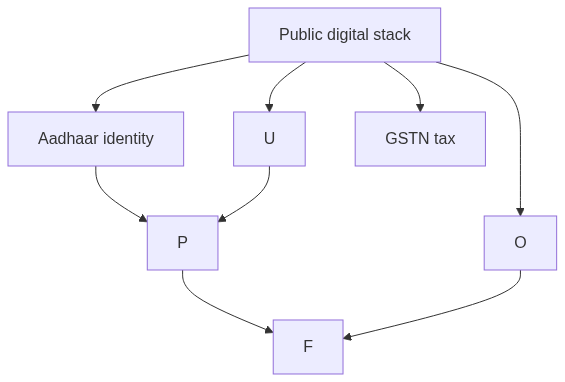
Digitalization here means payments, identity, tax, commerce and public services moving onto electronic rails. India built a public stack — Aadhaar, Unified Payments Interface (UPI), Goods and Services Tax Network — that is now used at national scale. The status is strong on rails and uneven on who is on those rails, and on who holds the data.
Body
Status
- Aadhaar covers almost the resident population and underpins Direct Benefit Transfer, e-KYC and many welfare payments.
- UPI has made real-time, low-cost person-to-merchant payments ordinary, including in small shops, and is among the world’s largest instant-payment systems by volume.
- GSTN, e-way bills, FASTag, DigiLocker, CoWIN and digital land and court pilots show the State itself running on software.
- Open Network for Digital Commerce (ONDC) is a public protocol meant to let small sellers meet buyers without one private app owning the market.
- The Digital Personal Data Protection Act, 2023 is the first comprehensive Union law on personal data, consent, and duties of data fiduciaries.
Problems
- Access: cheap data is wide; cheap smartphones, language, and last-mile BharatNet quality are not even. Women and older rural users lag.
- Fraud and cybercrime: UPI and KYC scams, SIM swaps, and phishing rose with volume.
- Privacy and profiling: Aadhaar-seeded databases and private apps collect more than a payment needs; rules under the 2023 Act were still to be tested in use.
- Platform concentration: a few apps still set price and visibility in retail, mobility and food, which ONDC is meant to loosen.
- MSME and farm gap: many units still invoice on paper; digital tax compliance is a cost, not a market.
Improvements
- Finish last-mile fibre and 4G/5G and treat digital literacy as a public skill, not a brochure.
- Notify and enforce DPDP rules: purpose limitation, breach notice, and penalties that bite large fiduciaries.
- Use ONDC and open APIs so MSMEs sell without paying a private gatekeeper.
- Strengthen cyber police, CERT-In and RBI fraud controls without choking UPI’s low cost.
- Keep Aadhaar as identity, not as a surveillance key for every private database.
Flow diagram
Conclusion
India’s digital status is a public-stack success in payments and identity, and an unfinished project in inclusion, privacy and fair commerce. UPI and Aadhaar must sit with DPDP enforcement and ONDC access, or volume will keep outrunning trust.
Quick related
Students also ask
-
Introduce the concept of Artificial Intelligence (AI). How does AI help clinical diagnosis? Do you perceive any threat to privacy of the individual in the use of AI in the healthcare?
Next question on this syllabus topic (2023 · Q5). View answer →
-
Is India fully digitalized because UPI is large?
No. Payments scaled. Many firms, farms and public offices still run on paper, and privacy rules are new.
-
Does Aadhaar equal a data-protection law?
No. Aadhaar is identity. The DPDP Act 2023 is the law that must govern how personal data is used.
Same topic · past papers
UPSC has asked this before
These previous-year questions sit on the same topic. Open one to practise the earlier ask.
More from this topic
Q17 · UPSC Mains 2026 · GS III · 15 marks · Solution
What are the challenges to solid waste management in India? Discuss the governmental policy framework on solid waste management. Discuss the success/failure cases of Delhi and Indore cities highlighting the salient features of their solid waste management initiatives.
Indian Economy
• Rapid urbanization has made solid waste management a critical environmental and public health crisis in India. • Key challenges include lack of source segregation, inadequate processing infrastructure, reliance on unprotected informal workers, and financially weak urban local bodies. • The policy framework relies on the SWM Rules 2016, Swachh Bharat Mission (Urban), and Plastic Waste Management Rules 2016. • Indore succeeded through 100% source segregation, zero dump-site remediation, and strict enforcement with digital monitoring. • Delhi failed due to overloaded legacy landfills (Ghazipur, Bhalswa), lack of decentralization, and fragmented municipal governance. • A successful transition requires moving to a circular economy focused on source segregation, decentralized processing, and polluter accountability.
Q16 · UPSC Mains 2026 · GS III · 15 marks · Solution
What is Agentic Artificial Intelligence (AI)? Explain its working. Describe its applications with suitable examples. Discuss the advantages, risks and challenges associated with agentic AI systems.
Indian Economy
Agentic Artificial Intelligence represents an advanced paradigm where AI systems operate with autonomy, setting goals and executing complex workflows without constant human prompts. Unlike traditional generative AI that merely responds to queries, agentic AI uses perception, planning, memory, and tool-use to achieve multi-step objectives. Its applications span across autonomous software engineering, supply chain optimization, and automated financial trading. While offering massive productivity gains and dynamic problem-solving, these systems pose significant risks including lack of transparency, alignment failures, security vulnerabilities, and ethical dilemmas. Governance frameworks and robust guardrails are essential to harness their potential safely.
Q15 · UPSC Mains 2026 · GS III · 15 marks · Solution
Mention salient features of 'Mission Drishti'. Discuss the imaging techniques used in the satellite launched on 3rd May 2026. Why is it being considered world's first satellite of its kind?
Indian Economy
Mission Drishti represents a major leap in India's space-based Earth observation capabilities, launched on 3rd May 2026. The mission employs advanced multi-spectral and hyperspectral imaging techniques to capture high-resolution data across various atmospheric and terrestrial layers. It is hailed as a global first due to its unique integration of real-time onboard edge computing with quantum encryption for secure data transmission. The satellite significantly enhances resource management, disaster response, and strategic surveillance. It aligns with India's policy of leveraging space technology for sustainable development and national security.