
Revision summary
India’s cropping pattern shifted toward rice, wheat, sugarcane and some horticulture, and away from millets. Diets added oil, vegetables, milk and packaged food, while PDS still props rice and wheat. MSP and procurement are the loudest market signal; pulses, oilseeds and millets often lack that lift. e-NAM, FPOs and cold chain help where they actually operate. A better pattern needs paid procurement for millets, pulses and oilseeds and honest water pricing for paddy.
Model answer
Copper italics in this answer — like this — are the key facts. Each one is unpacked in the Facts & figures rail.
Introduction
A cropping pattern is what is sown, where, and in which season. In India it has moved from mixed coarse cereals toward rice, wheat, sugarcane and some horticulture. That shift followed what people eat, what the mandi and the Food Corporation of India buy, and what water and power made cheap. The three do not always point the same way.
Body
How the pattern changed
- Green Revolution irrigation and seed locked Punjab, Haryana and western Uttar Pradesh into paddy–wheat.
- Sugarcane expanded where mills and State advice guaranteed a cane price.
- Coarse cereals (millets) lost area for decades even where they fit the rainfall.
- Horticulture — fruit, vegetable, spices — gained as cold chain and cities grew.
- Oilseeds and pulses remain short of domestic need; edible oil imports stay large.
- 2023 as the International Year of Millets and new millet procurement were an attempt to turn the pattern back a few degrees.
Consumption
- As incomes rise, households buy more milk, oil, vegetables, sugar, and some meat/eggs, and a smaller cereal share of the calorie plate.
- Public Distribution still leans on rice and wheat, which keeps demand for those two grains politically hard to cut.
- Urban packaged food and online grocery raise demand for uniform, branded, and perishable lots, not for a mixed rainfed basket.
- Nutrition policy now asks for millets and pulses; the plate has not fully followed the pamphlet.
Marketing conditions
- Minimum Support Price and assured procurement for wheat and paddy (and sugarcane’s State price) are the strongest market signal. Farmers sow what the State will lift.
- Thin procurement for pulses, oilseeds and millets in many districts leaves those crops to a volatile trader price.
- e-NAM (National Agriculture Market), Farmer Producer Organisations, contract farming, and export windows help horticulture and spices where quality and logistics exist.
- Cold storage and processing are still short, so perishable area cannot expand as fast as diet change.
Better alignment
- Shift incentives toward millets, pulses and oilseeds in rainfed belts: procurement, seed, and a real MSP that is paid.
- Keep rice–wheat where water is honest; do not pay with free power for paddy in a falling aquifer.
- Match horticulture to cluster cold chains, not to a one-year price spike.
Flow diagram
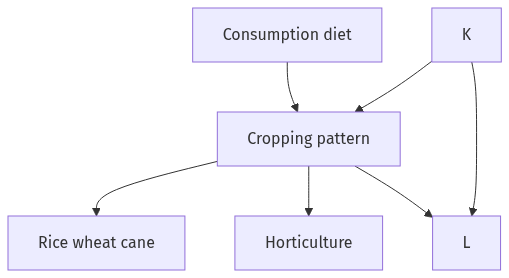
Conclusion
Cropping moved to rice, wheat, cane and some horticulture because consumption urbanised and because MSP-procurement and mills paid for those crops. Pulses, oilseeds and millets lagged both the plate and the import bill. Pattern will follow diet only when marketing pays for the crops nutrition policy names.
Quick related
Students also ask
-
What is the main task of India's third mood mission which could not be achieved in its earlier mission? List the countries that have achieved this task. Introduce the subsystems in the spacecraft launched and explain the role of the 'Virtual Launch Control Centre' at the Vikram Sarabhai Space Centre which contributed to the successful launch from Sriharikota.
Next question on this syllabus topic (2023 · Q16). View answer →
-
If people want vegetables, why do farmers still sow paddy?
Because paddy has a buyer of last resort. A tomato does not.
-
Does MSP alone fix the pulse gap?
Only if procurement actually happens at that price in the growing district, with seed and extension behind it.
Same topic · past papers
UPSC has asked this before
These previous-year questions sit on the same topic. Open one to practise the earlier ask.
-
2018 · Q14 · GS III · 15 marks
How has the emphasis on certain crops brought about changes in cropping patterns in recent past? Elaborate the emphasis on millets production and consumption. (250 Words, 15 Marks). -
2017 · Q15 · GS III · 15 marks
How do subsidies affect the cropping pattern, crop diversity and economy of farmers? What is the significance of crop insurance, minimum support price and food processing for small and marginal farmers?
More from this topic
Q17 · UPSC Mains 2026 · GS III · 15 marks · Solution
What are the challenges to solid waste management in India? Discuss the governmental policy framework on solid waste management. Discuss the success/failure cases of Delhi and Indore cities highlighting the salient features of their solid waste management initiatives.
Indian Economy
• Rapid urbanization has made solid waste management a critical environmental and public health crisis in India. • Key challenges include lack of source segregation, inadequate processing infrastructure, reliance on unprotected informal workers, and financially weak urban local bodies. • The policy framework relies on the SWM Rules 2016, Swachh Bharat Mission (Urban), and Plastic Waste Management Rules 2016. • Indore succeeded through 100% source segregation, zero dump-site remediation, and strict enforcement with digital monitoring. • Delhi failed due to overloaded legacy landfills (Ghazipur, Bhalswa), lack of decentralization, and fragmented municipal governance. • A successful transition requires moving to a circular economy focused on source segregation, decentralized processing, and polluter accountability.
Q16 · UPSC Mains 2026 · GS III · 15 marks · Solution
What is Agentic Artificial Intelligence (AI)? Explain its working. Describe its applications with suitable examples. Discuss the advantages, risks and challenges associated with agentic AI systems.
Indian Economy
Agentic Artificial Intelligence represents an advanced paradigm where AI systems operate with autonomy, setting goals and executing complex workflows without constant human prompts. Unlike traditional generative AI that merely responds to queries, agentic AI uses perception, planning, memory, and tool-use to achieve multi-step objectives. Its applications span across autonomous software engineering, supply chain optimization, and automated financial trading. While offering massive productivity gains and dynamic problem-solving, these systems pose significant risks including lack of transparency, alignment failures, security vulnerabilities, and ethical dilemmas. Governance frameworks and robust guardrails are essential to harness their potential safely.
Q15 · UPSC Mains 2026 · GS III · 15 marks · Solution
Mention salient features of 'Mission Drishti'. Discuss the imaging techniques used in the satellite launched on 3rd May 2026. Why is it being considered world's first satellite of its kind?
Indian Economy
Mission Drishti represents a major leap in India's space-based Earth observation capabilities, launched on 3rd May 2026. The mission employs advanced multi-spectral and hyperspectral imaging techniques to capture high-resolution data across various atmospheric and terrestrial layers. It is hailed as a global first due to its unique integration of real-time onboard edge computing with quantum encryption for secure data transmission. The satellite significantly enhances resource management, disaster response, and strategic surveillance. It aligns with India's policy of leveraging space technology for sustainable development and national security.