
Revision summary
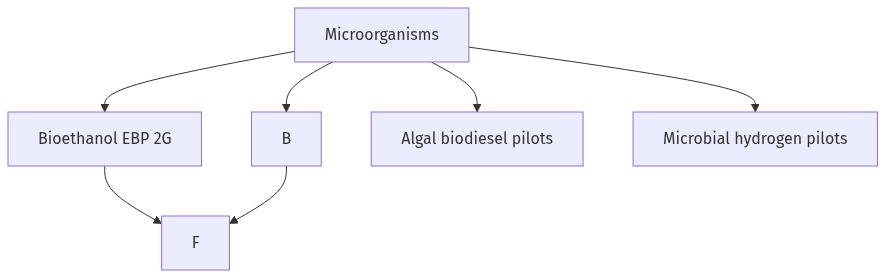
Yeasts and 2G microbes make ethanol; India blends it under the Ethanol Blended Petrol programme toward E20. Indian Oil’s Panipat 2G plant and Numaligarh’s bamboo bio-refinery are real second-generation sites. Anaerobic bacteria make biogas; SATAT and GOBARdhan upgrade it to transport and village fuel. Algal biodiesel and microbial hydrogen exist in CSIR and institute pilots, not as large national supply. These routes cut a slice of the oil shortage only with real plants and disciplined feedstock.
Model answer
Copper italics in this answer — like this — are the key facts. Each one is unpacked in the Facts & figures rail.
Introduction
India still imports most of its crude oil. Microbes cannot replace every barrel. They can make alcohol, methane, lipids and hydrogen from sugar, dung, residue and algae, which cuts a slice of the shortage and the import bill if plants actually run.
Body
Bioethanol
- Yeasts such as Saccharomyces ferment sugarcane molasses and grain starch to ethanol; bacteria and fungi are used in second-generation processes that break rice-straw and other cellulose.
- India blends ethanol in petrol under the Ethanol Blended Petrol programme, with an E20 (20 per cent) target.
- First-generation supply is molasses and surplus grain. Second-generation plants exist at scale in a few places, including Indian Oil’s 2G ethanol plant at Panipat and the Numaligarh bamboo-based bio-refinery in Assam; other oil-company 2G units have been under construction rather than all online.
Biogas and compressed biogas
- Anaerobic bacteria in digesters turn cattle dung, press-mud and urban wet waste into methane-rich biogas.
- Upgraded gas is Compressed Bio Gas, sold as a transport fuel under Sustainable Alternative Towards Affordable Transportation (SATAT) with oil marketing companies as off-takers.
- GOBARdhan supports village and cluster plants. This is a working rural fuel, not a laboratory story.
Algal biodiesel
- Microalgae can store lipids that are transesterified to biodiesel and can grow on non-arable water bodies.
- Indian work sits mainly in CSIR, DBT and IIT pilots. Commercial algal diesel is not a large operating source of national fuel yet; it is a research path with high harvest cost.
Microbial hydrogen
- Some bacteria and cyanobacteria make hydrogen by dark fermentation or photolysis of water.
- This remains pilot-scale. India’s hydrogen mission is still dominated by electrolysis and industrial by-product gas, not by microbial farms.
Meeting the shortage
- The honest contribution today is ethanol blending and SATAT biogas. Algae and microbial hydrogen are future options.
- They help only with feedstock discipline: food-versus-fuel for grain ethanol, and residue collection for 2G, must stay explicit.
Flow diagram
Conclusion
Microbes already add ethanol and biogas to India’s fuel mix through EBP, Panipat-type 2G plants, Numaligarh, SATAT and GOBARdhan. Algal biodiesel and microbial hydrogen are real science, not yet national supply. They ease shortage only where plants run and feedstock is honest.
Quick related
Students also ask
-
Dam failures are always catastrophic, especially on the downstream side, resulting in a colossal loss of life and property. Analyze the various causes of dam failures. Give two examples of large dam failures.
Next question on this syllabus topic (2023 · Q7). View answer →
-
Can microbes end India’s oil imports?
No. They substitute a share of petrol and some gas. Crude for diesel, aviation and chemicals still dominates.
-
Is algal biodiesel already a commercial Indian fuel?
Not at national scale. It is laboratory and pilot work; harvest cost is still high.
Same topic · past papers
UPSC has asked this before
These previous-year questions sit on the same topic. Open one to practise the earlier ask.
More from this topic
Q17 · UPSC Mains 2026 · GS III · 15 marks · Solution
What are the challenges to solid waste management in India? Discuss the governmental policy framework on solid waste management. Discuss the success/failure cases of Delhi and Indore cities highlighting the salient features of their solid waste management initiatives.
Indian Economy
• Rapid urbanization has made solid waste management a critical environmental and public health crisis in India. • Key challenges include lack of source segregation, inadequate processing infrastructure, reliance on unprotected informal workers, and financially weak urban local bodies. • The policy framework relies on the SWM Rules 2016, Swachh Bharat Mission (Urban), and Plastic Waste Management Rules 2016. • Indore succeeded through 100% source segregation, zero dump-site remediation, and strict enforcement with digital monitoring. • Delhi failed due to overloaded legacy landfills (Ghazipur, Bhalswa), lack of decentralization, and fragmented municipal governance. • A successful transition requires moving to a circular economy focused on source segregation, decentralized processing, and polluter accountability.
Q16 · UPSC Mains 2026 · GS III · 15 marks · Solution
What is Agentic Artificial Intelligence (AI)? Explain its working. Describe its applications with suitable examples. Discuss the advantages, risks and challenges associated with agentic AI systems.
Indian Economy
Agentic Artificial Intelligence represents an advanced paradigm where AI systems operate with autonomy, setting goals and executing complex workflows without constant human prompts. Unlike traditional generative AI that merely responds to queries, agentic AI uses perception, planning, memory, and tool-use to achieve multi-step objectives. Its applications span across autonomous software engineering, supply chain optimization, and automated financial trading. While offering massive productivity gains and dynamic problem-solving, these systems pose significant risks including lack of transparency, alignment failures, security vulnerabilities, and ethical dilemmas. Governance frameworks and robust guardrails are essential to harness their potential safely.
Q15 · UPSC Mains 2026 · GS III · 15 marks · Solution
Mention salient features of 'Mission Drishti'. Discuss the imaging techniques used in the satellite launched on 3rd May 2026. Why is it being considered world's first satellite of its kind?
Indian Economy
Mission Drishti represents a major leap in India's space-based Earth observation capabilities, launched on 3rd May 2026. The mission employs advanced multi-spectral and hyperspectral imaging techniques to capture high-resolution data across various atmospheric and terrestrial layers. It is hailed as a global first due to its unique integration of real-time onboard edge computing with quantum encryption for secure data transmission. The satellite significantly enhances resource management, disaster response, and strategic surveillance. It aligns with India's policy of leveraging space technology for sustainable development and national security.