
Revision summary
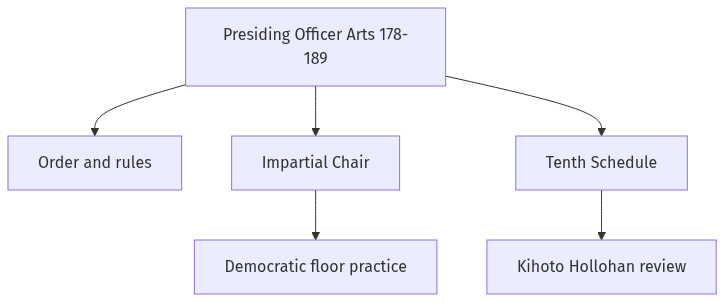
Articles 178 to 189 create Speakers and Chairmen of State legislatures. They maintain order by running questions, motions, and discipline under the House rules. Impartiality is tested in anti-defection cases under the Tenth Schedule. Kihoto Hollohan allows judicial review of the Speaker’s defection order; Nabam Rebia limits a compromised Chair. Best democratic practice is a fair share of floor time and timely, reviewable rulings, not a silent majority machine.
Model answer
Copper italics in this answer — like this — are the key facts. Each one is unpacked in the Facts & figures rail.
Introduction
The Speaker of the Legislative Assembly and the Chairman of the Legislative Council are the Presiding Officers of the State legislature under Articles 178 to 189. Their daily work is order on the floor, and their harder work is impartiality when majority and opposition collide.
Body
Order in legislative work
- The Presiding Officer admits questions, motions, and points of order, and interprets the Rules of Procedure of the House.
- He or she names members, suspends them, and can order the gallery to be cleared, which is the ordinary power to keep debate possible.
- Money bills and the Governor’s messages are read through the Chair, so financial business depends on a working Speaker, not only on the treasury benches.
- Committees are nominated or constituted with the Chair’s involvement; disorder on the floor often follows if committee scrutiny is skipped.
Impartiality
- Article 189 and the Tenth Schedule place the Speaker at the centre of defection disputes inside the Assembly, which is the sharpest test of impartiality.
- Kihoto Hollohan v. Zachillhu (1992) upheld the Tenth Schedule but made the Speaker’s order on defection subject to judicial review on limited grounds.
- Nabam Rebia v. Deputy Speaker, Arunachal Pradesh (2016) held that a Speaker facing a notice for his own removal cannot disqualify members in a way that decides the majority; the Court later revisited parts of this line in 2023 in Subhash Desai, but the democratic point remains that the Chair cannot be a faction tool.
- Resignation, swearing-in, and recognition of the Leader of the Opposition all pass through the Chair and can manufacture or deny a floor majority.
Democratic practices
- A Presiding Officer who gives the opposition a fair share of Question Hour, calling attention, and adjournment motions makes the House a forum, not a rally.
- Live proceedings, reasoned rulings, and restraint in using the marshal are democratic practices that no Article lists in detail but that every Assembly needs.
- Resignation from the ruling party after election as Speaker, as some Assemblies have practised, is a convention that supports impartiality even though the Constitution does not require it.
Recommendations
- Fix a time limit for Tenth Schedule decisions, as the Supreme Court has pressed, so that defection orders are not delayed until the term ends.
- Separate, as far as rules allow, the Speaker’s administrative majority from the treasury whip on ordinary legislative business.
- Train new Speakers in comparative rulings and publish them, so impartiality is a recorded practice, not a personal virtue.
Flow diagram
Conclusion
Presiding Officers keep order through the rules and keep democracy alive only when they apply those rules without the whip. Kihoto Hollohan and Nabam Rebia show that the Chair is both a constitutional office and a reviewable power, which is why impartiality is the core of the role.
Quick related
Students also ask
-
Discuss the role of the Competition Commission of India in containing the abuse of dominant position by the Multi-National Corporations in India. Refer to the recent decisions.
Next question on this syllabus topic (2023 · Q7). View answer →
-
Is the Speaker’s defection order final?
It is the first decision under the Tenth Schedule. Kihoto Hollohan allows courts to review it on constitutional grounds.
-
Must a Speaker leave his or her party?
The Constitution does not require it. Some Houses follow a convention of resignation from the party to signal impartiality.
Same topic · past papers
UPSC has asked this before
These previous-year questions sit on the same topic. Open one to practise the earlier ask.
More from this topic
Q15 · UPSC Mains 2026 · GS II · 15 marks · Solution
To what extent do pressure groups, social movements and corporate lobbies deepen pluralistic democracy in India by representing excluded interests? Analyse whether the growing convergence of corporate wealth and political power poses a threat to the autonomy of formal democratic institutions.
Governance and Policy
• Civil society groups and grassroots movements go beyond periodic elections to channel marginalized voices into policy spaces. • Social movements on tribal rights and environmental protection have successfully forced the state to create protective legislation. • Representation is uneven due to a severe resource asymmetry between well-funded corporate lobbies and unorganized labor. • Some interest groups act as elite fronts, subverting public welfare for narrow sectarian gains. • Corporate financial dominance through opaque funding creates severe risks of policy capture and quid pro quo corruption. • Strengthening transparency in political funding and reinforcing regulatory autonomy are essential to safeguard democratic governance.
Q12 · UPSC Mains 2026 · GS II · 15 marks · Solution
What is meant by judicial legislation? In this context, discuss the verdicts of the apex court allowing "passive euthanasia" and a "living will".
Governance and Policy
• Judicial legislation occurs when courts create binding rules to fill policy voids caused by legislative inaction. • The Supreme Court legalized passive euthanasia under Article 21, recognizing the right to die with dignity. • The *Common Cause* (2018) judgment permitted the withdrawal of life support for terminally ill patients with strict medical safeguards. • A living will is an advanced medical directive allowing individuals to pre-state their treatment preferences before incapacitation. • The Supreme Court simplified living will procedures in 2023, replacing complex magistrate approvals with basic notary attestation. • While court guidelines provide immediate relief, they underscore the need for a comprehensive parliamentary statute on end-of-life care. • Codifying these judicial norms through formal legislation ensures democratic legitimacy, ethical debate, and administrative clarity.
Q6 · UPSC Mains 2026 · GS II · 10 marks · Solution
Does India's tribal development policy reflect the aspirations for a socially grounded and equity-based governance? Justify your answer.
Governance and Policy
• India's tribal policy balances constitutional protections with socio-economic development goals. • Fifth and Sixth Schedules provide decentralized autonomy and safeguard tribal lands. • Articles 275(1) and 335 ensure grants-in-aid and reservations to bridge gaps. • PESA (1996) and FRA (2006) mark shifts toward rights-based and culturally sensitive governance. • Gram sabhas are empowered over minor forest produce and community forest rights. • Implementation is hindered by forced displacement without consent and bureaucratic inertia. • True equity requires empowering local institutions rather than relying solely on welfare delivery.