
Revision summary
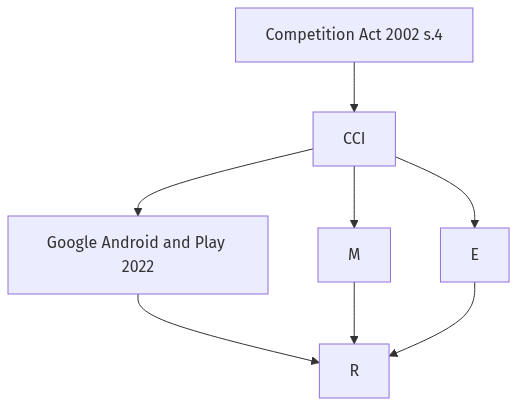
Section 4 of the Competition Act, 2002, bans abuse of dominance, including by MNCs. The CCI investigates, orders modification of terms, and may penalise; NCLAT hears appeals. 2022 public orders against Google on Android licensing and Play billing are the main digital-abuse precedents. The 2022 MakeMyTrip–Goibibo order and the Amazon–Flipkart investigation show platform intermediation is inside CCI’s reach. Enforcement works when the Indian relevant market is defined; monitoring of remedies is the unfinished part of the role.
Model answer
Copper italics in this answer — like this — are the key facts. Each one is unpacked in the Facts & figures rail.
Introduction
The Competition Act, 2002, prohibits abuse of dominant position under Section 4, whether the enterprise is Indian or a multi-national corporation. The Competition Commission of India investigates, orders cease-and-desist, modifies agreements, and may impose penalties; appellate review then sits with the National Company Law Appellate Tribunal.
Body
Legal role
- Section 4 of the Competition Act, 2002, lists abuses: unfair or discriminatory conditions or prices, limiting production or technical development, denying market access, and using dominance in one market to enter another.
- Dominance is not illegal; abuse is. MNCs are judged by the same relevant-market and dominance tests as domestic firms.
- The Commission can order a Director General investigation, pass interim orders, and require modification of platform or licensing terms that lock in users.
- Combinations under Sections 5 and 6 (now with the 2023 amendment’s deal-value threshold) let the CCI look at mergers of global firms that affect Indian markets.
Recent public decisions involving large digital and platform firms
- In 2022 the CCI held that Google had abused its dominant position in licensable mobile operating systems and in the Play Store by restrictive Android licensing and pre-installation conditions (the Android case).
- In a related 2022 order the CCI held that Google had abused dominance in the app-store billing market by forcing Play billing on app developers (the Play billing case).
- In 2022 the CCI found MakeMyTrip–Goibibo to have abused dominance in the online hotel intermediation market, including through arrangements that hurt competing hotel chains such as OYO; this is a platform case with global investors, not a small domestic shop.
- The CCI directed investigation into Amazon and Flipkart in 2020 on allegations of deep discounting and preferential listing; that probe is a public enforcement step against large e-commerce MNCs, even where a final penalty order was not the 2023 headline.
- These matters went through stay and appeal; the role of the CCI is to open the Indian relevant market, not to write the last appellate word.
Limits
- Global pricing, data localisation, and app-store rules change faster than a Section 26 inquiry.
- Remedies on algorithms and self-preferencing need technical monitoring that a small commission can under-staff.
- Overlap with the Digital Personal Data Protection Act, 2023, telecom licensing, and incoming digital-competition proposals can fragment the same MNC conduct across regulators.
Recommendations
- Staff digital units that can monitor behavioural remedies after Google-type orders, not only levy a first penalty.
- Use the deal-value merger threshold so asset-light MNC acquisitions of Indian start-ups do not escape notice.
- Coordinate CCI, TRAI, and MeitY so platform dominance is not litigated three times with three inconsistent definitions of the market.
Flow diagram
Conclusion
The CCI contains MNC abuse by applying Section 4 to Indian relevant markets, as in the 2022 Google Android and Play billing orders, the MakeMyTrip–Goibibo order, and the Amazon–Flipkart investigation. Its role is real where it can define the market and enforce conduct remedies; appeals and capacity remain the constraint.
Quick related
Students also ask
-
To what extent, in your opinion, as the decentralisation of power in India changed the governance landscape at the grassroots?
Next question on this syllabus topic (2022 · Q3). View answer →
-
Is every MNC merger illegal in India?
No. Only combinations that meet the Act’s thresholds need notice, and only those likely to cause an appreciable adverse effect on competition can be stopped or modified.
-
Does a CCI penalty against Google end the case?
No. Statutory appeal to NCLAT and then to the Supreme Court can stay, cut, or uphold the order. The CCI’s role is the first expert finding.
Same topic · past papers
UPSC has asked this before
These previous-year questions sit on the same topic. Open one to practise the earlier ask.
More from this topic
Q15 · UPSC Mains 2026 · GS II · 15 marks · Solution
To what extent do pressure groups, social movements and corporate lobbies deepen pluralistic democracy in India by representing excluded interests? Analyse whether the growing convergence of corporate wealth and political power poses a threat to the autonomy of formal democratic institutions.
Governance and Policy
• Civil society groups and grassroots movements go beyond periodic elections to channel marginalized voices into policy spaces. • Social movements on tribal rights and environmental protection have successfully forced the state to create protective legislation. • Representation is uneven due to a severe resource asymmetry between well-funded corporate lobbies and unorganized labor. • Some interest groups act as elite fronts, subverting public welfare for narrow sectarian gains. • Corporate financial dominance through opaque funding creates severe risks of policy capture and quid pro quo corruption. • Strengthening transparency in political funding and reinforcing regulatory autonomy are essential to safeguard democratic governance.
Q12 · UPSC Mains 2026 · GS II · 15 marks · Solution
What is meant by judicial legislation? In this context, discuss the verdicts of the apex court allowing "passive euthanasia" and a "living will".
Governance and Policy
• Judicial legislation occurs when courts create binding rules to fill policy voids caused by legislative inaction. • The Supreme Court legalized passive euthanasia under Article 21, recognizing the right to die with dignity. • The *Common Cause* (2018) judgment permitted the withdrawal of life support for terminally ill patients with strict medical safeguards. • A living will is an advanced medical directive allowing individuals to pre-state their treatment preferences before incapacitation. • The Supreme Court simplified living will procedures in 2023, replacing complex magistrate approvals with basic notary attestation. • While court guidelines provide immediate relief, they underscore the need for a comprehensive parliamentary statute on end-of-life care. • Codifying these judicial norms through formal legislation ensures democratic legitimacy, ethical debate, and administrative clarity.
Q6 · UPSC Mains 2026 · GS II · 10 marks · Solution
Does India's tribal development policy reflect the aspirations for a socially grounded and equity-based governance? Justify your answer.
Governance and Policy
• India's tribal policy balances constitutional protections with socio-economic development goals. • Fifth and Sixth Schedules provide decentralized autonomy and safeguard tribal lands. • Articles 275(1) and 335 ensure grants-in-aid and reservations to bridge gaps. • PESA (1996) and FRA (2006) mark shifts toward rights-based and culturally sensitive governance. • Gram sabhas are empowered over minor forest produce and community forest rights. • Implementation is hindered by forced displacement without consent and bureaucratic inertia. • True equity requires empowering local institutions rather than relying solely on welfare delivery.