
Revision summary
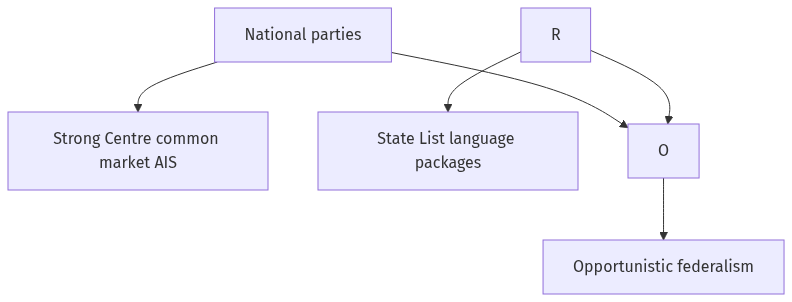
National parties have an organisational bias toward a strong Centre, concurrent legislation and nationwide schemes. Regional parties have an organisational bias toward State autonomy, language and control of local patronage. Coalition years showed regional parties making Union policy, which softens the contrast. The same party talks autonomy in Opposition and accepts Union instruments in office. The statement is a useful tendency, not a law. Impersonal federal institutions matter more than assuming party type will protect the State List.
Model answer
Copper italics in this answer — like this — are the key facts. Each one is unpacked in the Facts & figures rail.
Introduction
National parties recruit, fund, and campaign across the Union, so they often prefer a strong Centre, common markets, and All-India services. Regional parties live off a State’s language, caste coalition, and fiscal grievance, so they demand autonomy. The comment is a useful first cut, not a law of Indian federalism, because coalitions and centrally sponsored schemes pull both types of party toward the same purse.
Body
Why national parties lean to centralisation
- A national party seeks a single message, a single campaign machine, and interchangeable ministers; concurrent-list legislation, the IAS/IPS, and the Election Commission’s nationwide writ serve that machine.
- Goods and Services Tax, a national security narrative, and centrally sponsored schemes let a ruling national party claim delivery in every district, which is politically cheaper than negotiating twenty different State models.
- Article 356, the Governor, and residual power in Article 248 have historically been more congenial to parties that expect to occupy Raisina Hill than to those that never do.
- National parties also contain State units that bargain internally; centralisation is often intra-party as much as Centre-versus-State.
Why regional parties lean to State autonomy
- Regional parties are organised to win a Legislative Assembly first; control of land, police, education, and local recruitment is their patronage core, which they defend as federalism.
- They use the Rajya Sabha, inter-State councils, and special-category or package politics to extract Union money while resisting Union conditions on language, recruitment, and farm or education reform.
- Sarkaria and Punchhi Commission themes — consultation before Article 356, restraint on the Governor, and respect for the State List — are easier for a regional party to champion because it does not expect to wield 356 itself next year.
- Subnational identity (language, tribe, region) is their electoral brand; autonomy is that brand in constitutional vocabulary.
Why the dichotomy overstates the case
- From 1989 to 2014, regional parties at the Centre in coalitions actually wrote national policy; they were not secessionists, they were bargainers for portfolios and packages.
- National parties in Opposition in a State discover State rights overnight; regional parties in a Union coalition accept GST, CBI, and central schemes that they denounce when out of that coalition.
- Some regional parties prefer a strong Centre against a neighbouring State (river disputes, border, migrants); autonomy is then selective.
- The 1990s economic reforms were midwifed by a minority national government with regional support; centralisation of markets can coexist with political regionalisation.
A fair comment
- As a tendency, the statement holds: national parties have an organisational interest in a thick Union, regional parties in a thick State.
- As an iron rule it fails: money, security, and office pull both toward opportunistic federalism.
- Healthy federalism needs the Election Commission, Finance Commission, and GST Council to bind whoever is in office, not a hope that party type will reliably defend the State List.
Flow diagram
Conclusion
National parties do favour centralisation and regional parties do favour State autonomy, because that is how each wins elections. Coalitions, GST, and centrally sponsored schemes blur the line, so the comment is a tendency, not a constitutional destiny.
Quick related
Students also ask
-
How will 12U2 (India, Israel, UAE and USA) grouping transform India's position in global politics?
Next question on this syllabus topic (2022 · Q19). View answer →
-
Do regional parties want a weak India?
Not as a programme. They want a Union that funds the State and leaves State-list power with the Assembly. That is autonomy, not exit.
-
Is GST proof that national parties always centralise?
GST needed State ratification of a constitutional amendment and a Council with State votes. It is pooled sovereignty, not a simple one-party diktat.
Same topic · past papers
UPSC has asked this before
These previous-year questions sit on the same topic. Open one to practise the earlier ask.
-
2026 · Q15 · GS II · 15 marks
To what extent do pressure groups, social movements and corporate lobbies deepen pluralistic democracy in India by representing excluded interests? Analyse whether the growing convergence of corporate wealth and political power poses a threat to the autonomy of formal democratic institutions. -
2020 · Q2 · GS II · 10 marks
"Recent amendments to the Right to information Act will have profound impact on the autonomy and independence of the Information Commission". Discuss.
More from this topic
Q15 · UPSC Mains 2026 · GS II · 15 marks · Solution
To what extent do pressure groups, social movements and corporate lobbies deepen pluralistic democracy in India by representing excluded interests? Analyse whether the growing convergence of corporate wealth and political power poses a threat to the autonomy of formal democratic institutions.
Governance and Policy
• Civil society groups and grassroots movements go beyond periodic elections to channel marginalized voices into policy spaces. • Social movements on tribal rights and environmental protection have successfully forced the state to create protective legislation. • Representation is uneven due to a severe resource asymmetry between well-funded corporate lobbies and unorganized labor. • Some interest groups act as elite fronts, subverting public welfare for narrow sectarian gains. • Corporate financial dominance through opaque funding creates severe risks of policy capture and quid pro quo corruption. • Strengthening transparency in political funding and reinforcing regulatory autonomy are essential to safeguard democratic governance.
Q12 · UPSC Mains 2026 · GS II · 15 marks · Solution
What is meant by judicial legislation? In this context, discuss the verdicts of the apex court allowing "passive euthanasia" and a "living will".
Governance and Policy
• Judicial legislation occurs when courts create binding rules to fill policy voids caused by legislative inaction. • The Supreme Court legalized passive euthanasia under Article 21, recognizing the right to die with dignity. • The *Common Cause* (2018) judgment permitted the withdrawal of life support for terminally ill patients with strict medical safeguards. • A living will is an advanced medical directive allowing individuals to pre-state their treatment preferences before incapacitation. • The Supreme Court simplified living will procedures in 2023, replacing complex magistrate approvals with basic notary attestation. • While court guidelines provide immediate relief, they underscore the need for a comprehensive parliamentary statute on end-of-life care. • Codifying these judicial norms through formal legislation ensures democratic legitimacy, ethical debate, and administrative clarity.
Q6 · UPSC Mains 2026 · GS II · 10 marks · Solution
Does India's tribal development policy reflect the aspirations for a socially grounded and equity-based governance? Justify your answer.
Governance and Policy
• India's tribal policy balances constitutional protections with socio-economic development goals. • Fifth and Sixth Schedules provide decentralized autonomy and safeguard tribal lands. • Articles 275(1) and 335 ensure grants-in-aid and reservations to bridge gaps. • PESA (1996) and FRA (2006) mark shifts toward rights-based and culturally sensitive governance. • Gram sabhas are empowered over minor forest produce and community forest rights. • Implementation is hindered by forced displacement without consent and bureaucratic inertia. • True equity requires empowering local institutions rather than relying solely on welfare delivery.