
Revision summary
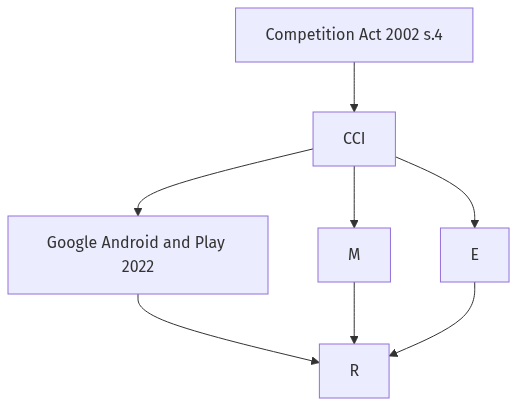
Section 4 of the Competition Act, 2002, bans abuse of dominance, including by MNCs. The CCI investigates, orders modification of terms, and may penalise; NCLAT hears appeals. 2022 public orders against Google on Android licensing and Play billing are the main digital-abuse precedents. The 2022 MakeMyTrip–Goibibo order and the Amazon–Flipkart investigation show platform intermediation is inside CCI’s reach. Enforcement works when the Indian relevant market is defined; monitoring of remedies is the unfinished part of the role.
Model answer
Copper italics in this answer — like this — are the key facts. Each one is unpacked in the Facts & figures rail.
Introduction
The Competition Act, 2002, prohibits abuse of dominant position under Section 4, whether the enterprise is Indian or a multi-national corporation. The Competition Commission of India investigates, orders cease-and-desist, modifies agreements, and may impose penalties; appellate review then sits with the National Company Law Appellate Tribunal.
Body
Legal role
- Section 4 of the Competition Act, 2002, lists abuses: unfair or discriminatory conditions or prices, limiting production or technical development, denying market access, and using dominance in one market to enter another.
- Dominance is not illegal; abuse is. MNCs are judged by the same relevant-market and dominance tests as domestic firms.
- The Commission can order a Director General investigation, pass interim orders, and require modification of platform or licensing terms that lock in users.
- Combinations under Sections 5 and 6 (now with the 2023 amendment’s deal-value threshold) let the CCI look at mergers of global firms that affect Indian markets.
Recent public decisions involving large digital and platform firms
- In 2022 the CCI held that Google had abused its dominant position in licensable mobile operating systems and in the Play Store by restrictive Android licensing and pre-installation conditions (the Android case).
- In a related 2022 order the CCI held that Google had abused dominance in the app-store billing market by forcing Play billing on app developers (the Play billing case).
- In 2022 the CCI found MakeMyTrip–Goibibo to have abused dominance in the online hotel intermediation market, including through arrangements that hurt competing hotel chains such as OYO; this is a platform case with global investors, not a small domestic shop.
- The CCI directed investigation into Amazon and Flipkart in 2020 on allegations of deep discounting and preferential listing; that probe is a public enforcement step against large e-commerce MNCs, even where a final penalty order was not the 2023 headline.
- These matters went through stay and appeal; the role of the CCI is to open the Indian relevant market, not to write the last appellate word.
Limits
- Global pricing, data localisation, and app-store rules change faster than a Section 26 inquiry.
- Remedies on algorithms and self-preferencing need technical monitoring that a small commission can under-staff.
- Overlap with the Digital Personal Data Protection Act, 2023, telecom licensing, and incoming digital-competition proposals can fragment the same MNC conduct across regulators.
Recommendations
- Staff digital units that can monitor behavioural remedies after Google-type orders, not only levy a first penalty.
- Use the deal-value merger threshold so asset-light MNC acquisitions of Indian start-ups do not escape notice.
- Coordinate CCI, TRAI, and MeitY so platform dominance is not litigated three times with three inconsistent definitions of the market.
Flow diagram
Conclusion
The CCI contains MNC abuse by applying Section 4 to Indian relevant markets, as in the 2022 Google Android and Play billing orders, the MakeMyTrip–Goibibo order, and the Amazon–Flipkart investigation. Its role is real where it can define the market and enforce conduct remedies; appeals and capacity remain the constraint.
Quick related
Students also ask
-
To what extent, in your opinion, as the decentralisation of power in India changed the governance landscape at the grassroots?
Next question on this syllabus topic (2022 · Q3). View answer →
-
Is every MNC merger illegal in India?
No. Only combinations that meet the Act’s thresholds need notice, and only those likely to cause an appreciable adverse effect on competition can be stopped or modified.
-
Does a CCI penalty against Google end the case?
No. Statutory appeal to NCLAT and then to the Supreme Court can stay, cut, or uphold the order. The CCI’s role is the first expert finding.
Same topic · past papers
UPSC has asked this before
These previous-year questions sit on the same topic. Open one to practise the earlier ask.
More from this topic
Q15 · UPSC Mains 2026 · GS II · 15 marks · Solution
To what extent do pressure groups, social movements and corporate lobbies deepen pluralistic democracy in India by representing excluded interests? Analyse whether the growing convergence of corporate wealth and political power poses a threat to the autonomy of formal democratic institutions.
Governance and Policy
• Pluralism needs many competing groups so that no single interest dominates policy • Trade unions, farmer bodies and movements such as Chipko and Narmada Bachao Andolan have brought excluded voices into public debate • Movements delivered RTI, Forest Rights and Lokpal laws that give citizens lasting tools • Weak resources and FCRA and protest restrictions limit civil society reach • Corporate influence runs through party funding, lobbying, regulators and media ownership • The electoral bonds scheme was struck down in 2024 for violating citizens' right to information • Institutions such as the Supreme Court, CAG and the Election Commission still check capture, but risks remain • Reforms include funding transparency, a lobbying law, cooling-off periods and protection of dissent
Q12 · UPSC Mains 2026 · GS II · 15 marks · Solution
What is meant by judicial legislation? In this context, discuss the verdicts of the apex court allowing "passive euthanasia" and a "living will".
Governance and Policy
• Judicial legislation is court-made law that fills a legislative vacuum, using Articles 32, 141 and 142 • Vishaka, Prakash Singh and NALSA are common examples, and each invited later legislation • Gian Kaur (1996) denied a right to die but spoke of dying with dignity when death is imminent • Aruna Shanbaug (2011) permitted passive euthanasia with High Court supervision • Common Cause (2018) held the right to die with dignity to be part of Article 21 and recognised living wills • The 2023 modification simplified attestation, board composition and timelines • The tension is between dignity under Article 21 and the legislature's domain on a sensitive moral issue • A national statute on terminal illness would replace interim court guidelines
Q6 · UPSC Mains 2026 · GS II · 10 marks · Solution
Does India's tribal development policy reflect the aspirations for a socially grounded and equity-based governance? Justify your answer.
Governance and Policy
• Constitution: Fifth and Sixth Schedules create tribal self-rule, with Tribes Advisory Councils and autonomous district councils. • Law: PESA 1996 makes the Gram Sabha central and FRA 2006 recognises individual and community forest rights. • Welfare: DAPST, Article 275(1) grants, Eklavya schools, PM JANMAN and the sickle cell mission target the gap. • Weakness: mining, dams and forest clearance rules often override Gram Sabha consent. • Weakness: delayed PESA rules, FRA claim rejections and diverted funds blunt equity. • Security: LWE districts show the cost of land alienation and weak service delivery. • Verdict: strong legal design, uneven delivery, so equity is partial and conditional. • Way ahead: enforce consent, social audit, benefit-sharing through District Mineral Foundations.