
Revision summary
Harms: grooming, bullying, addictive design, data profiling, deepfakes, influencer labour, and exclusion without devices. Law: POCSO, IT rules, JJ Act, DPDP 2023 parental consent, NEP caution on ed-tech. NCPCR can inquire, recommend and move courts under the 2005 Act. Measures: age-assurance, school device rules with offline equity, POCSO e-evidence protocol, ed-tech data audits, 1098 integration, influencer-work codes, privacy-by-default for minors. The Commission should regulate design, not become a meme censor.
Model answer
Copper italics in this answer — like this — are the key facts. Each one is unpacked in the Facts & figures rail.
Introduction
The National Commission for Protection of Child Rights (NCPCR) is a statutory body established under the Commission for Protection of Child Rights Act, 2005 to protect and promote child rights. In the digital era, children face new vulnerabilities such as cyberbullying, online grooming, CSEAM, data profiling, addictive platform design and digital exclusion, requiring the Commission to adapt its child-protection role to the online ecosystem.
Body
Challenges Faced by Children in the Digital Era
- 1. Online abuse and exploitation: Children face cyberbullying, online grooming and Child Sexual Exploitative and Abuse Material (CSEAM), making digital platforms potential spaces for sexual exploitation and abuse.
- 2. Weak age verification: Self-declared age checks allow children to access adult content, gambling and illegal betting platforms, exposing them to age-inappropriate material.
- 3. Data and privacy exploitation: EdTech, gaming and advertising platforms can track children's behaviour, collect personal data and create behavioural profiles, creating risks of manipulation and targeted advertising.
- 4. Mental health and addictive design: Excessive screen use, addictive platform features and unmoderated social media can contribute to sleep disruption, anxiety, depression and digital dependency.
- 5. Digital exclusion: Children without reliable devices or connectivity may be excluded when education and essential services increasingly move online.
Existing Policies and Frameworks
- 1. Commission for Protection of Child Rights Act, 2005: Establishes NCPCR as a statutory child-rights watchdog with powers to inquire, inspect, recommend remedial measures and approach higher courts.
- 2. POCSO Act, 2012: Provides the principal legal framework for protecting children from sexual offences, including offences facilitated through digital platforms. The POCSO e-Box also provides a mechanism for reporting abuse.
- 3. IT Act, 2000 and IT Rules, 2021: Provide obligations for intermediaries regarding illegal online content, including CSEAM, and mechanisms for its removal.
- 4. DPDP Act, 2023: Provides child-specific data protection by requiring verifiable parental consent and restricting tracking and targeted advertising directed at children.
- 5. NCPCR guidelines for entertainment and OTT platforms: Address children participating in digital content creation through safeguards such as District Magistrate permission, parental responsibility, education protection and financial safeguards.
- 6. Reporting mechanisms: The National Cyber Crime Reporting Portal, POCSO e-Box and Childline 1098 provide channels through which online abuse can be reported and assistance sought.
Measures NCPCR Can Initiate
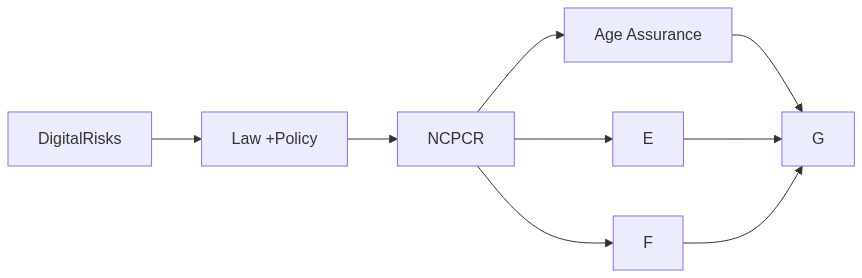
- 1. Standardised age-assurance system: NCPCR can work with MeitY and relevant authorities to develop privacy-preserving age-verification standards for high-risk platforms instead of relying on simple self-declaration.
- 2. Child-safety audits of platforms: The Commission can conduct or mandate periodic child-safety assessments covering content moderation, age assurance, reporting mechanisms and response to CSEAM complaints.
- 3. Children's data audits: NCPCR can examine EdTech, gaming and ad-tech platforms for unlawful tracking, behavioural profiling and manipulative design, and refer violations to the appropriate data-protection authority.
- 4. Integrated reporting mechanism: Existing channels such as 1098, POCSO e-Box and the National Cyber Crime Reporting Portal should be better integrated so that a child's complaint reaches the appropriate police, child-protection and platform authorities quickly.
- 5. Digital-safety education: NCPCR can promote structured digital-safety modules in schools covering cyberbullying, online grooming, privacy, CSEAM reporting, addictive screen use and responsible digital behaviour.
- 6. Model rules for schools: The Commission can develop child-centric guidelines for smartphone and digital-device use in schools while ensuring that children without personal devices are not excluded from digital learning.
- 7. Protect child influencers: NCPCR can strengthen safeguards for children appearing in YouTube, social-media and OTT content, including limits on working hours, protection of earnings and preservation of education and dignity.
- 8. Strengthen institutional coordination: NCPCR should coordinate with State Commissions for Protection of Child Rights, schools, police, MeitY and digital platforms so that online child protection is implemented consistently.
Flow diagram
Conclusion
The digital era has expanded children's opportunities but has also created new forms of exploitation, privacy violations and psychological vulnerability. NCPCR can address these risks most effectively by using its existing statutory powers to strengthen age assurance, audit platforms and children's data practices, integrate reporting mechanisms, improve digital-safety education and coordinate with relevant authorities, thereby making the digital ecosystem safer without unnecessarily restricting children's access to technology.
Quick related
Students also ask
-
"The duty of the Comptroller and Auditor General is not merely to ensure the legality of expenditure but also its propriety." Comment.
Next question on this syllabus topic (2024 · Q4). View answer →
-
Should NCPCR ban smartphones in schools?
It can issue model rules. A blanket ban without a school lab shifts homework to the richest phone in the house.
-
Is parental consent enough under DPDP?
It is the legal hook. Design and age-assurance decide whether the hook is real or a click.
Same topic · past papers
UPSC has asked this before
These previous-year questions sit on the same topic. Open one to practise the earlier ask.
-
2020 · Q13 · GS II · 15 marks
The strength sustenance of local institutions in India has shifted from their formative phase of 'Functions, Functionaries and Funs' to the contemporary stage of 'Functionality'. Highlight the critical challenges faced by local institutions in terms of their functionality in recent times. -
2019 · Q8 · GS II · 10 marks
Implementation of information and Communication Technology (ICT) based Projects / Programmes usually suffers in terms of certain vital factors. Identify these factors, and suggest measures for their effective implementation. -
2026 · Q5 · GS II · 10 marks
Do constitutional bodies like the National Commission for Scheduled Castes (NCSC) and the National Commission for Scheduled Tribes (NCST) possess adequate enforcement powers to secure substantive social equality? Suggest measures to enhance their institutional effectiveness. -
2026 · Q13 · GS II · 15 marks
How far has the Indian federal framework been successful in accommodating regional and cultural diversities? Highlight the role of asymmetric federalism and suggest measures to make dispute resolution mechanisms more effective. -
2024 · Q13 · GS II · 15 marks
What changes has the Union Government recently introduced in the domain of Centre-State relations? Suggest measures to be adopted to build the trust between the Centre and the States and for strengthening federalism.
More from this topic
Q15 · UPSC Mains 2026 · GS II · 15 marks · Solution
To what extent do pressure groups, social movements and corporate lobbies deepen pluralistic democracy in India by representing excluded interests? Analyse whether the growing convergence of corporate wealth and political power poses a threat to the autonomy of formal democratic institutions.
Governance and Policy
• Civil society groups and grassroots movements go beyond periodic elections to channel marginalized voices into policy spaces. • Social movements on tribal rights and environmental protection have successfully forced the state to create protective legislation. • Representation is uneven due to a severe resource asymmetry between well-funded corporate lobbies and unorganized labor. • Some interest groups act as elite fronts, subverting public welfare for narrow sectarian gains. • Corporate financial dominance through opaque funding creates severe risks of policy capture and quid pro quo corruption. • Strengthening transparency in political funding and reinforcing regulatory autonomy are essential to safeguard democratic governance.
Q12 · UPSC Mains 2026 · GS II · 15 marks · Solution
What is meant by judicial legislation? In this context, discuss the verdicts of the apex court allowing "passive euthanasia" and a "living will".
Governance and Policy
• Judicial legislation occurs when courts create binding rules to fill policy voids caused by legislative inaction. • The Supreme Court legalized passive euthanasia under Article 21, recognizing the right to die with dignity. • The *Common Cause* (2018) judgment permitted the withdrawal of life support for terminally ill patients with strict medical safeguards. • A living will is an advanced medical directive allowing individuals to pre-state their treatment preferences before incapacitation. • The Supreme Court simplified living will procedures in 2023, replacing complex magistrate approvals with basic notary attestation. • While court guidelines provide immediate relief, they underscore the need for a comprehensive parliamentary statute on end-of-life care. • Codifying these judicial norms through formal legislation ensures democratic legitimacy, ethical debate, and administrative clarity.
Q6 · UPSC Mains 2026 · GS II · 10 marks · Solution
Does India's tribal development policy reflect the aspirations for a socially grounded and equity-based governance? Justify your answer.
Governance and Policy
• India's tribal policy balances constitutional protections with socio-economic development goals. • Fifth and Sixth Schedules provide decentralized autonomy and safeguard tribal lands. • Articles 275(1) and 335 ensure grants-in-aid and reservations to bridge gaps. • PESA (1996) and FRA (2006) mark shifts toward rights-based and culturally sensitive governance. • Gram sabhas are empowered over minor forest produce and community forest rights. • Implementation is hindered by forced displacement without consent and bureaucratic inertia. • True equity requires empowering local institutions rather than relying solely on welfare delivery.