
Revision summary
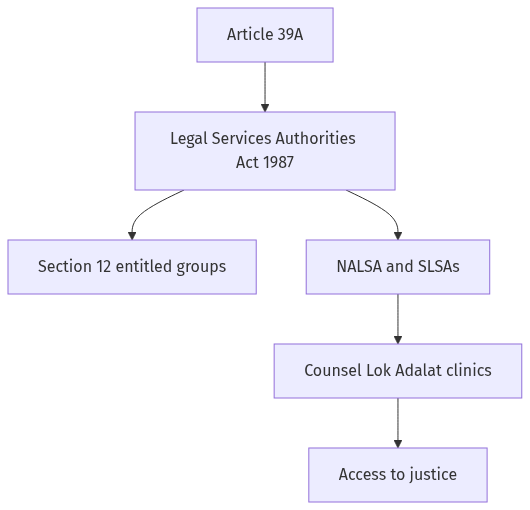
Article 39A and the Legal Services Authorities Act, 1987, create the right to free legal aid. Section 12 names SC/ST persons, women, children, persons in custody, workmen, persons with disability, disaster victims, and the income-poor. NALSA heads the statutory system of State authorities, court committees, clinics and Lok Adalats. The system is wide in design and still thin in quality of trial representation. Assessment therefore credits outreach and asks for better fees, first-hearing counsel, and published coverage data.
Model answer
Copper italics in this answer — like this — are the key facts. Each one is unpacked in the Facts & figures rail.
Introduction
Free legal aid is a constitutional promise under Article 39A and a statutory right under the Legal Services Authorities Act, 1987. Entitlement is defined by that Act and by NALSA’s regulations, and an assessment must weigh both outreach and the quality of the aid actually delivered.
Body
Who is entitled
- Article 39A directs the State to provide equal justice and free legal aid so that opportunity for securing justice is not denied by reason of economic or other disability.
- Section 12 of the Legal Services Authorities Act, 1987, lists eligible persons, including a member of a Scheduled Caste or Scheduled Tribe, a victim of trafficking or beggar, a woman or a child, a person with disability, an industrial workman, a person in custody, and a person whose income is below the notified ceiling.
- Victims of mass disaster, ethnic violence, caste atrocity, flood, drought, earthquake or industrial disaster are also covered.
- The income ceiling is notified by the Central or State Authority and is higher for cases in the Supreme Court than for cases in other courts.
- Entitlement is to legal services before courts, tribunals and authorities, including advice, drafting and representation, not only to a one-time pamphlet.
Role of NALSA
- NALSA is the apex statutory body under the 1987 Act; it frames policies, funds State Legal Services Authorities, and issues scheme regulations such as the NALSA (Free and Competent Legal Services) Regulations.
- It organises Lok Adalats, including National Lok Adalats, which dispose of compoundable and pre-litigation disputes without a full trial.
- It has issued victim-compensation and specialised schemes for workers in the unorganised sector, for persons in mental-health facilities, and for victims of trafficking.
- Legal aid clinics in law colleges, front offices in courts, and para-legal volunteers extend the first point of contact beyond the High Court bar.
- The Supreme Court Legal Services Committee and the High Court committees work under the same statutory umbrella for aid in the higher courts.
Assessment
- NALSA has made legal aid a visible national programme rather than an ad hoc charity of individual lawyers.
- Quality remains uneven: honorarium is low, panel lawyers are often junior, and many entitled persons still meet the police and the trial court without a lawyer at the first hearing.
- Awareness of Section 12 categories is weak in rural police stations and in undertrial wards, so entitlement on paper does not always become a vakalatnama on time.
- Lok Adalats clear volume, but they cannot replace trial aid in serious criminal and constitutional cases.
Recommendations
- Raise and index panel fees, and audit disposal quality, not only the number of Lok Adalat awards.
- Place a legal-aid lawyer at first production before the magistrate, in line with the spirit of Hussainara Khatoon and later legal-aid jurisprudence.
- Publish State-wise data on women, SC/ST, and custody cases actually represented, so NALSA can be judged by coverage of Section 12 groups, not by camp photographs.
Flow diagram
Conclusion
Women, children, SC/ST persons, persons in custody, industrial workmen, persons with disability, disaster victims, and the income-poor are entitled to free legal aid under Article 39A and Section 12 of the 1987 Act. NALSA has built the national machinery, yet competent representation at the first hearing is still the test it has not fully met.
Quick related
Students also ask
-
"The states in India seem reluctant to empower urban local bodies both functionally as well as financially." Comment.
Next question on this syllabus topic (2023 · Q3). View answer →
-
Is free legal aid only for the poor?
No. Income is one head. Women, children, SC/ST persons, persons in custody and several other Section 12 groups are entitled without that income test.
-
Can NALSA try a criminal case itself?
No. It funds and assigns legal services. The case is still heard by the ordinary court or disposed of in a Lok Adalat where the law allows.
Same topic · past papers
UPSC has asked this before
These previous-year questions sit on the same topic. Open one to practise the earlier ask.
-
2019 · Q2 · GS II · 10 marks
"The Central Administration Tribunal which was established for redressal of grievances and complaints by or against central government employees, nowadays is exercising its powers as an independent judicial authority." Explain. -
2026 · Q14 · GS II · 15 marks
Examine how the separation of powers is practised in India compared to the rigid presidential model of the United States of America. In this context, compare the actual authority of the Indian Prime Minister with that of the President of the USA.
More from this topic
Q15 · UPSC Mains 2026 · GS II · 15 marks · Solution
To what extent do pressure groups, social movements and corporate lobbies deepen pluralistic democracy in India by representing excluded interests? Analyse whether the growing convergence of corporate wealth and political power poses a threat to the autonomy of formal democratic institutions.
Governance and Policy
• Civil society groups and grassroots movements go beyond periodic elections to channel marginalized voices into policy spaces. • Social movements on tribal rights and environmental protection have successfully forced the state to create protective legislation. • Representation is uneven due to a severe resource asymmetry between well-funded corporate lobbies and unorganized labor. • Some interest groups act as elite fronts, subverting public welfare for narrow sectarian gains. • Corporate financial dominance through opaque funding creates severe risks of policy capture and quid pro quo corruption. • Strengthening transparency in political funding and reinforcing regulatory autonomy are essential to safeguard democratic governance.
Q12 · UPSC Mains 2026 · GS II · 15 marks · Solution
What is meant by judicial legislation? In this context, discuss the verdicts of the apex court allowing "passive euthanasia" and a "living will".
Governance and Policy
• Judicial legislation occurs when courts create binding rules to fill policy voids caused by legislative inaction. • The Supreme Court legalized passive euthanasia under Article 21, recognizing the right to die with dignity. • The *Common Cause* (2018) judgment permitted the withdrawal of life support for terminally ill patients with strict medical safeguards. • A living will is an advanced medical directive allowing individuals to pre-state their treatment preferences before incapacitation. • The Supreme Court simplified living will procedures in 2023, replacing complex magistrate approvals with basic notary attestation. • While court guidelines provide immediate relief, they underscore the need for a comprehensive parliamentary statute on end-of-life care. • Codifying these judicial norms through formal legislation ensures democratic legitimacy, ethical debate, and administrative clarity.
Q6 · UPSC Mains 2026 · GS II · 10 marks · Solution
Does India's tribal development policy reflect the aspirations for a socially grounded and equity-based governance? Justify your answer.
Governance and Policy
• India's tribal policy balances constitutional protections with socio-economic development goals. • Fifth and Sixth Schedules provide decentralized autonomy and safeguard tribal lands. • Articles 275(1) and 335 ensure grants-in-aid and reservations to bridge gaps. • PESA (1996) and FRA (2006) mark shifts toward rights-based and culturally sensitive governance. • Gram sabhas are empowered over minor forest produce and community forest rights. • Implementation is hindered by forced displacement without consent and bureaucratic inertia. • True equity requires empowering local institutions rather than relying solely on welfare delivery.