
Revision summary
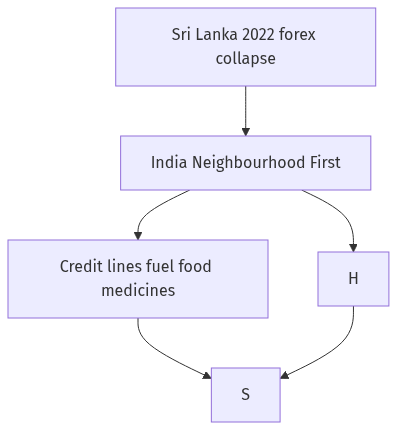
Sri Lanka’s 2022 economic crisis produced default, fuel and medicine shortages, and political change. India responded first with credit lines and humanitarian supplies for essentials, including fuel, under Neighbourhood First. The aim was neighbourhood stability, Tamil Nadu and IOR security, not only goodwill. IMF restructuring and other creditors remained the medium-term track. Friendship does not erase fishermen and strategic disagreements. Tonnage and tranche detail belong to official statements, not to invented figures.
Model answer
Copper italics in this answer — like this — are the key facts. Each one is unpacked in the Facts & figures rail.
Introduction
India and Sri Lanka share geography, the Palk Strait, and a long diplomatic relationship that has survived civil war, fishermen disputes, and extra-regional influence. In 2022, when Sri Lanka entered a sovereign default and a collapse of foreign exchange, fuel and medicines, India used Neighbourhood First to act as the first large responder rather than as a distant commentator.
Body
The 2022 crisis India was responding to
- Sri Lanka’s 2022 crisis combined depleted reserves, inability to pay for essential imports, shortages of fuel, food and medicines, and a political rupture that forced a change of presidency and government in Colombo.
- The island’s default and street unrest were a neighbourhood stability problem for India: refugee pressure in Tamil Nadu, sea-lane security in the Indian Ocean, and the risk of a vacuum filled only by one extra-regional creditor.
What India actually did
- New Delhi extended emergency economic support through currency-related arrangements, credit lines for food, medicines and essential commodities, and facilities that allowed Colombo to keep importing fuel when commercial suppliers demanded hard currency.
- India sent humanitarian consignments of medicines and essential supplies, and Indian oil-sector entities helped keep pumps and power plants running under government-to-government arrangements rather than leaving the island to spot markets it could not pay.
- Assistance was framed as Neighbourhood First and SAGAR (Security and Growth for All in the Region): a solvent, stable Sri Lanka is an Indian interest, not a favour to a party in Colombo.
- India also used existing mechanisms — development projects, housing in the north and east, and people-to-people links — so that 2022 was an intensification of a relationship, not a first meeting.
How the role should be read
- India’s role was that of a proximate stabilizer: fast, politically visible, and tied to essential imports, while the IMF programme and other creditors shaped the medium-term restructuring.
- Friendship did not erase disagreements on fishermen, on minority rights, or on extra-regional bases and ports; crisis diplomacy sat beside those files rather than deleting them.
- Compared with distant partners, India could move diesel, drugs, and credit faster because of distance, Tamil Nadu logistics, and resident High Commission capacity.
Limits and cautions
- Exact tonnes and every tranche should be taken from official MEA and High Commission statements, not from round numbers invented in an answer; the public record is that support was multi-billion-dollar in scale and front-loaded in 2022.
- Over-claiming that India “solved” the crisis would ignore domestic Sri Lankan politics, the IMF, and other lenders.
- A sustainable role after the emergency is debt transparency, energy cooperation, and avoiding a patronage contest that Sri Lankan democracy itself rejects.
Flow diagram
Conclusion
- In 2022 India acted as Sri Lanka’s nearest large friend: credit lines, fuel and humanitarian supply under Neighbourhood First, while Colombo negotiated a longer IMF path. That role fits an age-old relationship and still leaves fishermen, minorities, and extra-regional projects on the table.
Quick related
Students also ask
-
While the national political parties in India favour centralisation, the regional parties are in favour of State autonomy." Comment.
Next question on this syllabus topic (2022 · Q13). View answer →
-
Did India replace the IMF in Sri Lanka in 2022?
No. India provided fast emergency support. The IMF and a wider creditor process addressed the restructuring.
-
Is the India–Sri Lanka relationship only a 2022 story?
No. Civil-war era diplomacy, fishermen, and development projects long predate the default; 2022 was an acute test of that older friendship.
Same topic · past papers
UPSC has asked this before
These previous-year questions sit on the same topic. Open one to practise the earlier ask.
-
2024 · Q15 · GS II · 15 marks
Discuss India as a secular state and compare with the secular principles of the US constitution.
More from this topic
Q15 · UPSC Mains 2026 · GS II · 15 marks · Solution
To what extent do pressure groups, social movements and corporate lobbies deepen pluralistic democracy in India by representing excluded interests? Analyse whether the growing convergence of corporate wealth and political power poses a threat to the autonomy of formal democratic institutions.
Governance and Policy
• Civil society groups and grassroots movements go beyond periodic elections to channel marginalized voices into policy spaces. • Social movements on tribal rights and environmental protection have successfully forced the state to create protective legislation. • Representation is uneven due to a severe resource asymmetry between well-funded corporate lobbies and unorganized labor. • Some interest groups act as elite fronts, subverting public welfare for narrow sectarian gains. • Corporate financial dominance through opaque funding creates severe risks of policy capture and quid pro quo corruption. • Strengthening transparency in political funding and reinforcing regulatory autonomy are essential to safeguard democratic governance.
Q12 · UPSC Mains 2026 · GS II · 15 marks · Solution
What is meant by judicial legislation? In this context, discuss the verdicts of the apex court allowing "passive euthanasia" and a "living will".
Governance and Policy
• Judicial legislation occurs when courts create binding rules to fill policy voids caused by legislative inaction. • The Supreme Court legalized passive euthanasia under Article 21, recognizing the right to die with dignity. • The *Common Cause* (2018) judgment permitted the withdrawal of life support for terminally ill patients with strict medical safeguards. • A living will is an advanced medical directive allowing individuals to pre-state their treatment preferences before incapacitation. • The Supreme Court simplified living will procedures in 2023, replacing complex magistrate approvals with basic notary attestation. • While court guidelines provide immediate relief, they underscore the need for a comprehensive parliamentary statute on end-of-life care. • Codifying these judicial norms through formal legislation ensures democratic legitimacy, ethical debate, and administrative clarity.
Q6 · UPSC Mains 2026 · GS II · 10 marks · Solution
Does India's tribal development policy reflect the aspirations for a socially grounded and equity-based governance? Justify your answer.
Governance and Policy
• India's tribal policy balances constitutional protections with socio-economic development goals. • Fifth and Sixth Schedules provide decentralized autonomy and safeguard tribal lands. • Articles 275(1) and 335 ensure grants-in-aid and reservations to bridge gaps. • PESA (1996) and FRA (2006) mark shifts toward rights-based and culturally sensitive governance. • Gram sabhas are empowered over minor forest produce and community forest rights. • Implementation is hindered by forced displacement without consent and bureaucratic inertia. • True equity requires empowering local institutions rather than relying solely on welfare delivery.