
Revision summary
The 74th Amendment and the Twelfth Schedule create municipalities but leave devolution to State law. Parastatals and State-appointed commissioners keep functions out of the elected council. Property tax is constrained; GST ended octroi and sent compensation to States, not cities. Late State Finance Commissions and approval for borrowing keep cities fiscally dependent. The statement is correct: functional and financial empowerment is still a State choice.
Model answer
Copper italics in this answer — like this — are the key facts. Each one is unpacked in the Facts & figures rail.
Introduction
The Constitution (Seventy-fourth Amendment) Act, 1992, made municipalities a third tier of government and listed 18 functions in the Twelfth Schedule. A comment on State reluctance must show how States still hold those functions, staff, and taxes.
Body
Functional reluctance
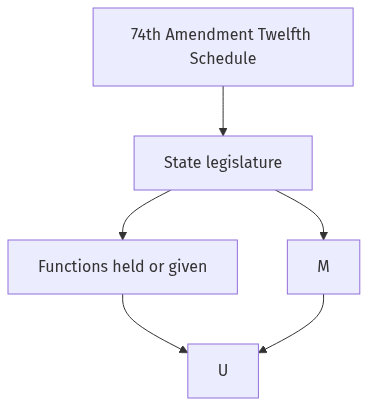
- Article 243W leaves it to the State legislature to endow municipalities with Twelfth Schedule functions; the Union cannot force devolution of urban planning, water, fire services, or slum improvement.
- Many States keep parastatal bodies for water, transport, and development authorities, so the elected council does not control the function that the Schedule names.
- Mayor-in-council or a weak ceremonial mayor, plus a State-appointed municipal commissioner, splits political authority from administrative control.
- The State Election Commission and State Finance Commission exist in the text, yet delayed elections, prolonged administrator rule, and delayed SFC reports are common.
- Building-plan, land-use, and police powers remain with State departments even in million-plus cities, which is functional reluctance in daily governance.
Financial reluctance
- Article 243X allows States to assign taxes, duties, tolls and fees; property tax is still the main own tax, and States cap rates, grant exemptions, and delay revision of guidance values.
- Goods and Services Tax absorbed octroi, entry tax, and local surcharges; GST compensation went to State governments, not automatically to city budgets.
- State Finance Commissions under Article 243Y are often late, and State governments do not always accept or notify the award in full.
- Central Finance Commission grants to urban local bodies (Fourteenth and Fifteenth Finance Commissions) are tied to reforms, but they cannot replace a State’s refusal to share stamp duty, entertainment tax residue, or a predictable share of GST.
- Municipal borrowing and municipal bonds need State guarantee or approval, so even a solvent city cannot raise debt on its own balance sheet.
Why the reluctance persists
- MLAs and State ministers treat cities as vote and patronage territory; a strong municipality is a rival power centre.
- The 74th Amendment constitutionalised the form of local government; it did not constitutionalise a minimum share of State tax or a list of exclusive municipal functions.
- A fair comment therefore agrees with the statement: devolution is discretionary, and both function and finance still sit with the State.
Flow diagram
Conclusion
States remain reluctant because the 74th Amendment leaves functions and taxes to State legislatures, and because parastatals and GST have concentrated money above the ward. Urban local bodies will be empowered only when SFCs, property-tax freedom, and Twelfth Schedule functions are actually transferred, not only listed.
Quick related
Students also ask
-
Discuss the role of Presiding Officers of state legislatures in maintaining order and impartiality in conducting legislative work and in facilitating best democratic practices.
Next question on this syllabus topic (2023 · Q5). View answer →
-
Did GST abolish municipal taxation entirely?
No. Property tax, some user charges, and a few local taxes remain. Octroi and entry tax, which funded many cities, did go into GST.
-
Can the Union devolve Twelfth Schedule functions by itself?
No. Article 243W is addressed to the State legislature. Union grants can only incentivise devolution.
Same topic · past papers
UPSC has asked this before
These previous-year questions sit on the same topic. Open one to practise the earlier ask.
-
2024 · Q5 · GS II · 10 marks
Analyse the role of local bodies in providing good governance at local level and bring out the pros and cons of merging the rural local bodies with the urban local bodies. -
2026 · Q2 · GS II · 10 marks
"Women as a class neither belong to a minority group nor are they regarded as forming a backward class." In the light of this statement, discuss the evolution of women's reservation from local bodies to Parliament. -
2015 · Q13 · GS II · 12 marks
Though there have been several different estimates of poverty in India, all indicate reduction in poverty over time. Do you agree. Critically examine with reference to urban and rural poverty indicators.
More from this topic
Q15 · UPSC Mains 2026 · GS II · 15 marks · Solution
To what extent do pressure groups, social movements and corporate lobbies deepen pluralistic democracy in India by representing excluded interests? Analyse whether the growing convergence of corporate wealth and political power poses a threat to the autonomy of formal democratic institutions.
Governance and Policy
• Civil society groups and grassroots movements go beyond periodic elections to channel marginalized voices into policy spaces. • Social movements on tribal rights and environmental protection have successfully forced the state to create protective legislation. • Representation is uneven due to a severe resource asymmetry between well-funded corporate lobbies and unorganized labor. • Some interest groups act as elite fronts, subverting public welfare for narrow sectarian gains. • Corporate financial dominance through opaque funding creates severe risks of policy capture and quid pro quo corruption. • Strengthening transparency in political funding and reinforcing regulatory autonomy are essential to safeguard democratic governance.
Q12 · UPSC Mains 2026 · GS II · 15 marks · Solution
What is meant by judicial legislation? In this context, discuss the verdicts of the apex court allowing "passive euthanasia" and a "living will".
Governance and Policy
• Judicial legislation occurs when courts create binding rules to fill policy voids caused by legislative inaction. • The Supreme Court legalized passive euthanasia under Article 21, recognizing the right to die with dignity. • The *Common Cause* (2018) judgment permitted the withdrawal of life support for terminally ill patients with strict medical safeguards. • A living will is an advanced medical directive allowing individuals to pre-state their treatment preferences before incapacitation. • The Supreme Court simplified living will procedures in 2023, replacing complex magistrate approvals with basic notary attestation. • While court guidelines provide immediate relief, they underscore the need for a comprehensive parliamentary statute on end-of-life care. • Codifying these judicial norms through formal legislation ensures democratic legitimacy, ethical debate, and administrative clarity.
Q6 · UPSC Mains 2026 · GS II · 10 marks · Solution
Does India's tribal development policy reflect the aspirations for a socially grounded and equity-based governance? Justify your answer.
Governance and Policy
• India's tribal policy balances constitutional protections with socio-economic development goals. • Fifth and Sixth Schedules provide decentralized autonomy and safeguard tribal lands. • Articles 275(1) and 335 ensure grants-in-aid and reservations to bridge gaps. • PESA (1996) and FRA (2006) mark shifts toward rights-based and culturally sensitive governance. • Gram sabhas are empowered over minor forest produce and community forest rights. • Implementation is hindered by forced displacement without consent and bureaucratic inertia. • True equity requires empowering local institutions rather than relying solely on welfare delivery.