
Revision summary
PM Gati Shakti (2021) is a National Master Plan to coordinate multimodal infrastructure on a common GIS map. It is meant to discipline the National Infrastructure Pipeline against silo planning. Trunk assets remain largely public; warehouses, terminals and many logistics services are private or PPP. Without government–private alignment on land, concessions and last-mile nodes, connectivity will not cheapen. The scheme succeeds as a coordination platform, not as a substitute for private capital.
Model answer
Copper italics in this answer — like this — are the key facts. Each one is unpacked in the Facts & figures rail.
Introduction
PM Gati Shakti, launched in 2021 as a National Master Plan for multimodal connectivity, is a planning and coordination platform, not a substitute for private capital. Last-mile logistics, terminals, and rolling stock will move at the speed of public–private alignment around the National Infrastructure Pipeline.
Body
What Gati Shakti is meant to do
- The National Master Plan maps existing and proposed infrastructure of ministries and States on a common GIS canvas so that a road, rail, port, airport, and utility line are planned together rather than in silos.
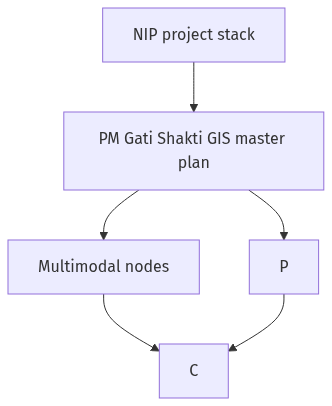
- It sits beside the National Infrastructure Pipeline announced in 2019, which listed a multi-year stack of projects; Gati Shakti is the coordination layer that is supposed to cut cost and time overruns on that stack.
- Multimodal connectivity is the test: a container should move from a factory to a port or inland waterway without separate, contradictory alignments of highway, railway, and power.
Why the government cannot do connectivity alone
- Public agencies still own trunk networks — Indian Railways, national highways, major ports, and airports under AAI or PPP concessions — and they must share alignments, land, and clearances.
- Warehousing, third-party logistics, rolling stock on some routes, port terminals, and gas and data pipelines are already private or PPP; without those operators on the same map, Gati Shakti is only an intra-government dashboard.
- Logistics cost as a share of GDP falls when private fleet and warehouse decisions follow a published national plan, not when every ministry announces a separate corridor.
How government–private coordination has to work
- A single window for alignments and a stable concession framework matter more than a new slogan: private bidders price political risk and delayed land more than they price GIS software.
- Bharatmala, Sagarmala, inland waterways, and UDAN only become one network if private feeder roads, cold chains, and coastal shipping are contracted to the same nodes the Master Plan names.
- States must plug industrial parks and city logistics into the map; most last-mile land is State land, and most warehouses are private.
Risks that a discussion should name
- If Gati Shakti remains a Union GIS exercise without binding inter-ministerial timelines, private capital will wait.
- If coordination means only large conglomerates at the table, MSME freight users will not see cheaper connectivity.
- Data-sharing with private operators has to protect security-sensitive layers while still being usable for commercial siting.
Flow diagram
Conclusion
Gati Shakti works if the State plans trunk infrastructure as one network and the private sector builds and runs the logistics around those nodes. Connectivity is a joint product of the National Master Plan, the National Infrastructure Pipeline, and bankable PPP, not of any one ministry acting alone.
Quick related
Students also ask
-
Reforming the government delivery system through the Direct Benefit Transfer Scheme is a progressive step, but it has its limitations too. Comment.
Next question on this syllabus topic (2022 · Q8). View answer →
-
Is Gati Shakti a new Ministry?
No. It is a coordination and planning platform across existing ministries and States, with a GIS National Master Plan at its core.
-
Can the private sector be kept off the Master Plan?
Only at the cost of the objective. Last-mile logistics and many terminals are already private or PPP; connectivity needs both.
Same topic · past papers
UPSC has asked this before
These previous-year questions sit on the same topic. Open one to practise the earlier ask.
-
2018 · Q7 · GS II · 10 marks
Appropriate local community level healthcare intervention is a prerequisite to achieve 'Health for All' in India. Explain. -
2017 · Q18 · GS II · 15 marks
Initially Civil Services in India were designed to achieve the goals of neutrality and effectiveness, which seems to be lacking in the present context. Do you agree with the view that drastic reforms are required in Civil Services. Comment (250 words).
More from this topic
Q15 · UPSC Mains 2026 · GS II · 15 marks · Solution
To what extent do pressure groups, social movements and corporate lobbies deepen pluralistic democracy in India by representing excluded interests? Analyse whether the growing convergence of corporate wealth and political power poses a threat to the autonomy of formal democratic institutions.
Governance and Policy
• Civil society groups and grassroots movements go beyond periodic elections to channel marginalized voices into policy spaces. • Social movements on tribal rights and environmental protection have successfully forced the state to create protective legislation. • Representation is uneven due to a severe resource asymmetry between well-funded corporate lobbies and unorganized labor. • Some interest groups act as elite fronts, subverting public welfare for narrow sectarian gains. • Corporate financial dominance through opaque funding creates severe risks of policy capture and quid pro quo corruption. • Strengthening transparency in political funding and reinforcing regulatory autonomy are essential to safeguard democratic governance.
Q12 · UPSC Mains 2026 · GS II · 15 marks · Solution
What is meant by judicial legislation? In this context, discuss the verdicts of the apex court allowing "passive euthanasia" and a "living will".
Governance and Policy
• Judicial legislation occurs when courts create binding rules to fill policy voids caused by legislative inaction. • The Supreme Court legalized passive euthanasia under Article 21, recognizing the right to die with dignity. • The *Common Cause* (2018) judgment permitted the withdrawal of life support for terminally ill patients with strict medical safeguards. • A living will is an advanced medical directive allowing individuals to pre-state their treatment preferences before incapacitation. • The Supreme Court simplified living will procedures in 2023, replacing complex magistrate approvals with basic notary attestation. • While court guidelines provide immediate relief, they underscore the need for a comprehensive parliamentary statute on end-of-life care. • Codifying these judicial norms through formal legislation ensures democratic legitimacy, ethical debate, and administrative clarity.
Q6 · UPSC Mains 2026 · GS II · 10 marks · Solution
Does India's tribal development policy reflect the aspirations for a socially grounded and equity-based governance? Justify your answer.
Governance and Policy
• India's tribal policy balances constitutional protections with socio-economic development goals. • Fifth and Sixth Schedules provide decentralized autonomy and safeguard tribal lands. • Articles 275(1) and 335 ensure grants-in-aid and reservations to bridge gaps. • PESA (1996) and FRA (2006) mark shifts toward rights-based and culturally sensitive governance. • Gram sabhas are empowered over minor forest produce and community forest rights. • Implementation is hindered by forced displacement without consent and bureaucratic inertia. • True equity requires empowering local institutions rather than relying solely on welfare delivery.