
Revision summary
Input and paddy–wheat procurement subsidies push a cereal pattern and shrink crop diversity. They support small-farm cash this season but capitalise into rents, borewells, and soil imbalance. PM Fasal Bima Yojana is the main income hedge for a failed crop if claims are timely. MSP helps small farmers only where procurement is real, including pulses and oilseeds. Food processing and FPOs turn perishable output into a market for the one-acre household.
Model answer
Copper italics in this answer — like this — are the key facts. Each one is unpacked in the Facts & figures rail.
Introduction
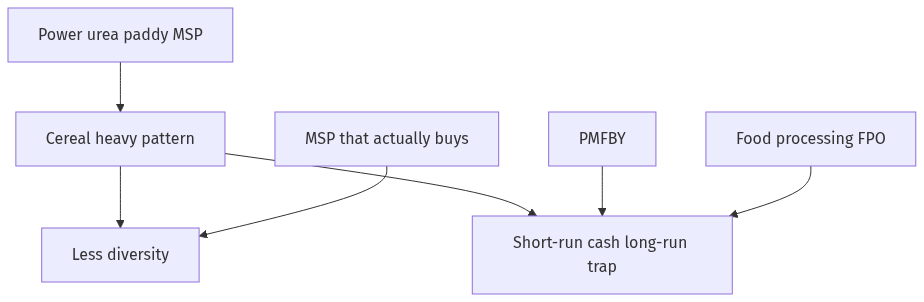
A subsidy changes what is cheap to grow. In India, fertiliser, power, canal water, and cheap credit, plus Minimum Support Price procurement of rice and wheat, have built a cereal-heavy pattern, thinned diversity, and given many small farmers a cash cushion that is also a trap. Crop insurance, a wider MSP, and food processing are the tools that can protect the small lot without locking the whole village into paddy.
Body
How subsidies affect pattern, diversity, and the farmer’s economy
- Power and canal water that are free or flat-rate make paddy and sugarcane rational even on thirsty land; coarse cereals and pulses lose the calendar.
- Urea subsidy (and a weaker phosphate–potash signal for years) pushed nitrogen-heavy doses; soil balance and crop mix suffered.
- MSP plus Food Corporation of India procurement is a de facto subsidy to rice and wheat belts; oilseeds and millets stay on the rainfed margin.
- Diversity falls: fewer intercrops, fewer legumes, more specialised pest pressure — the yield problem of the previous question.
- Farmer economy: subsidies cut the cash cost this season and can keep a marginal farmer afloat. They also capitalise into land rents and borewell races, so the tenant and the water table lose. Leakage to large farmers and to the fertiliser plant is well known.
- Export and livestock get less policy energy than grain, so income sources stay narrow.
- When a subsidy is delayed (fertiliser shortage, unpaid cane dues), the small farmer’s liquidity breaks at once because she has no buffer.
Crop insurance for small and marginal farmers
- Pradhan Mantri Fasal Bima Yojana (2016) cut premium rates and used more technology for crop-cutting. For a one-hectare household, a failed monsoon is ruin; insurance is the substitute for the savings she does not have.
- Gaps: delayed claims, village-level assessment that misses plot-level loss, and awareness. Insurance stabilises income, not the cropping pattern, unless premiums and products also cover horticulture and livestock.
MSP for the small lot
- MSP is a price floor where procurement actually happens. For small farmers in Punjab–Haryana it is real; in much of eastern and rainfed India it is a newspaper number.
- A declared MSP for pulses and oilseeds without purchase does not change the pattern. Price deficiency or local procurement through cooperatives can.
- MSP must not mean open-ended paddy in overdrawn blocks; that “helps” the farmer while mining her children’s water.
Food processing
- A plant or pack-house near the village turns a perishable glut into a cheque. That is more valuable to a one-acre horticulture or milk producer than another urea bag.
- Mega Food Parks, cold chain, and Farmer Producer Organisations let small lots aggregate. Without them, the small farmer remains a price-taker at the mandi in a two-week harvest.
- Processing also absorbs women and landless labour — the household economy, not only the landowner.
A less distorting mix
- Direct income support and Direct Benefit Transfer of fertiliser subsidy where leakage is high; keep kind support where markets fail.
- Meter irrigation energy; pay a cash equivalent for saving power.
- Insurance that pays on time; MSP that is implemented for pulses, millets, and oilseeds; processing linked to those crops.
Flow diagram
Conclusion
Fertiliser, power, and rice–wheat procurement subsidies cheapen a narrow cropping pattern, cut diversity, and give small farmers short-run relief that can become a water-and-soil trap. Crop insurance is their disaster hedge. MSP matters only where someone buys. Food processing is the demand limb for perishables. Shift from unmetered inputs toward income support, real pulse–millet purchase, and plants next to the farm.
Quick related
Students also ask
-
What is water-use efficiency? Describe the role of micro-irrigation in increasing the water-use efficiency.
Next question on this syllabus topic (2016 · Q7). View answer →
-
Should all farm subsidies be abolished?
A sudden cut without income support and working markets would crush the small farmer. The reform is retargeting, metering, and buying a wider crop basket.
-
Does MSP always help the smallest farmer?
Only if she has a surplus and a procurement centre. Many marginal farmers are net food buyers and gain more from wages and processing jobs.
Same topic · past papers
UPSC has asked this before
These previous-year questions sit on the same topic. Open one to practise the earlier ask.
-
2018 · Q3 · GS III · 10 marks
What do you mean by Minimum Support Price (MSP)? How will MSP rescue the farmers from the low income trap? (150 Words, 10 Marks). -
2023 · Q13 · GS III · 15 marks
Explain the changes in cropping pattern in India in the context of changes in consumption pattern and marketing conditions. -
2018 · Q14 · GS III · 15 marks
How has the emphasis on certain crops brought about changes in cropping patterns in recent past? Elaborate the emphasis on millets production and consumption. (250 Words, 15 Marks).
More from this topic
Q14 · UPSC Mains 2026 · GS III · 15 marks · Solution
Discuss the different types of subsidies and supports provided by the Government of India to agricultural sector. Examine the related issues pertaining to Agreement on Agriculture of World Trade Organisation (WTO).
Crops, Irrigation and Marketing
• Input subsidies: fertiliser, power, irrigation, credit interest subvention. • Output support: MSP and public procurement where operational. • Income/insurance: PM-KISAN-type transfers and crop insurance premium help. • Infrastructure support is largely Green Box-compatible public goods. • AoA boxes: Green, Blue, Amber (AMS) plus market access and export rules. • India disputes outdated reference prices for stockholding AMS math. • Bali peace clause temporary; permanent stockholding solution still sought. • SSM and careful shift to decoupled/Green supports are strategic responses.
Q13 · UPSC Mains 2026 · GS III · 15 marks · Solution
In which manner has Indian agriculture been transformed from food scarcity to food-surplus level? Describe the various government policies implemented for diversification of Indian agriculture.
Crops, Irrigation and Marketing
• Mid-1960s crises exposed import dependence and ship-to-mouth risk. • HYV wheat/rice, irrigation and chemicals raised yields in key plains. • MSP–FCI–PDS converted yield into national buffer security. • Surplus mainly means staple confidence; nutrition gaps remain. • MIDH drives fruit–vegetable diversification and post-harvest links. • Dairy/livestock and fisheries add protein and cash incomes. • Pulses, oilseeds and millets missions address imports and climate diets. • Market, storage and groundwater policies must accompany crop shifts.
Q5 · UPSC Mains 2026 · GS III · 10 marks · Solution
Explain by giving two examples, how biotechnology has helped the Indian farmers in processing their perishable crops.
Crops, Irrigation and Marketing
• Perishables lose value fast; biotech helps at nursery and packhouse stages. • Tissue-culture banana gives disease-indexed, uniform plantlets for processing. • Uniform bunches cut sorting waste in chips, puree and export packs. • Ethylene ripening chambers apply plant physiology to replace carbide and time firmness. • Enzyme treatments improve juice clarity and extraction from mango/banana. • Surplus fruit can enter fermentation or dehydrated product lines. • Prefer deployed Indian examples over unverified commercial GM shelf-life claims. • Net effect: less spoilage, better processing fit, higher chance of organised-market sales.