
Revision summary
Vaccines present a safe antigen so the immune system forms memory without the full disease. Platforms include inactivated, live attenuated, subunit, viral vector and nucleic acid. Antibodies and memory T/B cells then respond faster on real exposure. Covishield is an adenovirus vector made by SII; Covaxin is an inactivated whole-virion vaccine from Bharat Biotech with ICMR–NIV. India also authorised a DNA vaccine and protein-subunit products; protection against severe disease was the public-health aim as variants evolved.
Model answer
Copper italics in this answer — like this — are the key facts. Each one is unpacked in the Facts & figures rail.
Introduction
A vaccine teaches the immune system to recognise a pathogen before a dangerous infection. Development is the craft of showing that teacher safely: an antigen, a delivery method, and trials that prove protection. COVID-19 forced India to run that craft at national scale with Covishield and Covaxin, plus other platforms in the pipeline.
Body
Basic principle of vaccine development
- Identify an antigen (protein, sugar, whole killed microbe, or genetic code for that protein) that is immunogenic but not pathogenic in the form given.
- Combine it with a platform: live attenuated, inactivated whole virus, subunit/protein, toxoid, viral vector, or nucleic acid (mRNA/DNA).
- Add adjuvants where needed so the innate system notices the antigen.
- Prove safety, immunogenicity and efficacy in phased clinical trials, then pharmacovigilance after approval.
- Manufacture under GMP, cold chain, and strain update when the pathogen evolves (influenza yearly; COVID boosters as variants rose).
- Ethics: informed consent, and correlates of protection when efficacy trials become hard.
How vaccines work
- Innate cells at the injection site take up antigen and present it to T cells in lymph nodes.
- B cells make antibodies that can neutralise the pathogen; memory B and T cells remain after the shot.
- On later exposure, memory cells respond faster and stronger, preventing disease or reducing severity.
- Vaccines do not typically ‘cause the disease’ when inactivated, subunit, vector (non-replicating) or mRNA; live attenuated vaccines use a weakened organism and have specific contraindications.
- Herd effects appear when enough people have memory that transmission falls; they are a population result, not a promise to one unvaccinated person.
Indian COVID-19 approaches
- Covishield: Serum Institute of India manufacture of the Oxford–AstraZeneca chimpanzee adenovirus vector carrying the SARS-CoV-2 spike gene. Non-replicating vector; spike protein is produced in the vaccinee’s cells.
- Covaxin (BBV152): Bharat Biotech with ICMR–NIV; inactivated whole virion plus alum-like adjuvant (Alhydroxiquim-II). Traditional kill-and-inject logic, indigenous strain work.
- Other Indian lines included protein subunit (for example Corbevax-type receptor-binding domain), DNA (ZyCoV-D, first plasmid DNA COVID vaccine authorised in India), and later mRNA and nasal candidates in development or limited use.
- National rollout: CoWIN, staggered age groups, and later precaution doses; mix-and-match was studied as evidence evolved.
- Public communication must stay factual: vaccines cut severe disease and death; they are not a 100 per cent shield against all infection, especially as variants changed.
Principle illustrated
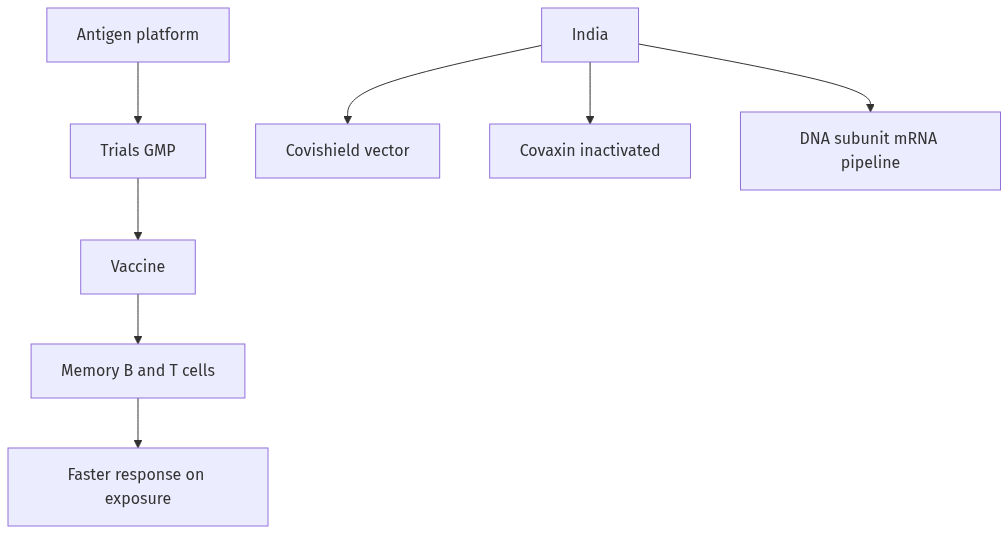
- Vector and inactivated platforms are two validated answers to the same principle: present spike (or the whole virus) without COVID disease, then rely on memory.
Flow diagram
Conclusion
Vaccine development isolates a safe antigen, tests it, and manufactures it. In the body it builds antibody and cellular memory. India’s COVID mainstays were Covishield (adenoviral vector) and Covaxin (inactivated virion), with DNA and subunit approaches alongside. That is platform diversity, not a single miracle shot.
Quick related
Students also ask
-
Explain the causes and effects of coastal erosion in India. What are the available coastal management techniques for combating the hazard ?
Next question on this syllabus topic (2022 · Q18). View answer →
-
Does an inactivated vaccine insert viral genes into human DNA?
No. The virus is killed. Vector and DNA/mRNA vaccines deliver genetic instructions for a protein; they do not become a live COVID infection.
-
Why two different Indian mainstays?
Vector and inactivated platforms diversify supply risk and immune profiles. Both aim at spike or whole-virus recognition.
Same topic · past papers
UPSC has asked this before
These previous-year questions sit on the same topic. Open one to practise the earlier ask.
-
2020 · Q3 · GS III · 10 marks
What are the main constraints in transport and marketing of agricultural produce in India? -
2023 · Q3 · GS III · 10 marks
How does e-Technology help farmers in production and marketing of agricultural produce? Explain it.
More from this topic
Q17 · UPSC Mains 2026 · GS III · 15 marks · Solution
What are the challenges to solid waste management in India? Discuss the governmental policy framework on solid waste management. Discuss the success/failure cases of Delhi and Indore cities highlighting the salient features of their solid waste management initiatives.
Indian Economy
• Rapid urbanization has made solid waste management a critical environmental and public health crisis in India. • Key challenges include lack of source segregation, inadequate processing infrastructure, reliance on unprotected informal workers, and financially weak urban local bodies. • The policy framework relies on the SWM Rules 2016, Swachh Bharat Mission (Urban), and Plastic Waste Management Rules 2016. • Indore succeeded through 100% source segregation, zero dump-site remediation, and strict enforcement with digital monitoring. • Delhi failed due to overloaded legacy landfills (Ghazipur, Bhalswa), lack of decentralization, and fragmented municipal governance. • A successful transition requires moving to a circular economy focused on source segregation, decentralized processing, and polluter accountability.
Q16 · UPSC Mains 2026 · GS III · 15 marks · Solution
What is Agentic Artificial Intelligence (AI)? Explain its working. Describe its applications with suitable examples. Discuss the advantages, risks and challenges associated with agentic AI systems.
Indian Economy
Agentic Artificial Intelligence represents an advanced paradigm where AI systems operate with autonomy, setting goals and executing complex workflows without constant human prompts. Unlike traditional generative AI that merely responds to queries, agentic AI uses perception, planning, memory, and tool-use to achieve multi-step objectives. Its applications span across autonomous software engineering, supply chain optimization, and automated financial trading. While offering massive productivity gains and dynamic problem-solving, these systems pose significant risks including lack of transparency, alignment failures, security vulnerabilities, and ethical dilemmas. Governance frameworks and robust guardrails are essential to harness their potential safely.
Q15 · UPSC Mains 2026 · GS III · 15 marks · Solution
Mention salient features of 'Mission Drishti'. Discuss the imaging techniques used in the satellite launched on 3rd May 2026. Why is it being considered world's first satellite of its kind?
Indian Economy
Mission Drishti represents a major leap in India's space-based Earth observation capabilities, launched on 3rd May 2026. The mission employs advanced multi-spectral and hyperspectral imaging techniques to capture high-resolution data across various atmospheric and terrestrial layers. It is hailed as a global first due to its unique integration of real-time onboard edge computing with quantum encryption for secure data transmission. The satellite significantly enhances resource management, disaster response, and strategic surveillance. It aligns with India's policy of leveraging space technology for sustainable development and national security.