
Revision summary
Village roads and a thin cold-chain waste perishable produce before it is sold. Small loads and truck dependence keep agri freight costly. APMC concentration, weak assaying, and poor price information squeeze the seller. Distress harvest sales and thin warehouse-receipt credit force low prices. MSP procurement is not a marketing system for most crops and States.
Model answer
Copper italics in this answer — like this — are the key facts. Each one is unpacked in the Facts & figures rail.
Introduction
Indian farms can grow a surplus and still lose it between the field and the plate. Transport is slow, broken, and costly. Marketing is layered, poorly informed, and often tied to a local mandi. Together they tax the farmer twice: a lower farm-gate price and higher wastage.
Body
Transport constraints
- First-mile roads from village to market remain seasonal in many blocks; PMGSY helped but last-mile trucks and carts still bruise perishables.
- A thin cold-chain: pack-houses, reefer trucks, and ripening chambers are scarce outside a few corridors, so horticulture and milk lose value in heat.
- Rail and water take a small share of agri-freight; dependence on diesel trucks raises cost and time. Dedicated freight capacity for food is still catching up.
- Fragmented loads from small holdings make full-truck economics hard without aggregation by FPOs, cooperatives, or a village collection centre.
- Check-posts may have fallen under GST, but weighbridges, local cess habits, and poor warehousing at stations still delay cargo.
Marketing constraints
- APMC mandis in many States still concentrate sale: limited buyers, commission agents, and weak price discovery for the small seller.
- Information asymmetry: MSP headlines do not equal a local buyer; e-NAM connectivity is uneven, and quality assaying is thin.
- Standards, grading, and sorting are weak, so the farmer cannot claim a premium and the processor cannot trust a lot.
- Credit and distress sale after harvest flood the mandi; warehouse-receipt finance (WDRA, e-NWR) has not become the default.
- Private trade, contract farming, and direct retail exist, but legal uncertainty and political risk around farm laws (the 2020 ordinances were already a live fight) deter long offtake contracts.
- Export and interstate movement hit SPS barriers, logistics, and sudden stock limits, which make marketing risky even when the crop is good.
Why it matters
- High post-harvest loss and a large retail–farm gate wedge are the same constraint seen from two ends.
- Public grain procurement works for wheat and paddy in a few States; it is not a national marketing system for oilseeds, pulses, or vegetables.
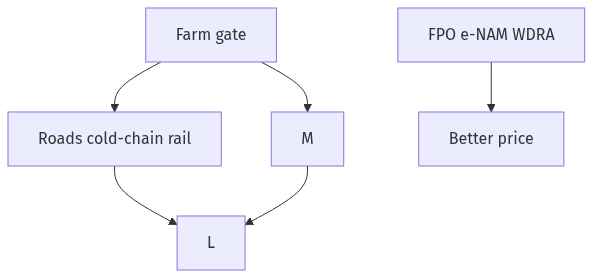
Flow diagram
Conclusion
Agri transport is constrained by roads, cold-chain, and unconsolidated loads. Agri marketing is constrained by mandi bottlenecks, poor grading, thin finance, and shaky contract certainty. Aggregation, cold logistics, and open, informed sale are the remedies, not only a higher MSP poster.
Quick related
Students also ask
-
What do you understand by nanotechnology and how is it helping in health sector?
Next question on this syllabus topic (2020 · Q5). View answer →
-
Does abolishing mandis automatically raise farmer prices?
Only if alternative buyers, roads, and quality systems exist. A vacuum can leave the farmer with a local monopsony.
-
Is MSP the marketing constraint?
MSP is a price floor for a few crops where FCI buys. Most produce never sees that window; transport and local sale rules do.
Same topic · past papers
UPSC has asked this before
These previous-year questions sit on the same topic. Open one to practise the earlier ask.
More from this topic
Q17 · UPSC Mains 2026 · GS III · 15 marks · Solution
What are the challenges to solid waste management in India? Discuss the governmental policy framework on solid waste management. Discuss the success/failure cases of Delhi and Indore cities highlighting the salient features of their solid waste management initiatives.
Indian Economy
• Challenges: volume growth, mixed waste, land, informal exclusion, weak finance. • SWM Rules 2016 mandate segregation, collection, processing, user fees. • Plastic/C&D/e-waste rules and SBM Urban complete the framework. • Swachh Survekshan creates competitive accountability. • Indore: strong segregation, collection, processing, enforcement. • Delhi: huge volumes, legacy dumps, fires, fragmented stress. • Lesson: behaviour + processing beat trucks-only strategies. • Biomining and bulk-generator compliance are essential for metros.
Q16 · UPSC Mains 2026 · GS III · 15 marks · Solution
What is Agentic Artificial Intelligence (AI)? Explain its working. Describe its applications with suitable examples. Discuss the advantages, risks and challenges associated with agentic AI systems.
Indian Economy
• Agentic AI pursues goals via plan–act–observe loops, not one-shot replies. • Working parts: planning, tools, memory, guardrails, stop conditions. • Uses: grievance assist, compliance, agri/disaster fusion, cyber SOCs, tutoring. • Advantages: speed, consistency, expert leverage, continuous monitoring. • Risks: harmful actions from hallucinations, injection attacks, privacy leaks. • India challenges: languages, liability, data law, compute cost, evaluation. • Govern with human approval for high stakes, logs and allow-listed tools. • Sandboxes beat unsupervised autonomy over money and rights.
Q15 · UPSC Mains 2026 · GS III · 15 marks · Solution
Mention salient features of 'Mission Drishti'. Discuss the imaging techniques used in the satellite launched on 3rd May 2026. Why is it being considered world's first satellite of its kind?
Indian Economy
• Mission Drishti is GalaxEye's EO satellite launched 3 May 2026. • Marketed as world's first OptoSAR combining optical + all-weather radar. • Described as India's largest privately built satellite in that category. • Imaging: X-band SAR (Stripmap/Spotlight) plus 7-band MSI. • Fusion on one platform avoids two-satellite parallax/time errors. • Fused resolution marketed near 1.8 m; SAR spotlight finer (~0.9 m claimed). • Orbit: sun-synchronous LEO ~500 km class; revisit ~4 days (company). • Novelty is integrated commercial OptoSAR—not inventing SAR/optical physics.