
Revision summary
Weather, mKisan, Soil Health Card and drones improve the production decision. PM-KISAN and PMFBY ride digital rails so cash and insurance reach the farmer. e-NAM, AGMARKNET and e-warehouse receipts improve the sale decision. FPOs and ONDC-type tools can widen the buyer set. The phone works only if mandi assaying, storage and roads exist.
Model answer
Copper italics in this answer — like this — are the key facts. Each one is unpacked in the Facts & figures rail.
Introduction
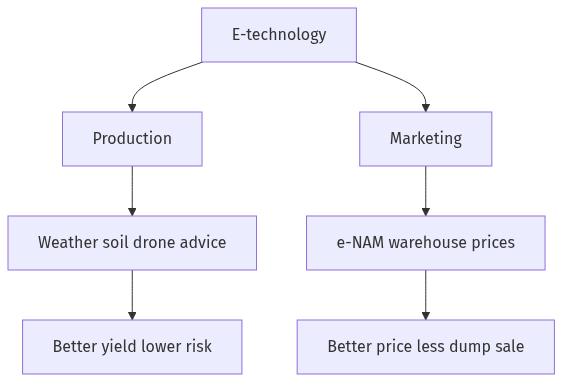
E-technology in farming is not a slogan. It is weather on a phone, a soil card, a drone map, a warehouse receipt, and a price on e-NAM (National Agriculture Market). Production decisions and sale decisions both improve when the farmer sees timely data instead of only the trader at the gate.
Body
Production
- India Meteorological Department nowcasts, mKisan and Kisan Call Centres give weather and pest advice in local languages so sowing and spray are timed.
- Soil Health Card and remote-sensing maps show nutrient gaps; this cuts blind use of urea.
- Drones, satellite imagery and Kisan drones under agricultural guidelines help survey crop stress, spray in a narrow window, and estimate area.
- Precision tools — drip with sensors, seeders with GPS in larger farms — save water and seed where the farmer can afford them.
- Digital Direct Benefit Transfer of Pradhan Mantri Kisan Samman Nidhi (PM-KISAN) and crop-insurance enrolment under Pradhan Mantri Fasal Bima Yojana (PMFBY) put cash and cover on an electronic trail, which is part of the production risk pad.
Marketing
- e-NAM links mandis so a lot can, in principle, find a buyer beyond the local yard, with quality assaying and online bidding.
- AGMARKNET and State price apps publish arrivals and rates, which weakens the information monopoly of the first trader.
- Electronic Negotiable Warehouse Receipts let stored grain become credit, so the farmer need not dump the harvest in one week.
- Farmer Producer Organisations using apps, Open Network for Digital Commerce pilots, and private traceability tools open a path to bulk buyers and exports.
- Logistics platforms for trucks and cold chain reduce spoilage of horticulture if the road and the pack-house exist.
Limits
- A phone does not replace a road, a dry warehouse, or an assaying lab. E-technology amplifies public mandi and storage reform; it does not substitute them.
Flow diagram
Conclusion
E-technology helps production through weather, soil, pest and insurance data. It helps marketing through e-NAM, warehouse receipts and price visibility. The farmer gains only where connectivity, assaying and storage sit behind the screen.
Quick related
Students also ask
-
What is Integrated Farming System ? How is it helpful to small and marginal farmers in India ?
Next question on this syllabus topic (2022 · Q14). View answer →
-
Does e-NAM set the farm-gate price by itself?
No. It is a trading layer. Price still depends on quality labs, lots, and whether buyers actually bid.
-
Is a drone a production technology or a marketing one?
Mainly production: survey and spray. Yield maps can later support insurance and credit, which sit next to marketing.
Same topic · past papers
UPSC has asked this before
These previous-year questions sit on the same topic. Open one to practise the earlier ask.
-
2022 · Q16 · GS III · 15 marks
What is the basic principle behind vaccine development? How do vaccines work? What approaches were adopted by the Indian vaccine manufacturers to produce COVID-19 vaccines ? -
2020 · Q3 · GS III · 10 marks
What are the main constraints in transport and marketing of agricultural produce in India?
More from this topic
Q14 · UPSC Mains 2026 · GS III · 15 marks · Solution
Discuss the different types of subsidies and supports provided by the Government of India to agricultural sector. Examine the related issues pertaining to Agreement on Agriculture of World Trade Organisation (WTO).
Crops, Irrigation and Marketing
• India supports farmers through MSP procurement, subsidized inputs like fertilizers and power, and cheap
Q13 · UPSC Mains 2026 · GS III · 15 marks · Solution
In which manner has Indian agriculture been transformed from food scarcity to food-surplus level? Describe the various government policies implemented for diversification of Indian agriculture.
Crops, Irrigation and Marketing
• India shifted from chronic post-independence food scarcity to a surplus nation through systemic technological
Q5 · UPSC Mains 2026 · GS III · 10 marks · Solution
Explain by giving two examples, how biotechnology has helped the Indian farmers in processing their perishable crops.
Crops, Irrigation and Marketing
• Biotechnology extends the post-harvest shelf life and processing capabilities of perishable crops, protecting farmers from distress sales. • Silencing ripening enzymes (like polygalacturonase) in transgenic varieties prevents premature softening and reduces transit losses. • Example 1: Genetically modified tomatoes engineered to resist rapid rotting during storage without complete cold-chain dependency. • Microbial fermentation and bio-processing convert surplus perishable harvests into stable, high-value industrial and food products. • Enzymatic maceration using pectinases and cellulases allows efficient fruit pulp breakdown and juice extraction. • Example 2: Biotech-driven conversion of surplus horticulture crops into stable concentrates, purees, and fermented beverages. • Scaling these interventions requires strengthening public-private research partnerships and biosafety frameworks.