
Revision summary
I2U2 is India, Israel, the UAE and the United States; the 2022 paper’s 12U2 is that grouping. It grew in the opening created by Israel–UAE normalisation and US convening. The agenda is investments in food, water, energy, transport, space and health, not a military treaty. It can seat India as a West Asian project partner, complementing the Quad’s eastward story. Transformation is limited by delivery risk and by the need to keep strategic autonomy toward Iran and the Palestinian file. The grouping matters as one lattice among several, not as a new world order.
Model answer
Copper italics in this answer — like this — are the key facts. Each one is unpacked in the Facts & figures rail.
Introduction
I2U2 is the minilateral of India, Israel, the United Arab Emirates and the United States, convened after the Abraham Accords opened Israel–UAE normalisation. It will not replace the UN or the Quad; it can still shift India from a looker-on in West Asian deals to a co-author of food, water, energy and technology projects that sit on both the Indian Ocean and the eastern Mediterranean.
Body
What I2U2 is
- The four governments framed I2U2 as a partnership for joint investments and new initiatives in water, energy, transport, space, health and food security, with a leaders’ meeting in 2022.
- It is a product of a changed West Asia: UAE–Israel diplomatic ties, US willingness to convene, and India’s already deep energy and diaspora links with the Gulf plus defence and water ties with Israel.
- The stem’s “12U2” is a printing of I2U2 — two I’s (India, Israel) and two U’s (UAE, USA).
How it can transform India’s global position
- It places India inside a West Asian economic architecture that was long US–Gulf–Europe, not Delhi–Abu Dhabi–Jerusalem. That is a status shift from energy buyer to project partner.
- Food parks, hybrid renewable projects, and water technologies give India a development-diplomacy product to show in the Global South, distinct from a purely military alignment.
- It complements the Quad and Indo-Pacific talk with a westward economic corridor: the same India that talks sea lanes in the east can talk food and clean power in the west without choosing one ocean.
- Diaspora, IIT and start-up links with the US, Israeli innovation, and UAE capital can, if projects actually close, move India up the value chain in climate tech and agritech rather than only in IT services.
- Strategically, it signals that India can sit with the US and Israel without abandoning its Palestinian diplomatic line or its Iran-energy memory — a test of multi-alignment, not of camp membership.
Limits of “transformation”
- A four-country working group does not rewrite the Security Council, WTO, or China’s role in West Asia; transformation is incremental and project-based.
- Delivery risk is high: hybrid energy and food corridors need land, tariffs, and politics in Gujarat or the UAE as much as a joint communiqué.
- Over-identification with one West Asian camp could raise costs with Iran or with domestic opinion; India’s global position still depends on strategic autonomy as the brand.
- The US political cycle can cool minilaterals that a previous administration launched; India has seen this in other formats.
Net assessment
- I2U2 transforms India’s position if it produces visible public goods and if Delhi remains a convenor rather than a client.
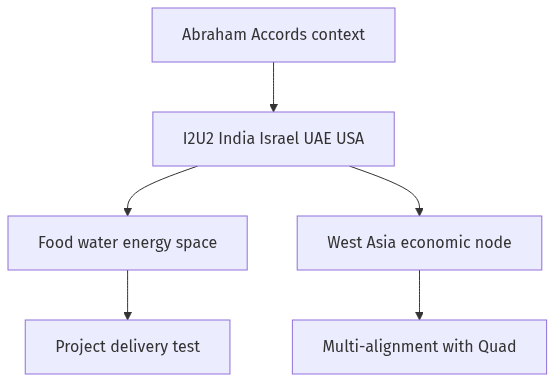
- It is best read as one node in a lattice (Quad, I2U2, BRICS, SCO, ISA): the transformation is India’s ability to inhabit several lattices at once, and I2U2 adds the missing West Asia economic node.
Flow diagram
Conclusion
I2U2 can upgrade India from a Gulf energy customer to a co-investor in West Asian food, water and clean-energy public goods, sitting with Israel, the UAE and the US. That is a real shift in diplomatic geography. It becomes a transformation of global position only if projects land and if multi-alignment is preserved.
Quick related
Students also ask
-
How have the recommendations of the 14th Finance Commission of India enabled the states to improve their fiscal position?
Next question on this syllabus topic (2021 · Q3). View answer →
-
Is I2U2 the same as the Quad?
No. Different members and a different geography. I2U2 is West Asia economic cooperation; the Quad is Indo-Pacific strategic coordination.
-
Did the UPSC paper mean a different body by 12U2?
No. In context it is I2U2 — India, Israel, UAE, USA — with a numeral-for-letter slip in the printed stem.
Same topic · past papers
UPSC has asked this before
These previous-year questions sit on the same topic. Open one to practise the earlier ask.
More from this topic
Q15 · UPSC Mains 2026 · GS II · 15 marks · Solution
To what extent do pressure groups, social movements and corporate lobbies deepen pluralistic democracy in India by representing excluded interests? Analyse whether the growing convergence of corporate wealth and political power poses a threat to the autonomy of formal democratic institutions.
Governance and Policy
• Civil society groups and grassroots movements go beyond periodic elections to channel marginalized voices into policy spaces. • Social movements on tribal rights and environmental protection have successfully forced the state to create protective legislation. • Representation is uneven due to a severe resource asymmetry between well-funded corporate lobbies and unorganized labor. • Some interest groups act as elite fronts, subverting public welfare for narrow sectarian gains. • Corporate financial dominance through opaque funding creates severe risks of policy capture and quid pro quo corruption. • Strengthening transparency in political funding and reinforcing regulatory autonomy are essential to safeguard democratic governance.
Q12 · UPSC Mains 2026 · GS II · 15 marks · Solution
What is meant by judicial legislation? In this context, discuss the verdicts of the apex court allowing "passive euthanasia" and a "living will".
Governance and Policy
• Judicial legislation occurs when courts create binding rules to fill policy voids caused by legislative inaction. • The Supreme Court legalized passive euthanasia under Article 21, recognizing the right to die with dignity. • The *Common Cause* (2018) judgment permitted the withdrawal of life support for terminally ill patients with strict medical safeguards. • A living will is an advanced medical directive allowing individuals to pre-state their treatment preferences before incapacitation. • The Supreme Court simplified living will procedures in 2023, replacing complex magistrate approvals with basic notary attestation. • While court guidelines provide immediate relief, they underscore the need for a comprehensive parliamentary statute on end-of-life care. • Codifying these judicial norms through formal legislation ensures democratic legitimacy, ethical debate, and administrative clarity.
Q6 · UPSC Mains 2026 · GS II · 10 marks · Solution
Does India's tribal development policy reflect the aspirations for a socially grounded and equity-based governance? Justify your answer.
Governance and Policy
• India's tribal policy balances constitutional protections with socio-economic development goals. • Fifth and Sixth Schedules provide decentralized autonomy and safeguard tribal lands. • Articles 275(1) and 335 ensure grants-in-aid and reservations to bridge gaps. • PESA (1996) and FRA (2006) mark shifts toward rights-based and culturally sensitive governance. • Gram sabhas are empowered over minor forest produce and community forest rights. • Implementation is hindered by forced displacement without consent and bureaucratic inertia. • True equity requires empowering local institutions rather than relying solely on welfare delivery.