
Revision summary
About nine-tenths of India’s trade volume and most oil still move by sea, so a chokepoint shock is an economic shock. Coastal creeks, 26/11-style gaps, illegal fishing, piracy and a denser Chinese naval presence are the main challenges. Red Sea attacks in 2023–24 showed how quickly freight and insurance can jump. SAGAR, IPOI, IMAC fusion, coastal police and partner patrols are the reply. Ports and shipbuilding make security a growth story, not only a patrol story.
Model answer
Copper italics in this answer — like this — are the key facts. Each one is unpacked in the Facts & figures rail.
Introduction
India’s economy breathes through the sea, with around 90% of trade by volume moving through maritime routes. Energy imports, containerised trade, offshore assets and submarine cables depend on secure Sea Lines of Communication (SLOCs). Hence, maritime security is not merely a defence concern but a prerequisite for economic security, energy security and strategic autonomy.
Body
Maritime and coastal security challenges
Non-traditional and transnational threats
- Maritime terrorism: Gaps in coastal surveillance can be exploited for infiltration and attacks.
- Example: The 26/11 Mumbai attacks exposed vulnerabilities in India's coastal security architecture.
- Piracy and disruption of SLOCs: Piracy and instability around strategic routes can increase freight, insurance and transit costs, affecting India's trade.
- Example: The Red Sea crisis forced ships to take longer routes around the Cape of Good Hope.
- Smuggling and narco-terrorism: Maritime routes are used for trafficking narcotics, arms, gold and other contraband, creating a nexus between organised crime and terrorism.
Structural and institutional challenges
- Fragmented security architecture: The Navy, Coast Guard, Marine Police, Customs and port authorities have overlapping responsibilities, creating coordination and intelligence-sharing challenges.
- Weakness of minor ports and small vessels: Smaller ports and fishing vessels are harder to monitor, creating vulnerabilities for infiltration and smuggling.
- Example: Tracking thousands of small fishing boats, particularly those below 20 metres, remains a major maritime-domain-awareness challenge.
- Limited Maritime Domain Awareness (MDA): Gaps in radar, vessel tracking, satellite surveillance and real-time intelligence fusion can leave parts of the maritime domain insufficiently monitored.
Socio-economic and environmental challenges
- Fishermen and boundary disputes: Fishermen may inadvertently cross maritime boundaries, leading to arrests and diplomatic tensions.
- Example: Recurring disputes involving Indian fishermen in the Palk Strait create both livelihood and maritime-security concerns.
- Illegal, Unreported and Unregulated (IUU) fishing: Unsustainable fishing by domestic or foreign fleets threatens marine resources and can undermine coastal livelihoods.
- Climate-related vulnerabilities: Cyclones, coastal flooding and sea-level rise can damage ports, coastal infrastructure and security installations, complicating continuous maritime surveillance.
Way forward
- Strengthen the three-tier security architecture: Marine Police should focus on near-shore waters, the Indian Coast Guard on coastal and EEZ security, and the Indian Navy on external defence and SLOC protection.
- Expand Maritime Domain Awareness: Complete the coastal radar chain and integrate radar, AIS, satellite imagery, UAVs and vessel-tracking systems for continuous surveillance.
- Strengthen intelligence fusion: Expand the role of the Information Fusion Centre–Indian Ocean Region (IFC-IOR) for real-time information sharing and coordinated responses.
- Improve inter-agency coordination: Establish seamless coordination among the Navy, Coast Guard, Marine Police, Customs, ports and intelligence agencies, supported by regular joint exercises.
- Secure the legal framework: Effectively implement the Maritime Anti-Piracy Act, 2022 and strengthen enforcement against piracy, smuggling and other maritime crimes.
- Empower coastal communities: Treat fishermen as the “eyes and ears” of coastal security through community-interaction programmes and local surveillance networks.
- Deepen regional cooperation: Strengthen maritime cooperation through SAGAR, IORA, BIMSTEC, Quad and coordinated patrols (CORPAT) to secure the wider Indian Ocean region.
- Build resilient maritime infrastructure: Develop secure ports, coastal jetties, shipbuilding capacity and modern surveillance infrastructure so that maritime security also supports India's blue economy.
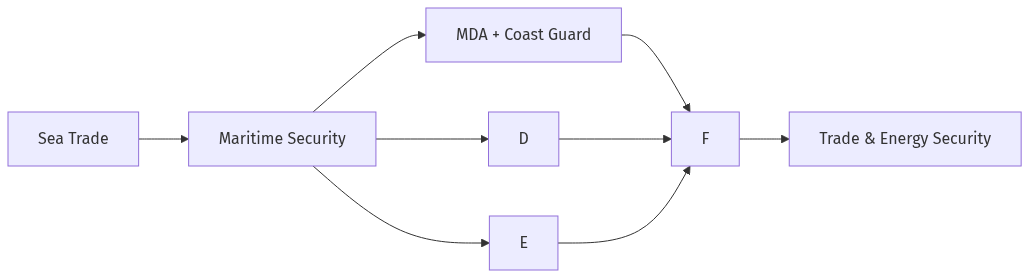
Flow diagram
Conclusion
India’s sea trade, energy imports and strategic interests depend on secure maritime routes. Addressing terrorism, piracy, smuggling, IUU fishing and institutional gaps requires an integrated approach based on Maritime Domain Awareness, inter-agency coordination, empowered coastal communities and regional cooperation. A secure Indian Ocean is therefore essential for India’s economic resilience and strategic autonomy.
Quick related
Students also ask
-
What are the causes of persistent high food inflation in India? Comment on the effectiveness of the monetary policy of RBI to control this type of inflation.
Next question on this syllabus topic (2024 · Q2). View answer →
-
Is the navy enough for coastal security?
No. Creeks need police, Customs and the Coast Guard. The navy is the outer ring.
-
Why should India care about the Red Sea?
Because Indian cargo and energy contracts still price that route; a detour around Africa is a tax on every importer.
Same topic · past papers
UPSC has asked this before
These previous-year questions sit on the same topic. Open one to practise the earlier ask.
More from this topic
Q17 · UPSC Mains 2026 · GS III · 15 marks · Solution
What are the challenges to solid waste management in India? Discuss the governmental policy framework on solid waste management. Discuss the success/failure cases of Delhi and Indore cities highlighting the salient features of their solid waste management initiatives.
Indian Economy
• Rapid urbanization has made solid waste management a critical environmental and public health crisis in India. • Key challenges include lack of source segregation, inadequate processing infrastructure, reliance on unprotected informal workers, and financially weak urban local bodies. • The policy framework relies on the SWM Rules 2016, Swachh Bharat Mission (Urban), and Plastic Waste Management Rules 2016. • Indore succeeded through 100% source segregation, zero dump-site remediation, and strict enforcement with digital monitoring. • Delhi failed due to overloaded legacy landfills (Ghazipur, Bhalswa), lack of decentralization, and fragmented municipal governance. • A successful transition requires moving to a circular economy focused on source segregation, decentralized processing, and polluter accountability.
Q16 · UPSC Mains 2026 · GS III · 15 marks · Solution
What is Agentic Artificial Intelligence (AI)? Explain its working. Describe its applications with suitable examples. Discuss the advantages, risks and challenges associated with agentic AI systems.
Indian Economy
Agentic Artificial Intelligence represents an advanced paradigm where AI systems operate with autonomy, setting goals and executing complex workflows without constant human prompts. Unlike traditional generative AI that merely responds to queries, agentic AI uses perception, planning, memory, and tool-use to achieve multi-step objectives. Its applications span across autonomous software engineering, supply chain optimization, and automated financial trading. While offering massive productivity gains and dynamic problem-solving, these systems pose significant risks including lack of transparency, alignment failures, security vulnerabilities, and ethical dilemmas. Governance frameworks and robust guardrails are essential to harness their potential safely.
Q15 · UPSC Mains 2026 · GS III · 15 marks · Solution
Mention salient features of 'Mission Drishti'. Discuss the imaging techniques used in the satellite launched on 3rd May 2026. Why is it being considered world's first satellite of its kind?
Indian Economy
Mission Drishti represents a major leap in India's space-based Earth observation capabilities, launched on 3rd May 2026. The mission employs advanced multi-spectral and hyperspectral imaging techniques to capture high-resolution data across various atmospheric and terrestrial layers. It is hailed as a global first due to its unique integration of real-time onboard edge computing with quantum encryption for secure data transmission. The satellite significantly enhances resource management, disaster response, and strategic surveillance. It aligns with India's policy of leveraging space technology for sustainable development and national security.