
Revision summary
Indian food inflation is kept high by weather, perishable supply chains, rising protein demand, cereal floors and edible-oil imports. It is mainly a supply and market problem, not a pure money problem. RBI repo hikes cool demand and second-round wage effects; they do not grow a crop. Flexible inflation targeting still must watch food because food sits inside CPI. First-best tools are buffers, storage, timed imports and better mandis; monetary policy is the anchor.
Model answer
Copper italics in this answer — like this — are the key facts. Each one is unpacked in the Facts & figures rail.
Introduction
India’s poor live on a food-heavy CPI basket. When onion, tomato, pulse or cereal prices stay high, headline inflation hurts them first. That pain has been persistent in several phases of the last two decades, even when industrial prices were quiet. The causes sit mostly on the farm and the mandi. The RBI’s interest rate is a blunt tool against a failed monsoon.
Body
Why food inflation stays high
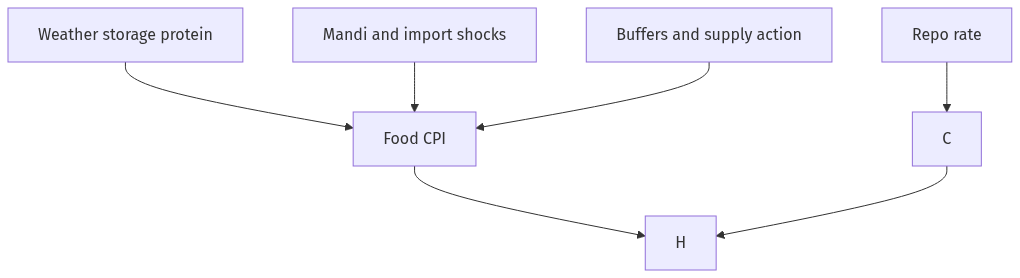
Food inflation in India is recurring, not a one-season accident. Weather and climate still swing output of onion, tomato, potato and pulses. Small farms, weak storage and a long mandi chain turn a local shortfall into a national spike. Protein demand (milk, egg, meat, pulses) rises with income faster than supply. MSP and procurement support cereal floors, which can hold rice and wheat up even when global prices ease. Export bans and stocking limits try to cool retail prices and often scare planting the next season. Fuel, freight and wages feed into farm costs. Global edible oil and fertiliser shocks pass through because India imports those. Hoarding and thin futures markets add noise. The result is a high-frequency, supply-heavy inflation, concentrated in a few perishable items that dominate the household’s kitchen.
- Peg: Onion, tomato and pulses have repeatedly led CPI-food spikes even when core inflation was softer.
- Peg: Edible oils show how an import bill becomes kitchen inflation.
What monetary policy can and cannot do
The RBI’s flexible inflation targeting (4 per cent CPI, with a band of two points either side) uses the repo rate to cool demand. That works better on core prices — services, durables, housing — than on a failed kharif pulse crop. A rate hike cannot harvest a tomato. It can, with a lag, slow the second-round pass-through into wages and expectations, and it can police a credit boom that would otherwise lift all prices. If the RBI chases every food spike with a hike, it hurts growth and jobs without planting a single acre. If it ignores a food spike that lasts, inflation expectations unhinge. The honest comment is therefore limited short-run effectiveness, useful as an anchor. Food inflation needs buffer stocks, storage, import timing, competition in mandis, and climate-resilient horticulture. Monetary policy is the backstop, not the farm ministry.
- Peg: The 2016 monetary-policy framework made CPI the target; food is inside that CPI, which is why the RBI must explain food even when it cannot grow it.
- Peg: Supply action (open-market sale, import, onion buffer) is the first-best tool; the repo is the second-best.
Flow diagram
Conclusion
Persistent food inflation comes from weather, storage, protein demand, import dependence and mandi frictions. RBI policy can hold the second round and the target’s credibility. It cannot replace a working farm-to-kitchen chain.
Quick related
Students also ask
-
Explain the role of millets for ensuring health and nutritional security in India.
Next question on this syllabus topic (2024 · Q4). View answer →
-
Should the RBI ignore food inflation?
Not if it lasts and feeds wages. It should still not pretend a rate hike is a monsoon.
-
Does MSP cause food inflation?
A rising cereal floor can hold rice and wheat up. It is not the main story for onion and tomato spikes.
Same topic · past papers
UPSC has asked this before
These previous-year questions sit on the same topic. Open one to practise the earlier ask.
More from this topic
Q17 · UPSC Mains 2026 · GS III · 15 marks · Solution
What are the challenges to solid waste management in India? Discuss the governmental policy framework on solid waste management. Discuss the success/failure cases of Delhi and Indore cities highlighting the salient features of their solid waste management initiatives.
Indian Economy
• Rapid urbanization has made solid waste management a critical environmental and public health crisis in India. • Key challenges include lack of source segregation, inadequate processing infrastructure, reliance on unprotected informal workers, and financially weak urban local bodies. • The policy framework relies on the SWM Rules 2016, Swachh Bharat Mission (Urban), and Plastic Waste Management Rules 2016. • Indore succeeded through 100% source segregation, zero dump-site remediation, and strict enforcement with digital monitoring. • Delhi failed due to overloaded legacy landfills (Ghazipur, Bhalswa), lack of decentralization, and fragmented municipal governance. • A successful transition requires moving to a circular economy focused on source segregation, decentralized processing, and polluter accountability.
Q16 · UPSC Mains 2026 · GS III · 15 marks · Solution
What is Agentic Artificial Intelligence (AI)? Explain its working. Describe its applications with suitable examples. Discuss the advantages, risks and challenges associated with agentic AI systems.
Indian Economy
Agentic Artificial Intelligence represents an advanced paradigm where AI systems operate with autonomy, setting goals and executing complex workflows without constant human prompts. Unlike traditional generative AI that merely responds to queries, agentic AI uses perception, planning, memory, and tool-use to achieve multi-step objectives. Its applications span across autonomous software engineering, supply chain optimization, and automated financial trading. While offering massive productivity gains and dynamic problem-solving, these systems pose significant risks including lack of transparency, alignment failures, security vulnerabilities, and ethical dilemmas. Governance frameworks and robust guardrails are essential to harness their potential safely.
Q15 · UPSC Mains 2026 · GS III · 15 marks · Solution
Mention salient features of 'Mission Drishti'. Discuss the imaging techniques used in the satellite launched on 3rd May 2026. Why is it being considered world's first satellite of its kind?
Indian Economy
Mission Drishti represents a major leap in India's space-based Earth observation capabilities, launched on 3rd May 2026. The mission employs advanced multi-spectral and hyperspectral imaging techniques to capture high-resolution data across various atmospheric and terrestrial layers. It is hailed as a global first due to its unique integration of real-time onboard edge computing with quantum encryption for secure data transmission. The satellite significantly enhances resource management, disaster response, and strategic surveillance. It aligns with India's policy of leveraging space technology for sustainable development and national security.