
Revision summary
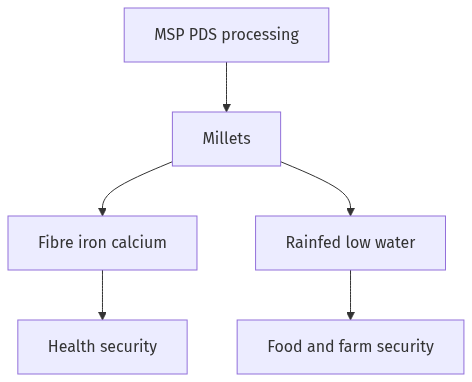
Millets such as jowar, bajra and ragi offer fibre, iron and calcium that polished rice does not. They help dietary defence against diabetes and micronutrient gaps. They grow on rainfed land with less water than paddy, which supports food security in a hotter climate. India used 2023, the International Year of Millets, to brand Shree Anna and to widen recipes and some procurement. Without mills, MSP and a place in meals, farmers will not keep the crop and the health case stays on a poster.
Model answer
Copper italics in this answer — like this — are the key facts. Each one is unpacked in the Facts & figures rail.
Introduction
Millets — jowar, bajra, ragi, kodo, kutki, kangni and their kin — were India’s older grain before irrigation made rice and wheat the public plate. They are back because health, drought and a protein-iron gap have all become national problems. The Union now brands them Shree Anna. The case is not nostalgia. It is nutrition per drop of water.
Body
Health security
Health security here means fewer diet-linked diseases and a plate that a poor household can actually cook. Millets are typically high in fibre, which steadies blood sugar and helps against the diabetes and obesity wave in urban India. Finger millet (ragi) is valued for calcium. Pearl millet and several small millets carry iron and B-vitamins that polished rice does not. They are usually gluten-free, which matters for a minority of patients and, more broadly, for a less refined staple. A millet roti does not replace a hospital. It lowers the dietary load that public health is otherwise left to treat.
- Peg: Ragi’s calcium and bajra’s iron are the usual clinical reasons dieticians put millets back on the plate.
- Peg: Fibre and a lower glycaemic load are the link to India’s rising non-communicable disease burden.
Nutritional and food-system security
Nutritional security is calories plus micronutrients, stable through climate shocks. Millets grow on thin soils and thin rain. They need less irrigation than paddy, which is why they fit rainfed Deccan, Rajasthan and tribal central India. A crop that survives a failed monsoon is a household food reserve. India is among the world’s largest millet producers; 2023 as the International Year of Millets was used to push recipes, MSP procurement of some nutri-cereals, and inclusion in parts of ICDS and midday meals. Farmers need a buyer and a mill, or they will return to paddy. Health and nutrition security therefore meet procurement, processing and a PDS that does not only speak in rice and wheat.
- Peg: Nutri-cereals under MSP and some State PDS millet kits are the policy bridge from farm to plate.
- Peg: Climate resilience is the national-security face of the same grain: less water, more dietary diversity.
Flow diagram
Conclusion
Millets thicken the plate with fibre, iron and calcium, and they grow where paddy would drink the aquifer. They serve health and nutrition security only if procurement and processing make them as easy as rice.
Quick related
Students also ask
-
What is the present world scenario of intellectual property rights with respect to life materials? Although, India is second in the world to file patents, still only a few have been commercialized. Explain the reasons behind this less commercialization.
Next question on this syllabus topic (2024 · Q5). View answer →
-
Can millets replace rice in the PDS?
They can share the basket. A sudden swap without mills and taste acceptance would fail both farmer and consumer.
-
Are millets only a poor person’s grain?
That stigma is the problem. Nutritionally they are a better staple for the diabetic city as well as the rainfed village.
Same topic · past papers
UPSC has asked this before
These previous-year questions sit on the same topic. Open one to practise the earlier ask.
More from this topic
Q17 · UPSC Mains 2026 · GS III · 15 marks · Solution
What are the challenges to solid waste management in India? Discuss the governmental policy framework on solid waste management. Discuss the success/failure cases of Delhi and Indore cities highlighting the salient features of their solid waste management initiatives.
Indian Economy
• Rapid urbanization has made solid waste management a critical environmental and public health crisis in India. • Key challenges include lack of source segregation, inadequate processing infrastructure, reliance on unprotected informal workers, and financially weak urban local bodies. • The policy framework relies on the SWM Rules 2016, Swachh Bharat Mission (Urban), and Plastic Waste Management Rules 2016. • Indore succeeded through 100% source segregation, zero dump-site remediation, and strict enforcement with digital monitoring. • Delhi failed due to overloaded legacy landfills (Ghazipur, Bhalswa), lack of decentralization, and fragmented municipal governance. • A successful transition requires moving to a circular economy focused on source segregation, decentralized processing, and polluter accountability.
Q16 · UPSC Mains 2026 · GS III · 15 marks · Solution
What is Agentic Artificial Intelligence (AI)? Explain its working. Describe its applications with suitable examples. Discuss the advantages, risks and challenges associated with agentic AI systems.
Indian Economy
Agentic Artificial Intelligence represents an advanced paradigm where AI systems operate with autonomy, setting goals and executing complex workflows without constant human prompts. Unlike traditional generative AI that merely responds to queries, agentic AI uses perception, planning, memory, and tool-use to achieve multi-step objectives. Its applications span across autonomous software engineering, supply chain optimization, and automated financial trading. While offering massive productivity gains and dynamic problem-solving, these systems pose significant risks including lack of transparency, alignment failures, security vulnerabilities, and ethical dilemmas. Governance frameworks and robust guardrails are essential to harness their potential safely.
Q15 · UPSC Mains 2026 · GS III · 15 marks · Solution
Mention salient features of 'Mission Drishti'. Discuss the imaging techniques used in the satellite launched on 3rd May 2026. Why is it being considered world's first satellite of its kind?
Indian Economy
Mission Drishti represents a major leap in India's space-based Earth observation capabilities, launched on 3rd May 2026. The mission employs advanced multi-spectral and hyperspectral imaging techniques to capture high-resolution data across various atmospheric and terrestrial layers. It is hailed as a global first due to its unique integration of real-time onboard edge computing with quantum encryption for secure data transmission. The satellite significantly enhances resource management, disaster response, and strategic surveillance. It aligns with India's policy of leveraging space technology for sustainable development and national security.