
Revision summary
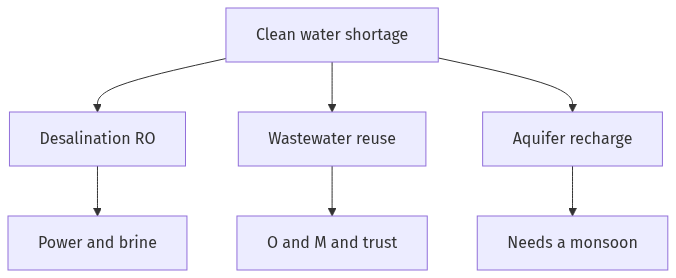
The world is short of clean, climate-safe freshwater as rivers and aquifers fail. Desalination (mainly RO) can supply coasts regardless of rainfall, but it is energy-intensive and produces brine. Wastewater reuse cuts pollution and freshwater demand if sewers actually reach working plants; public trust is a barrier to potable reuse. Managed aquifer recharge and rainwater harvesting store the monsoon cheaply; they cannot invent rain or replace a city network alone. A workable mix uses desalination where there is sea, reuse in cities, and recharge on the land.
Model answer
Copper italics in this answer — like this — are the key facts. Each one is unpacked in the Facts & figures rail.
Introduction
Rivers, lakes and aquifers are finite, polluted and politically spoken for. Climate change makes the reliable litre rarer. The world is therefore hunting alternative freshwater: water that is not a clean glacier stream. Three technologies already in the field are seawater desalination, wastewater reuse, and managed aquifer recharge (with rainwater harvesting as its city face). Each makes water. Each has a bill and a brine.
Body
Desalination
Reverse osmosis (and, less often now, thermal distillation) turns seawater or brackish water into potable or industrial water. Merit: it is climate-independent at the coast and can supply a city that has no river left. Gulf States and some Indian coastal plants already run on this logic. Demerit: it is energy-heavy, which means a carbon bill unless the plant is paired with clean power. Brine returned to the sea can harm local ecology. Capital cost is high, so the water is often too dear for irrigation. Inland, there is no sea to draw.
- Peg: Coastal RO is the mature large-scale option; brine and power are the constraints that never leave.
- Peg: Brackish-groundwater RO is a cousin used in some Indian inland belts, with a concentrate-disposal problem.
Wastewater reuse
Treating municipal and industrial sewage to a standard that allows industrial cooling, horticulture, or, with higher treatment, potable reuse creates a new river inside the city. Merit: it cuts both pollution and fresh abstraction; the source is located where the demand is. Singapore’s reused-water story is the global teaching case; several Indian cities now mandate treated reuse for industry and parks. Demerit: public distrust of toilet-to-tap, patchy sewage collection, and plants that are built and not run. If the sewer never reaches the plant, the technology is a shed.
- Peg: Tertiary treatment plus dual plumbing or industrial offtake is the practical Indian path; direct potable reuse is rarer.
- Peg: A dry STP is not a technology failure; it is an O&M failure.
Managed aquifer recharge and rainwater harvesting
Check dams, percolation tanks, recharge wells and rooftop harvesting put monsoon water back into soil and aquifers instead of into a flood drain. Merit: low energy, local, and suited to India’s monsoon pulse. It treats the aquifer as a reservoir. Demerit: it cannot create water in a drought year if there is no rain to harvest. Poorly designed recharge can push polluted runoff into drinking aquifers. It does not, by itself, supply a megacity’s 24×7 pressurised network.
- Peg: Atal Bhujal-style community recharge and city rainwater by-laws are the Indian policy face of this technology.
- Peg: Three technologies, three scales: coast, city sewage, and monsoon land. None is a solitary saviour.
Flow diagram
Conclusion
Clean alternative freshwater will come from desalination, reuse and recharge, not from a new planet. Desalination is sure and costly. Reuse is circular if sewers work. Recharge is cheap and rain-bound. A serious programme mixes all three and pays the power, brine and maintenance bills in public.
Quick related
Students also ask
-
what are asteroids? How real is the threat of them causing extinction of life? What strategies have been developed to prevent such a catastrophe?
Next question on this syllabus topic (2024 · Q16). View answer →
-
Can desalination irrigate Indian farms at scale?
Not at typical farm water prices. It is a coastal-city and industry tool unless energy becomes far cheaper.
-
Is bottled atmospheric water a third technology?
Atmospheric water generators exist but remain small and power-hungry. Reuse and recharge are the scalable pair beside desalination.
Same topic · past papers
UPSC has asked this before
These previous-year questions sit on the same topic. Open one to practise the earlier ask.
More from this topic
Q17 · UPSC Mains 2026 · GS III · 15 marks · Solution
What are the challenges to solid waste management in India? Discuss the governmental policy framework on solid waste management. Discuss the success/failure cases of Delhi and Indore cities highlighting the salient features of their solid waste management initiatives.
Indian Economy
• Rapid urbanization has made solid waste management a critical environmental and public health crisis in India. • Key challenges include lack of source segregation, inadequate processing infrastructure, reliance on unprotected informal workers, and financially weak urban local bodies. • The policy framework relies on the SWM Rules 2016, Swachh Bharat Mission (Urban), and Plastic Waste Management Rules 2016. • Indore succeeded through 100% source segregation, zero dump-site remediation, and strict enforcement with digital monitoring. • Delhi failed due to overloaded legacy landfills (Ghazipur, Bhalswa), lack of decentralization, and fragmented municipal governance. • A successful transition requires moving to a circular economy focused on source segregation, decentralized processing, and polluter accountability.
Q16 · UPSC Mains 2026 · GS III · 15 marks · Solution
What is Agentic Artificial Intelligence (AI)? Explain its working. Describe its applications with suitable examples. Discuss the advantages, risks and challenges associated with agentic AI systems.
Indian Economy
Agentic Artificial Intelligence represents an advanced paradigm where AI systems operate with autonomy, setting goals and executing complex workflows without constant human prompts. Unlike traditional generative AI that merely responds to queries, agentic AI uses perception, planning, memory, and tool-use to achieve multi-step objectives. Its applications span across autonomous software engineering, supply chain optimization, and automated financial trading. While offering massive productivity gains and dynamic problem-solving, these systems pose significant risks including lack of transparency, alignment failures, security vulnerabilities, and ethical dilemmas. Governance frameworks and robust guardrails are essential to harness their potential safely.
Q15 · UPSC Mains 2026 · GS III · 15 marks · Solution
Mention salient features of 'Mission Drishti'. Discuss the imaging techniques used in the satellite launched on 3rd May 2026. Why is it being considered world's first satellite of its kind?
Indian Economy
Mission Drishti represents a major leap in India's space-based Earth observation capabilities, launched on 3rd May 2026. The mission employs advanced multi-spectral and hyperspectral imaging techniques to capture high-resolution data across various atmospheric and terrestrial layers. It is hailed as a global first due to its unique integration of real-time onboard edge computing with quantum encryption for secure data transmission. The satellite significantly enhances resource management, disaster response, and strategic surveillance. It aligns with India's policy of leveraging space technology for sustainable development and national security.