
Revision summary
Articles 148–151 and the 1971 Act make the CAG the Union and State auditor. Legality is sanction, appropriation and rule-compliance. Propriety and performance audit test waste and value for money even when vouchers are valid. PAC is the parliamentary partner; major performance reports mixed both functions. Indian audit is overwhelmingly after the spend, so the report must sting. The CAG cannot convict or make policy; it can still refuse to be a mere notary.
Model answer
Copper italics in this answer — like this — are the key facts. Each one is unpacked in the Facts & figures rail.
Introduction
Article 148 makes the Comptroller and Auditor General an independent constitutional officer. The job is not only to ask whether a rupee was spent under a valid appropriation. It is also to ask whether that rupee was spent as a trustee would spend it. That second question is propriety. The quote is the doctrine of Indian audit, not a slogan.
Body
Legality
Without a legality check, public finance is a rumour.
- Peg: The Comptroller and Auditor-General’s (Duties, Powers and Conditions of Service) Act, 1971, and the audit codes, require audit of receipts and expenditure of the Union and the States.
- Peg: Article 151 carries the report to the President or Governor, then to the House.
- Peg: Legality means sanction, a budget head, a competent authority, and compliance with General Financial Rules and the scheme’s own rules.
Propriety and performance
Propriety asks whether expenditure was excessive, wasteful or avoidable even if each voucher was stamped.
- Peg: Buying a machine that is not needed, or designing a stadium that cannot be used after the games, can be legal and still improper.
- Peg: Performance audit — economy, efficiency, effectiveness — grew from that habit; reports on spectrum allocation, the Commonwealth Games, coal-block allotments and leaking food grain mixed illegal process with waste.
- Peg: The Public Accounts Committee is the parliamentary half of the same function: the CAG supplies the facts; the PAC questions the ministry.
- Peg: India’s CAG is largely post-audit, unlike the old British Comptroller who could stop issue; that makes the sting of the report, after the event, even more important.
Limits
A CAG who only stamps legality is a notary; a CAG who pretends to be a court is something else.
- Peg: The CAG does not convict; an audit figure is not a trial.
- Peg: Policy choice — whether to run a welfare scheme — is the executive’s; how the scheme leaked is the CAG’s.
- Peg: Over-reach into policy is a real risk; under-reach into polite legality is the older vice.
Flow diagram
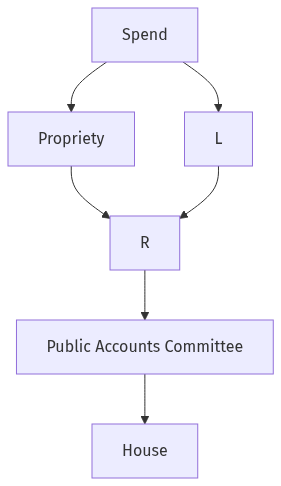
Conclusion
Legality keeps spend inside the Appropriation Act. Propriety asks whether the spend was worthy of public trust. Both belong to the CAG; neither turns the office into a court.
Quick related
Students also ask
-
Analyse the role of local bodies in providing good governance at local level and bring out the pros and cons of merging the rural local bodies with the urban local bodies.
Next question on this syllabus topic (2024 · Q5). View answer →
-
Can the CAG stop a payment in advance?
In the main Union system, no. Indian audit is overwhelmingly after the spend, unlike the old British Exchequer control.
-
Is a CAG figure automatically a scam?
No. It is an audit finding. Loss, criminality and policy are for the PAC, investigators and the House.
Same topic · past papers
UPSC has asked this before
These previous-year questions sit on the same topic. Open one to practise the earlier ask.
-
2017 · Q6 · GS II · 10 marks
'To ensure effective implementation of policies addressing water, sanitation and hygiene needs, the identification of beneficiary segments is to be synchronized with the anticipated outcomes' Examine the statement in the context of the WASH scheme. -
2017 · Q7 · GS II · 10 marks
Does the Rights of Persons with Disabilities Act, 2016 ensure effective mechanism for empowerment and inclusion of the intended beneficiaries in the society? Discuss. -
2015 · Q16 · GS II · 12 marks
For achieving the desired objectives,it is necessary to ensure that the regulatory institutions remain independent and autonomous. Discuss in the light of experiences in recent past.
More from this topic
Q15 · UPSC Mains 2026 · GS II · 15 marks · Solution
To what extent do pressure groups, social movements and corporate lobbies deepen pluralistic democracy in India by representing excluded interests? Analyse whether the growing convergence of corporate wealth and political power poses a threat to the autonomy of formal democratic institutions.
Governance and Policy
• Civil society groups and grassroots movements go beyond periodic elections to channel marginalized voices into policy spaces. • Social movements on tribal rights and environmental protection have successfully forced the state to create protective legislation. • Representation is uneven due to a severe resource asymmetry between well-funded corporate lobbies and unorganized labor. • Some interest groups act as elite fronts, subverting public welfare for narrow sectarian gains. • Corporate financial dominance through opaque funding creates severe risks of policy capture and quid pro quo corruption. • Strengthening transparency in political funding and reinforcing regulatory autonomy are essential to safeguard democratic governance.
Q12 · UPSC Mains 2026 · GS II · 15 marks · Solution
What is meant by judicial legislation? In this context, discuss the verdicts of the apex court allowing "passive euthanasia" and a "living will".
Governance and Policy
• Judicial legislation occurs when courts create binding rules to fill policy voids caused by legislative inaction. • The Supreme Court legalized passive euthanasia under Article 21, recognizing the right to die with dignity. • The *Common Cause* (2018) judgment permitted the withdrawal of life support for terminally ill patients with strict medical safeguards. • A living will is an advanced medical directive allowing individuals to pre-state their treatment preferences before incapacitation. • The Supreme Court simplified living will procedures in 2023, replacing complex magistrate approvals with basic notary attestation. • While court guidelines provide immediate relief, they underscore the need for a comprehensive parliamentary statute on end-of-life care. • Codifying these judicial norms through formal legislation ensures democratic legitimacy, ethical debate, and administrative clarity.
Q6 · UPSC Mains 2026 · GS II · 10 marks · Solution
Does India's tribal development policy reflect the aspirations for a socially grounded and equity-based governance? Justify your answer.
Governance and Policy
• India's tribal policy balances constitutional protections with socio-economic development goals. • Fifth and Sixth Schedules provide decentralized autonomy and safeguard tribal lands. • Articles 275(1) and 335 ensure grants-in-aid and reservations to bridge gaps. • PESA (1996) and FRA (2006) mark shifts toward rights-based and culturally sensitive governance. • Gram sabhas are empowered over minor forest produce and community forest rights. • Implementation is hindered by forced displacement without consent and bureaucratic inertia. • True equity requires empowering local institutions rather than relying solely on welfare delivery.