
Revision summary
Recent Centre–State shifts: GST compensation end, cess and surcharge, centrally sponsored schemes, NITI replacing plan bargaining, Governor delays on Bills, Article 370, simultaneous-election talk. The Supreme Court in the Punjab Bills case limited pocket-veto use of Articles 200–201. GST Council remains a federal bargain; CBI consent and cadre rules remain sore. Sarkaria and Punchhi asked for an Inter-State Council, consultation, less cess, and a non-partisan Governor. Trust is procedural — calendars, terms of reference, devolution — not a communiqué. Cooperative federalism is minutes and transfers, not a chapter in a brochure.
Model answer
Copper italics in this answer — like this — are the key facts. Each one is unpacked in the Facts & figures rail.
Introduction
Indian federalism is bargaining inside a strong Union. In recent years the Union has used money, Governors and framework laws more loudly. States have used the Supreme Court and the GST Council. The question asks what changed, and how to put trust back into a structure that still has Article 3 and a single Constitution.
Body
Fiscal recasting
The purse has moved faster than the Seventh Schedule.
- Peg: The five-year GST compensation guarantee ran out; the Union leaned more on cess and surcharge, which do not enter the divisible pool.
- Peg: Centrally sponsored schemes still steer a large part of State budgets; the Fifteenth Finance Commission used 2011 population figures and attached conditions to some grants.
- Peg: NITI Aayog replaced the Planning Commission: more a think-tank, less a table at which States bargained plan money.
Institutional and administrative recasting
Offices that were meant to be a buckle have been read in State capitals as a bit.
- Peg: Governors in several Opposition-ruled States sat on Bills; in State of Punjab the Court read Articles 200 and 201 as not allowing a pocket veto.
- Peg: Union terms of reference to Finance Commissions, and the Kovind simultaneous-election design, are read as an attempt to set the political calendar from Delhi.
- Peg: The 2019 reorganisation of Jammu and Kashmir under Article 370 was a federal shock of another kind.
- Peg: Several States withdrew general consent for the CBI; All India Services cadre rules and “one nation” platforms for ration and identity leave States as implementers more than designers.
Measures for trust
Sarkaria and Punchhi already wrote the homework.
- Peg: A living Inter-State Council (Article 263), consultation before Bills that eat into the State list, and Governors who are not extra Chief Ministers.
- Peg: A Finance Commission whose terms of reference are not a Union manifesto; less cess, more devolution; centrally sponsored schemes that States can opt and adapt.
- Peg: Opposition-ruled States in the room — GST rate talks, service postings, disaster money — without treating dissent as anti-national.
- Peg: Codify Bill timelines as a convention so the Union does not need a mandamus to forward a file; let the GST Council’s dispute mechanism work before the Court is the first stop.
Flow diagram
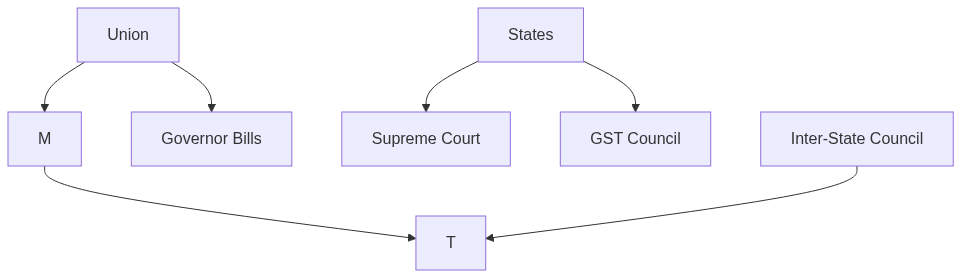
Conclusion
Recent years tightened Union money and gubernatorial delay, then the Court pushed back on Bills. Trust will return through Inter-State Council habit, cleaner devolution and Governors who sign — not through another slogan about cooperation.
Quick related
Students also ask
-
Explain the significance of the 101st Constitutional Amendment Act. To what extent does it reflect the accommodative spirit of federalism?
Next question on this syllabus topic (2023 · Q15). View answer →
-
Did GST end federalism?
It pooled tax power. It did not end States. Cess outside the pool is the sharper recent grievance.
-
Is a strong Union un-federal?
The text is a strong Union. Federalism here is fair process inside that text, which Sarkaria already assumed.
Same topic · past papers
UPSC has asked this before
These previous-year questions sit on the same topic. Open one to practise the earlier ask.
-
2025 · Q14 · GS II · 15 marks
Examine the evolving pattern of Centre-State financial relations in the context of planned development in India. How far have the recent reforms impacted the fiscal federalism in India? -
2026 · Q13 · GS II · 15 marks
How far has the Indian federal framework been successful in accommodating regional and cultural diversities? Highlight the role of asymmetric federalism and suggest measures to make dispute resolution mechanisms more effective. -
2026 · Q5 · GS II · 10 marks
Do constitutional bodies like the National Commission for Scheduled Castes (NCSC) and the National Commission for Scheduled Tribes (NCST) possess adequate enforcement powers to secure substantive social equality? Suggest measures to enhance their institutional effectiveness. -
2025 · Q18 · GS II · 15 marks
The National Commission for Protection of Child Rights has to address the challenges faced by children in the digital era. Examine the existing policies and suggest measures the Commission can initiate to tackle the issue. -
2024 · Q16 · GS II · 15 marks
The Citizens' charter has been a landmark initiative in ensuring citizen-centric administration. But it is yet to reach its full potential. Identify the factors hindering the realisation of its promise and suggest measures to overcome them.
More from this topic
Q13 · UPSC Mains 2026 · GS II · 15 marks · Solution
How far has the Indian federal framework been successful in accommodating regional and cultural diversities? Highlight the role of asymmetric federalism and suggest measures to make dispute resolution mechanisms more effective.
Federal Structure and Devolution
1. India’s quasi-federal design balances national unity with regional autonomy using linguistic reorganization and constitutional safeguards. 2. Successes include the 1956 linguistic states, tribal protections under Fifth/Sixth Schedules, and grassroots democracy via the 73rd and 74th Amendments. 3. Key limitations involve centralizing tendencies, frequent Governor-State friction, vertical fiscal imbalances, and uniform policy impositions. 4. Asymmetric federalism (like Article 371) accommodates unique historical and cultural needs, successfully neutralizing separatist tendencies. 5. Financial dependence on the Centre restricts true policy autonomy for States, requiring structural corrections. 6. Inter-governmental friction can be managed by empowering the Inter-State Council as a permanent arbitration body under Article 263. 7. Establishing specialized Supreme Court federal benches and expanding GST-style cooperative platforms will resolve water and boundary disputes. 8. Strengthening cooperative federalism requires treating States as equal partners in nation-building rather than administrative subordinates.
Q11 · UPSC Mains 2026 · GS II · 15 marks · Solution
Discuss the position of the Governor in the federal polity of India. What is the nature of his power while giving assent to a bill passed by the State Legislature? Is he bound by the aid and advice of his Council of Ministers in all his functions?
Federal Structure and Devolution
• The Governor serves as the nominal state executive and a constitutional bridge between the Centre and the state under Article 153. • Under Article 200, options for state bills include granting assent, withholding it, returning it for reconsideration, or reserving it for the President. • The Governor can withhold assent or reserve bills mainly if a measure violates the Constitution or encroaches on Union legislative domains. • By default, the Governor is bound by the aid and advice of the Council of Ministers, as established by the Shamsher Singh judgment. • Explicit discretionary powers under Article 163 include appointing a Chief Minister during a hung assembly or recommending President's Rule. • The Supreme Court (Nabam Rebia case) ruled that these discretionary powers are not arbitrary and must follow strict constitutional norms. • The office aims to uphold cooperative federalism, requiring restraint and constitutional morality to respect the democratic mandate of states.
Q14 · UPSC Mains 2025 · GS II · 15 marks · Solution
Examine the evolving pattern of Centre-State financial relations in the context of planned development in India. How far have the recent reforms impacted the fiscal federalism in India?
Federal Structure and Devolution
Finance Commissions devolve taxes; Planning Commission Plan grants created a discretionary second channel. Sarkaria and Punchhi criticised that discretion. NITI Aayog ended Plan cheques; 14th FC raised the States’ share of the divisible pool to 42%. GST shares tax but limits State rate power; cesses outside the pool and CSS keep Union leverage. Article 293 borrowing conditions remain a hard federal tool.