
Revision summary
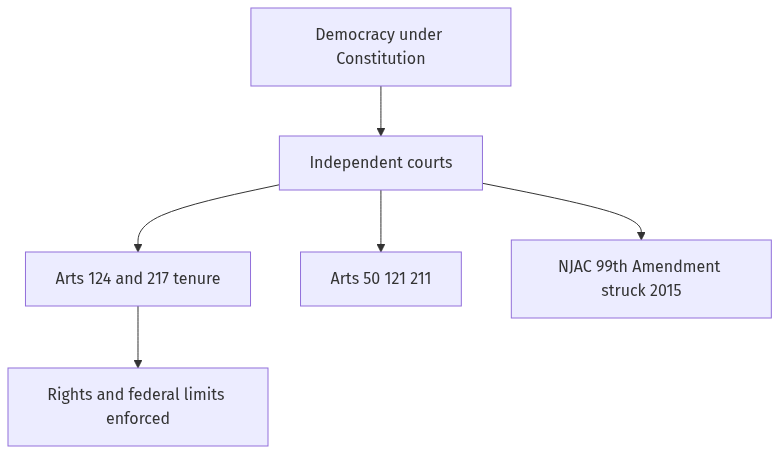
Democracy needs courts that can enforce the Constitution against the elected majority. Articles 50, 121, 124, 211 and 217, charged salaries, and a hard removal process are the main guarantees. The 99th Amendment and the NJAC were struck down in 2015 as a threat to independence of appointments. Independence is a prerequisite; opacity of the collegium is a separate reform problem, not a reason to remove the guarantee.
Model answer
Copper italics in this answer — like this — are the key facts. Each one is unpacked in the Facts & figures rail.
Introduction
Democracy needs an independent court that can hold the elected executive and the legislature to the Constitution. The Constitution of India therefore writes judicial independence into appointment, tenure, salaries, and speech in Parliament, rather than leaving it to political goodwill.
Body
Why independence is a democratic prerequisite
- A democracy is not only majority rule; it is majority rule under a written Constitution that the courts can enforce.
- Without independence, fundamental rights, federal limits, and free elections become paper promises that the government of the day can ignore.
- Articles 32 and 226 give the Supreme Court and the High Courts the power to issue writs; that power is useless if judges fear removal, pay cuts, or political posting.
Constitutional guarantees
- Article 50 directs the State to separate the judiciary from the executive in the public services of the State.
- Article 124 and Article 217 fix the manner of appointment and the tenure of Supreme Court and High Court judges, with removal only by a parliamentary address on proved misbehaviour or incapacity, which is the impeachment process used in the Justice V. Ramaswami episode and later motions.
- Salaries, privileges, and the administrative expenses of the Supreme Court are charged on the Consolidated Fund, so the annual vote cannot starve the Court.
- Article 121 and Article 211 bar discussion in Parliament and in a State legislature on the conduct of a sitting judge except on a motion for removal.
- The collegium practice after the Second and Third Judges Cases, and the striking down of the National Judicial Appointments Commission in Supreme Court Advocates-on-Record Association v. Union of India (2015) after the Constitution (Ninety-ninth Amendment) Act, 2014, show that the Court treats appointment insulation as part of independence.
Limits that the comment must record
- Independence is not a licence for a closed collegium; the 2015 judgment itself asked for a Memorandum of Procedure and for more transparency.
- Delay in filling vacancies, in-house opacity, and the unused but heavy impeachment process are real stresses, yet they do not cancel the need for a constitutional guarantee.
- A comment that is fair therefore treats Articles 50, 121, 124, 211 and 217, and the failed NJAC amendment, as the democratic minimum, not as a finished reform of the appointments system.
Flow diagram
Conclusion
Constitutionally guaranteed independence is a prerequisite of democracy because only a secure court can enforce rights and limits against the majority of the day. India’s text supplies that security through appointment, tenure, money, and speech bars, even while appointments remain an unfinished public debate.
Quick related
Students also ask
-
" The Construction of India is a living instrument with capabilities of enormous dynamism. It is a constitution made for a progressive society". Illustrate with special reference to the expanding horizons of the right to life and personal liberty.
Next question on this syllabus topic (2023 · Q11). View answer →
-
Does impeachment make judges independent?
The high threshold of a parliamentary address on proved misbehaviour protects tenure. It is a safeguard, not a day-to-day disciplinary tool.
-
Did the 2015 case say the collegium cannot be improved?
No. The Court struck down the NJAC as designed, and still asked for a better, more transparent Memorandum of Procedure.
Same topic · past papers
UPSC has asked this before
These previous-year questions sit on the same topic. Open one to practise the earlier ask.
-
2025 · Q11 · GS II · 15 marks
"Constitutional morality is the fulcrum which acts as an essential check upon the high functionaries and citizens alike…"In view of the above observation of the Supreme Court, explain the concept of constitutional morality and its application to ensure balance between judicial independence and judicial accountability in India. -
2018 · Q7 · GS II · 10 marks
Appropriate local community level healthcare intervention is a prerequisite to achieve 'Health for All' in India. Explain.
More from this topic
Q17 · UPSC Mains 2026 · GS II · 15 marks · Solution
Can the constitutional mandate of rights-based welfare be effectively realised in the context of non-integrated governance and minimal public investment? Examine.
Indian Constitution
• India’s constitutional welfare mandate struggles due to fragmented administrative silos and low public spending. • Siloed departmental functioning causes duplication, exclusion errors, and severe frontline administrative overload. • Suboptimal public investment in health and education forces heavy reliance on profit-driven private providers. • Fiscal federalism pressures leave financially weaker states unable to co-finance central welfare mandates properly. • Overcoming these bottlenecks requires a whole-of-government approach using unified digital platforms for convergence. • Progressively increasing public expenditure on core social infrastructure is vital to meet statutory entitlements. • Strengthening social audits and grievance redressal ensures legal rights translate into tangible grassroots outcomes.
Q1 · UPSC Mains 2026 · GS II · 10 marks · Solution
Right to privacy relating to self-identity is very dear to every human being and well protected under Article 21 of the Constitution. In this context, examine the effect of the amendment in 2026 to the Transgender Persons (Protection of Rights) Act, 2019.
Indian Constitution
• Article 21 protects personal autonomy, bodily integrity, and the right to self-identity as core components of human dignity. • The Supreme Court's *K.S. Puttaswamy* judgment firmly established privacy as a fundamental right encompassing personal choices. • The 2026 amendment to the Transgender Persons Act, 2019, aims to align statutory laws with evolving constitutional jurisprudence. • Key reforms include decentralising identity certification to eliminate bureaucratic delays and arbitrary state interference. • The amendment also strengthens punitive and remedial mechanisms against social and institutional discrimination. • Persistent challenges remain, notably bridging the gap between legal recognition and deep-rooted societal stigma. • True realization of these rights requires continuous administrative sensitization and inclusive access to education, healthcare, and jobs.
Q3 · UPSC Mains 2025 · GS II · 10 marks · Solution
Compare and contrast the President's power to pardon in India and in the USA. Are there any limits to it in both the countries? What are 'preemptive pardons'?
Indian Constitution
Article 72 (and 161) are exercised on aid and advice; Maru Ram, Kehar Singh, Epuru Sudhakar and Shatrughan Chauhan frame Indian limits and delay. The US Article II pardon is personal, federal-only, and barred in impeachment. Judicial review is stronger in India; political cost is the main US brake. A preemptive pardon forgives before conviction, as in Ford–Nixon. India has no working doctrine of preemptive pardon for the untried.