
Revision summary
Indian secularism: Preamble, Articles 25–28, Bommai as basic structure, personal laws, State reform of Hindu law and regulation of temples. US secularism: First Amendment establishment and free exercise, Everson’s wall, Engel on school prayer, no millet personal law. India practises principled distance and social reform; the United States practises non-establishment. Minority educational rights under Article 30 have no US analogue of that form. Neither wall nor distance is a finished peace with majoritarian politics. Comparison is of method, not of piety.
Model answer
Copper italics in this answer — like this — are the key facts. Each one is unpacked in the Facts & figures rail.
Introduction
Both India and the United States refuse a theocratic State. They do not refuse it in the same grammar. India is a secular republic that regulates and reforms religion while funding aspects of it. The United States is a disestablished republic that spends more energy on a wall between church and Congress. Comparison is about those methods, not about which people are more devout.
Body
India as a secular state
Indian secularism is equal respect plus the power to reform.
- Peg: The Preamble, after the 42nd Amendment, describes India as secular; in S.R. Bommai v. Union of India the Court treated secularism as a basic feature even apart from that word.
- Peg: Articles 25 to 28 guarantee profession, practice and propagation, subject to public order, morality and health, and let the State throw open Hindu public institutions and regulate the economic side of religion.
- Peg: Articles 15, 16 and 17 outlaw caste in the public sphere; family law is still largely personal law unless a Uniform Civil Code is made under Article 44.
- Peg: Parliament reformed Hindu law in 1955–56; States run many temple boards; Article 30 protects minority educational institutions — principled distance, not absence.
United States principles
The First Amendment is two clauses, not a social-reform kit.
- Peg: Congress shall make no law respecting an establishment of religion, and it shall not prohibit the free exercise of religion.
- Peg: Everson v. Board of Education used Jefferson’s wall of separation and applied the establishment clause to the States.
- Peg: Engel v. Vitale held that a school-sponsored prayer, even a nondenominational one, breached that wall.
- Peg: There is no millet-style personal-law system by church; a federal statute recoding a majority religion’s family law, on the pattern of the Hindu Code, would be unthinkable.
Compare
Neither model is a copy; both struggle with majority sentiment.
- Peg: Indian secularism is often called positive: minority rights, the State as social reformer of majority personal law, religious equality as a project.
- Peg: US secularism is negative in the older sense: no established church, free exercise, no Uniform Civil Code to unify communities.
- Peg: India’s live tension is reform versus equal respect; America’s is public religion versus the wall.
- Peg: Transplanting Jefferson’s wall would freeze Article 17 and Hindu-code reform; transplanting Indian temple control to the US would explode the establishment clause.
Flow diagram
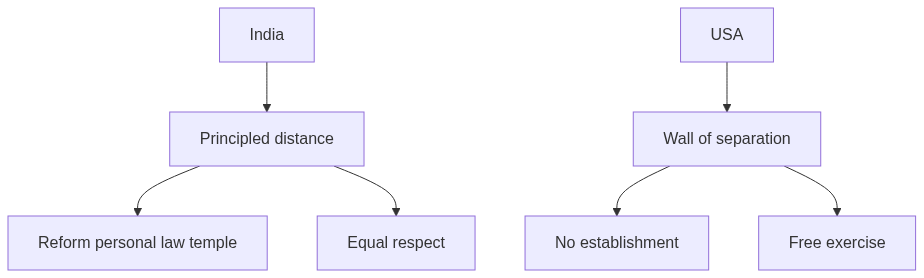
Conclusion
India’s secularism is equal respect plus the power to reform. The US model is disestablishment plus free exercise. Both check theocracy; only India writes the State in as a social reformer of religion.
Quick related
Students also ask
-
"Constitutionally guaranteed judicial independence is a prerequisite of democracy". Comment.
Next question on this syllabus topic (2023 · Q1). View answer →
-
Is India pseudo-secular because it regulates temples?
The text allows regulation of economic and social aspects and opening of Hindu institutions. That is a design, not a slip. Whether boards are fair is a separate governance question.
-
Does the United States have no religious politics?
It has plenty. It channels them through elections and free exercise, not through a Hindu Code Bill.
Same topic · past papers
UPSC has asked this before
These previous-year questions sit on the same topic. Open one to practise the earlier ask.
More from this topic
Q17 · UPSC Mains 2026 · GS II · 15 marks · Solution
Can the constitutional mandate of rights-based welfare be effectively realised in the context of non-integrated governance and minimal public investment? Examine.
Indian Constitution
• India’s constitutional welfare mandate struggles due to fragmented administrative silos and low public spending. • Siloed departmental functioning causes duplication, exclusion errors, and severe frontline administrative overload. • Suboptimal public investment in health and education forces heavy reliance on profit-driven private providers. • Fiscal federalism pressures leave financially weaker states unable to co-finance central welfare mandates properly. • Overcoming these bottlenecks requires a whole-of-government approach using unified digital platforms for convergence. • Progressively increasing public expenditure on core social infrastructure is vital to meet statutory entitlements. • Strengthening social audits and grievance redressal ensures legal rights translate into tangible grassroots outcomes.
Q1 · UPSC Mains 2026 · GS II · 10 marks · Solution
Right to privacy relating to self-identity is very dear to every human being and well protected under Article 21 of the Constitution. In this context, examine the effect of the amendment in 2026 to the Transgender Persons (Protection of Rights) Act, 2019.
Indian Constitution
• Article 21 protects personal autonomy, bodily integrity, and the right to self-identity as core components of human dignity. • The Supreme Court's *K.S. Puttaswamy* judgment firmly established privacy as a fundamental right encompassing personal choices. • The 2026 amendment to the Transgender Persons Act, 2019, aims to align statutory laws with evolving constitutional jurisprudence. • Key reforms include decentralising identity certification to eliminate bureaucratic delays and arbitrary state interference. • The amendment also strengthens punitive and remedial mechanisms against social and institutional discrimination. • Persistent challenges remain, notably bridging the gap between legal recognition and deep-rooted societal stigma. • True realization of these rights requires continuous administrative sensitization and inclusive access to education, healthcare, and jobs.
Q3 · UPSC Mains 2025 · GS II · 10 marks · Solution
Compare and contrast the President's power to pardon in India and in the USA. Are there any limits to it in both the countries? What are 'preemptive pardons'?
Indian Constitution
Article 72 (and 161) are exercised on aid and advice; Maru Ram, Kehar Singh, Epuru Sudhakar and Shatrughan Chauhan frame Indian limits and delay. The US Article II pardon is personal, federal-only, and barred in impeachment. Judicial review is stronger in India; political cost is the main US brake. A preemptive pardon forgives before conviction, as in Ford–Nixon. India has no working doctrine of preemptive pardon for the untried.