
Revision summary
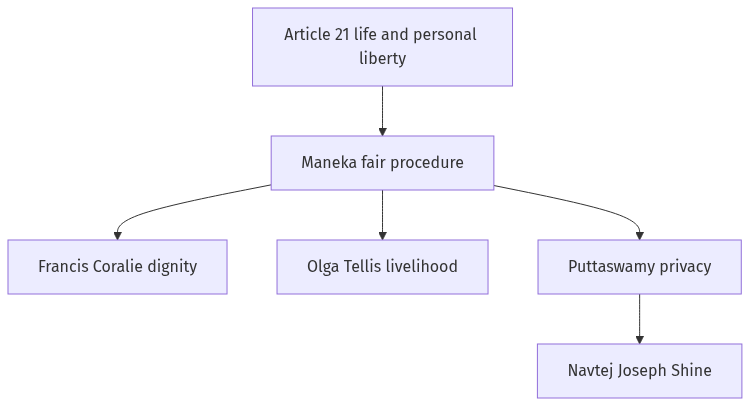
A living Constitution applies open-textured rights to new social facts. Maneka Gandhi (1978) required fair, just and reasonable procedure and linked Articles 14, 19 and 21. Francis Coralie Mullin (1981) read life as dignity, not animal existence. Olga Tellis (1985) read livelihood into Article 21. Puttaswamy (2017), Navtej Singh Johar (2018) and Joseph Shine (2018) extended privacy, sexual orientation and women’s equal dignity. Dynamism is interpretation plus amendment, bounded by basic structure and proportionality.
Model answer
Copper italics in this answer — like this — are the key facts. Each one is unpacked in the Facts & figures rail.
Introduction
A living Constitution is one whose text is applied to new facts by interpretation, amendment, and judicial review, not frozen in 1950 meanings. Article 21 is the clearest illustration: “life” and “personal liberty” have been read as dignity, livelihood, privacy, and bodily autonomy for a society that the framers called progressive.
Body
Living instrument
- The amending power in Article 368, the Directive Principles, and the open texture of Part III let later generations answer problems the Constituent Assembly did not name.
- Kesavananda Bharati preserved a basic structure so that dynamism does not mean destruction of the Constitution’s identity.
- Progressive society in this setting means a society that can enlarge liberty and equality without waiting for a new Constituent Assembly on every social question.
From A.K. Gopalan to Maneka Gandhi
- Early reading in A.K. Gopalan v. State of Madras treated Article 21 as a separate silo: any procedure established by law was enough.
- Maneka Gandhi v. Union of India (1978) held that the procedure must be fair, just and reasonable, and that Articles 14, 19 and 21 are to be read together.
- That single shift turned Article 21 into a due-process style guarantee and opened the later catalogue of unenumerated rights.
Dignity, livelihood and the material conditions of life
- Francis Coralie Mullin v. Administrator, Union Territory of Delhi (1981) held that life is not mere animal existence; it includes the right to live with human dignity, and in a prisoner’s case that meant humane conditions and legal aid.
- Olga Tellis v. Bombay Municipal Corporation (1985) held that the right to livelihood is part of the right to life, because no person can live without the means of living; eviction of pavement dwellers had to follow a fair procedure.
- Later public-health and environment benches (for example Parmanand Katara on emergency care and the Oleum gas / precautionary line) extended life to health and a habitable environment, which a 1950 draft had not listed as separate Articles.
Privacy, intimacy and equal liberty
- Justice K.S. Puttaswamy v. Union of India (2017) held that the right to privacy is protected under Article 21 (and the liberty cluster of Part III), including informational privacy and decisional autonomy.
- Navtej Singh Johar v. Union of India (2018) read down Section 377 of the Indian Penal Code for consensual adult same-sex relations, grounding sexual orientation in dignity, equality and privacy under Articles 14, 15, 19 and 21.
- Joseph Shine v. Union of India (2018) struck down Section 497 of the Indian Penal Code on adultery as a denial of women’s dignity and equality, again using the Article 21 cluster with Articles 14 and 15.
- Common Cause v. Union of India (2018) recognised a living will and passive euthanasia as part of dignity in dying, which is dynamism at the end of life, not only at its start.
What the illustration does not mean
- Expansion is not unlimited: Puttaswamy itself accepted reasonable restrictions and a proportionality test.
- Parliament can still amend, and the Court can still err; a living Constitution is a method, not a claim that every desired policy is already inside Article 21.
Flow diagram
Conclusion
Article 21 shows the Constitution as a living instrument because Maneka Gandhi opened fairness, Francis Coralie and Olga Tellis opened dignity and livelihood, and Puttaswamy, Navtej Singh Johar and Joseph Shine opened privacy and equal intimacy. That expansion is how a 1950 text governs a progressive society without rewriting the whole charter for each generation.
Quick related
Students also ask
-
Explain the constitutional perspectives of Gender Justice with the help of relevant Constitutional Provisions and case laws.
Next question on this syllabus topic (2023 · Q12). View answer →
-
Did the Constituent Assembly list privacy in Article 21?
No. Puttaswamy derived privacy from life and personal liberty and from the structure of Part III. That derivation is the living-instrument method.
-
Is every social claim now an Article 21 right?
No. The Court uses dignity and proportionality. Policy on budgets and welfare still needs statute and resources, not only a slogan of life.
Same topic · past papers
UPSC has asked this before
These previous-year questions sit on the same topic. Open one to practise the earlier ask.
More from this topic
Q17 · UPSC Mains 2026 · GS II · 15 marks · Solution
Can the constitutional mandate of rights-based welfare be effectively realised in the context of non-integrated governance and minimal public investment? Examine.
Indian Constitution
• India’s constitutional welfare mandate struggles due to fragmented administrative silos and low public spending. • Siloed departmental functioning causes duplication, exclusion errors, and severe frontline administrative overload. • Suboptimal public investment in health and education forces heavy reliance on profit-driven private providers. • Fiscal federalism pressures leave financially weaker states unable to co-finance central welfare mandates properly. • Overcoming these bottlenecks requires a whole-of-government approach using unified digital platforms for convergence. • Progressively increasing public expenditure on core social infrastructure is vital to meet statutory entitlements. • Strengthening social audits and grievance redressal ensures legal rights translate into tangible grassroots outcomes.
Q1 · UPSC Mains 2026 · GS II · 10 marks · Solution
Right to privacy relating to self-identity is very dear to every human being and well protected under Article 21 of the Constitution. In this context, examine the effect of the amendment in 2026 to the Transgender Persons (Protection of Rights) Act, 2019.
Indian Constitution
• Article 21 protects personal autonomy, bodily integrity, and the right to self-identity as core components of human dignity. • The Supreme Court's *K.S. Puttaswamy* judgment firmly established privacy as a fundamental right encompassing personal choices. • The 2026 amendment to the Transgender Persons Act, 2019, aims to align statutory laws with evolving constitutional jurisprudence. • Key reforms include decentralising identity certification to eliminate bureaucratic delays and arbitrary state interference. • The amendment also strengthens punitive and remedial mechanisms against social and institutional discrimination. • Persistent challenges remain, notably bridging the gap between legal recognition and deep-rooted societal stigma. • True realization of these rights requires continuous administrative sensitization and inclusive access to education, healthcare, and jobs.
Q3 · UPSC Mains 2025 · GS II · 10 marks · Solution
Compare and contrast the President's power to pardon in India and in the USA. Are there any limits to it in both the countries? What are 'preemptive pardons'?
Indian Constitution
Article 72 (and 161) are exercised on aid and advice; Maru Ram, Kehar Singh, Epuru Sudhakar and Shatrughan Chauhan frame Indian limits and delay. The US Article II pardon is personal, federal-only, and barred in impeachment. Judicial review is stronger in India; political cost is the main US brake. A preemptive pardon forgives before conviction, as in Ford–Nixon. India has no working doctrine of preemptive pardon for the untried.