
Revision summary
Article 72 (and 161) are exercised on aid and advice; Maru Ram, Kehar Singh, Epuru Sudhakar and Shatrughan Chauhan frame Indian limits and delay. The US Article II pardon is personal, federal-only, and barred in impeachment. Judicial review is stronger in India; political cost is the main US brake. A preemptive pardon forgives before conviction, as in Ford–Nixon. India has no working doctrine of preemptive pardon for the untried.
Model answer
Copper italics in this answer — like this — are the key facts. Each one is unpacked in the Facts & figures rail.
Introduction
Pardon is the executive power to forgive, reduce or modify criminal punishment. In India, it is exercised under Article 72 on ministerial advice, while in the USA, Article II gives the President a largely personal power over federal offences. Thus, both systems recognise clemency but differ significantly in scope, control and judicial review.
Body
India: Presidential Pardon
- Constitutional basis: Article 72 empowers the President to grant pardon, reprieve, respite, remission and commutation.
- Scope: Covers Union offences, court-martial cases and all death sentences.
- Aid and advice: The President acts on the aid and advice of the Council of Ministers.
- Case: Maru Ram v. Union of India (1980) established that the power is not a personal discretion of the President.
- Judicial review: Clemency is subject to limited judicial review for mala fide, arbitrariness, irrelevant considerations or non-application of mind.
- Case: Epuru Sudhakar v. Govt. of A.P. (2006) established these limits.
- Death penalty: The President can consider mercy even after judicial confirmation of the sentence.
- Case: Kehar Singh v. Union of India (1988) recognised the President's power to examine the mercy petition even after conviction by the Supreme Court.
USA: Presidential Pardon
- Constitutional basis: Article II, Section 2 empowers the President to grant reprieves and pardons for offences against the United States.
- Federal limitation: The President can pardon only federal offences, not offences under State law.
- Personal power: Unlike India, the President exercises the power personally, without being constitutionally bound by Cabinet advice.
- Impeachment limitation: The pardon power does not extend to cases of impeachment.
- Judicial review: The power is considerably broader and courts generally give the President substantial discretion.
- Case: Ex parte Garland (1866) recognised the broad nature of the federal pardon power.
India vs USA: Key Contrast
| Basis | India 🇮🇳 | USA 🇺🇸 | Key Difference |
|---|---|---|---|
| Constitutional basis | Article 72 | Article II, Section 2 | Both derive the power directly from the Constitution |
| Who exercises it? | President acts on the aid and advice of the Council of Ministers | President exercises the power independently | India is parliamentary; USA is presidential |
| Scope | Union-law offences, court-martial cases and all death sentences | Federal offences only | US President cannot pardon State offences |
| Forms of clemency | Pardon, commutation, remission, respite and reprieve | Pardon, commutation, reprieve etc. | Indian Constitution expressly specifies five forms |
| Death penalty | President can pardon, commute, remit, respite or reprieve death sentences | President can pardon/commute federal death sentences | Both have clemency over federal/national death sentences |
| Before conviction | Preemptive pardons are not recognised | Preemptive pardons are permitted | Major difference |
| Judicial review | Limited judicial review is available against arbitrary, mala fide or irrelevant exercise | Presidential pardon is generally subject to very limited judicial scrutiny | Indian power is more amenable to constitutional review |
| Impeachment | No equivalent constitutional restriction | President cannot pardon cases of impeachment | Explicit limitation exists in the US |
| State offences | President's power extends to certain State-law situations involving death sentences; Governor has Article 161 power | President cannot pardon State offences; State Governors exercise clemency | Federal structure operates differently |
| Preemptive pardon | Not recognised under Article 72 | Permitted for offences already committed, even before prosecution/conviction | Gerald Ford's pardon of Richard Nixon is the classic US example |
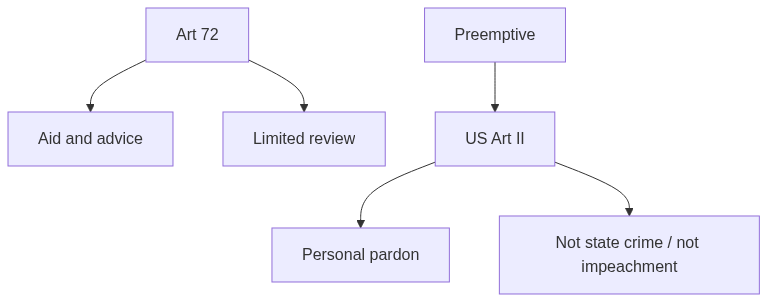
- India: Aid and advice + limited judicial review
- USA: Personal presidential discretion + stronger constitutional autonomy
- India: Covers court-martial + Union offences + all death sentences
- USA: Covers only federal offences
- India: No pardon for an offence before conviction is an established constitutional practice.
- USA: Pre-conviction pardons are constitutionally possible.
Limits on Pardoning Power
- India:
- Constitutional limit: President acts on ministerial advice.
- Judicial limit: Courts can intervene for mala fide, arbitrariness, irrelevant considerations and undue delay.
- Federal limit: Article 72 operates within the Union's constitutional jurisdiction.
- USA:
- Federal limit: Cannot pardon State offences.
- Impeachment bar: Cannot pardon the consequences of impeachment.
- Temporal limit: A pardon cannot validly be used as a licence for future crimes.
Preemptive Pardons
- Meaning: A pardon granted before conviction, and potentially before formal charges, for offences already committed.
- USA: Constitutionally recognised.
- Example: President Gerald Ford's 1974 pardon of Richard Nixon covered federal offences Nixon may have committed during his presidency, despite Nixon not having been convicted.
- India: No established practice of Nixon-style preemptive pardons for untried offences; Indian mercy practice operates principally after conviction and sentencing.
Flow diagram
Conclusion
Both India and the USA recognise executive clemency as a safeguard against excessive or unjust punishment. However, India follows a ministerial and judicially reviewable model, whereas the USA provides a more personal presidential power limited mainly to federal offences and impeachment. Preemptive pardons illustrate this difference most clearly: they are an established American possibility but have no comparable working doctrine in India.
Quick related
Students also ask
-
Examine the need for electoral reforms as suggested by various committees, with particular reference to "one nation - one election" principle.
Next question on this syllabus topic (2024 · Q1). View answer →
-
Can the Indian President pardon before a trial ends?
The working scheme is mercy after sentence. A Nixon-style preemptive pardon is not an established Indian practice and would face equality and review objections.
-
Is a rejected mercy petition appealable as of right?
There is no second statutory appeal. Courts still examine delay, non-application of mind and mala fides in the Shatrughan Chauhan line.
Same topic · past papers
UPSC has asked this before
These previous-year questions sit on the same topic. Open one to practise the earlier ask.
-
2023 · Q4 · GS II · 10 marks
Compare and contrast the British and Indian approaches to Parliamentary sovereignty.
More from this topic
Q17 · UPSC Mains 2026 · GS II · 15 marks · Solution
Can the constitutional mandate of rights-based welfare be effectively realised in the context of non-integrated governance and minimal public investment? Examine.
Indian Constitution
• India’s constitutional welfare mandate struggles due to fragmented administrative silos and low public spending. • Siloed departmental functioning causes duplication, exclusion errors, and severe frontline administrative overload. • Suboptimal public investment in health and education forces heavy reliance on profit-driven private providers. • Fiscal federalism pressures leave financially weaker states unable to co-finance central welfare mandates properly. • Overcoming these bottlenecks requires a whole-of-government approach using unified digital platforms for convergence. • Progressively increasing public expenditure on core social infrastructure is vital to meet statutory entitlements. • Strengthening social audits and grievance redressal ensures legal rights translate into tangible grassroots outcomes.
Q1 · UPSC Mains 2026 · GS II · 10 marks · Solution
Right to privacy relating to self-identity is very dear to every human being and well protected under Article 21 of the Constitution. In this context, examine the effect of the amendment in 2026 to the Transgender Persons (Protection of Rights) Act, 2019.
Indian Constitution
• Article 21 protects personal autonomy, bodily integrity, and the right to self-identity as core components of human dignity. • The Supreme Court's *K.S. Puttaswamy* judgment firmly established privacy as a fundamental right encompassing personal choices. • The 2026 amendment to the Transgender Persons Act, 2019, aims to align statutory laws with evolving constitutional jurisprudence. • Key reforms include decentralising identity certification to eliminate bureaucratic delays and arbitrary state interference. • The amendment also strengthens punitive and remedial mechanisms against social and institutional discrimination. • Persistent challenges remain, notably bridging the gap between legal recognition and deep-rooted societal stigma. • True realization of these rights requires continuous administrative sensitization and inclusive access to education, healthcare, and jobs.
Q15 · UPSC Mains 2024 · GS II · 15 marks · Solution
Discuss India as a secular state and compare with the secular principles of the US constitution.
Indian Constitution
Indian secularism: Preamble, Articles 25–28, Bommai as basic structure, personal laws, State reform of Hindu law and regulation of temples. US secularism: First Amendment establishment and free exercise, Everson’s wall, Engel on school prayer, no millet personal law. India practises principled distance and social reform; the United States practises non-establishment. Minority educational rights under Article 30 have no US analogue of that form. Neither wall nor distance is a finished peace with majoritarian politics. Comparison is of method, not of piety.