
Revision summary
Cooperation runs through the GST Council, All-India Services and disaster law. Competition appears in investment races and NITI-style indices after higher tax devolution. Confrontation shows in CBI consent withdrawals, GST compensation fights and 2020 farm-law resistance. Delhi’s LG–government dispute is executive confrontation inside a Union Territory with a legislature. Indian federalism is all three at once; no single word captures 2014–20 practice.
Model answer
Copper italics in this answer — like this — are the key facts. Each one is unpacked in the Facts & figures rail.
Introduction
Indian federalism is not a frozen list of Articles 245–263. It is a daily mix of cooperation in shared subjects, competition for investment and rankings, and confrontation when party and fiscal interests collide. All three have shaped the Union of States, especially after coalition decline and GST.
Body
Cooperation
- The GST Council under Article 279A is cooperative federalism in a fiscal form: Union and States vote on rates and the compensation bargain.
- All-India Services, the Inter-State Council, and disaster response under the Disaster Management Act, 2005, force joint working even when governments differ.
- NITI Aayog replaced the Planning Commission’s one-way plan with a think-tank and index culture; the cooperative claim is consultation, though States still contest the Union’s agenda-setting.
- COVID-19 in 2020 showed both: States ran hospitals and lockdowns; the Union used the Epidemic Diseases Act, 1897, and the DM Act as national frames.
Competition
- Competitive federalism is visible in ease-of-doing-business tables, health and education indices, and States bidding for electronics and automobile plants.
- The Fourteenth Finance Commission’s 42 per cent devolution widened untied space in which States could compete on their own priorities.
- Competition is healthy when it raises service delivery; it is hollow when rankings hide the Union’s hold on cesses and CSS design.
Confrontation
- GST compensation delay, CBI general-consent withdrawals by Andhra Pradesh and West Bengal, and the 2020 farm-law protests (States such as Punjab legislating against the Union package) are confrontation inside the same Constitution.
- Article 356 is rarer than in the 1970s–80s, but Lieutenant Governor versus elected government in Delhi, and Governor–government friction in several States, keep a confrontational executive federalism alive.
- The Supreme Court’s NCT Delhi line on collaborative federalism is itself a judicial attempt to civilise confrontation.
How far they have shaped the federation
- Cooperation built the working machinery; competition changed the language of reform; confrontation decides the political limits of the Centre. India’s federation is cooperative in design, competitive in growth politics, and confrontational whenever a strong Union meets Opposition States.
Flow diagram
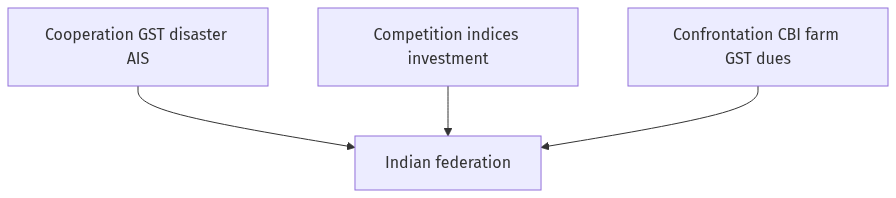
Conclusion
- Cooperation, competition and confrontation have jointly shaped Indian federalism: GST and disaster law as joint work, indices and investment as State rivalry, and consent, compensation and farm laws as conflict. The nature of the federation is therefore a moving bargain, not a single adjective.
Quick related
Students also ask
-
The judicial systems in India and UK seem to be converging as well as diverging in the recent times. Highlight the key points of convergence and divergence between the two nations in terms of their judicial practices.
Next question on this syllabus topic (2020 · Q4). View answer →
-
Is Indian federalism only cooperative?
The Constitution leans Union-strong and invites cooperation. Practice also includes competition and open confrontation.
-
Did GST end Centre–State conflict?
It created a joint table. Compensation and cess disputes show the table does not abolish conflict.
Same topic · past papers
UPSC has asked this before
These previous-year questions sit on the same topic. Open one to practise the earlier ask.
-
2023 · Q7 · GS II · 10 marks
Discuss the role of the Competition Commission of India in containing the abuse of dominant position by the Multi-National Corporations in India. Refer to the recent decisions. -
2026 · Q20 · GS II · 15 marks
"China's Belt and Road Initiative (BRI) has transformed South Asia from a regional space into a theatre of great power competition." Analyse the strategic implications of the BRI for India's security and regional influence in South Asia. -
2024 · Q20 · GS II · 15 marks
Discuss the geopolitical and geostrategic importance of Maldives for India, with a focus on global trade and energy flows. Further, also discuss how this relationship affects India's maritime security and regional stability amidst international competition?
More from this topic
Q15 · UPSC Mains 2026 · GS II · 15 marks · Solution
To what extent do pressure groups, social movements and corporate lobbies deepen pluralistic democracy in India by representing excluded interests? Analyse whether the growing convergence of corporate wealth and political power poses a threat to the autonomy of formal democratic institutions.
Governance and Policy
• Pluralism needs many competing groups so that no single interest dominates policy • Trade unions, farmer bodies and movements such as Chipko and Narmada Bachao Andolan have brought excluded voices into public debate • Movements delivered RTI, Forest Rights and Lokpal laws that give citizens lasting tools • Weak resources and FCRA and protest restrictions limit civil society reach • Corporate influence runs through party funding, lobbying, regulators and media ownership • The electoral bonds scheme was struck down in 2024 for violating citizens' right to information • Institutions such as the Supreme Court, CAG and the Election Commission still check capture, but risks remain • Reforms include funding transparency, a lobbying law, cooling-off periods and protection of dissent
Q12 · UPSC Mains 2026 · GS II · 15 marks · Solution
What is meant by judicial legislation? In this context, discuss the verdicts of the apex court allowing "passive euthanasia" and a "living will".
Governance and Policy
• Judicial legislation is court-made law that fills a legislative vacuum, using Articles 32, 141 and 142 • Vishaka, Prakash Singh and NALSA are common examples, and each invited later legislation • Gian Kaur (1996) denied a right to die but spoke of dying with dignity when death is imminent • Aruna Shanbaug (2011) permitted passive euthanasia with High Court supervision • Common Cause (2018) held the right to die with dignity to be part of Article 21 and recognised living wills • The 2023 modification simplified attestation, board composition and timelines • The tension is between dignity under Article 21 and the legislature's domain on a sensitive moral issue • A national statute on terminal illness would replace interim court guidelines
Q6 · UPSC Mains 2026 · GS II · 10 marks · Solution
Does India's tribal development policy reflect the aspirations for a socially grounded and equity-based governance? Justify your answer.
Governance and Policy
• Constitution: Fifth and Sixth Schedules create tribal self-rule, with Tribes Advisory Councils and autonomous district councils. • Law: PESA 1996 makes the Gram Sabha central and FRA 2006 recognises individual and community forest rights. • Welfare: DAPST, Article 275(1) grants, Eklavya schools, PM JANMAN and the sickle cell mission target the gap. • Weakness: mining, dams and forest clearance rules often override Gram Sabha consent. • Weakness: delayed PESA rules, FRA claim rejections and diverted funds blunt equity. • Security: LWE districts show the cost of land alienation and weak service delivery. • Verdict: strong legal design, uneven delivery, so equity is partial and conditional. • Way ahead: enforce consent, social audit, benefit-sharing through District Mineral Foundations.