
Revision summary
Maldives sits on Indian Ocean channels that carry Gulf energy and East–West trade past India’s south-west. Bilateral trade is small; location, tourism, fuel and people-to-people ties are the substance. India’s security tools: SAGAR, radar, hydrography, Greater Male projects, Colombo Security Conclave. Electoral swings in Male, including India Out politics, show Chinese competition and sovereign sensitivity. Regional stability is a stable Male, not a client. Sea lanes remain; patrons change.
Model answer
Copper italics in this answer — like this — are the key facts. Each one is unpacked in the Facts & figures rail.
Introduction
The Maldives is a thin chain of atolls a few hundred kilometres from India’s west coast, astride the sea lanes that take Gulf oil to East Asia and containers across the eight-degree and one-and-a-half-degree channels. For Delhi it is not a small tourism market. It is a maritime neighbour whose politics can open or close the western Indian Ocean.
Body
Geopolitics, trade and energy flows
The Maldives does not pump the oil. It sits beside the road.
- Peg: Most of India’s seaborne oil and a large share of East Asian energy transit the wider Indian Ocean; a hostile or extra-regional base, dual-use port or survey ship in those waters changes maritime domain awareness.
- Peg: Colombo and Male together are the southern lid on India’s peninsula; Gwadar and Hambantota already taught the cost of extra-regional logistics.
- Peg: Bilateral trade is modest next to India’s majors; tourism, rice, medicines, aviation and workers are the everyday economy.
- Peg: Energy here means the sea lane, plus Indian help with fuel, grid and water — location plus dependence, not a customs union.
Maritime security and the relationship
India’s tools are presence and first response, not a resident overlord.
- Peg: SAGAR, the Colombo Security Conclave, hydrography, coastal radar, patrol craft and Greater Male connectivity were the security relationship.
- Peg: An India-leaning spell and then an “India Out” campaign that asked Indian military personnel to leave and courted Chinese visits show how quickly the file swings.
- Peg: Radicalisation in pockets of the archipelago has been a counter-terror file for Delhi; naval diplomacy must live with sovereignty rhetoric.
International competition and regional stability
Competition with China is real and reversible with each Maldivian vote.
- Peg: Belt and Road credit versus neighbourhood-first presence is the contest the question names.
- Peg: A bankrupt or polarised Male invites external security patrons; overbearing hydrography can lose an election, absence can lose a sea.
- Peg: The relationship affects India by early warning, exclusive-economic-zone watch, and the message to the rest of the Indian Ocean that Delhi is a first responder.
- Peg: Energy sea lanes will still flow; who is alongside them is the variable.
Flow diagram
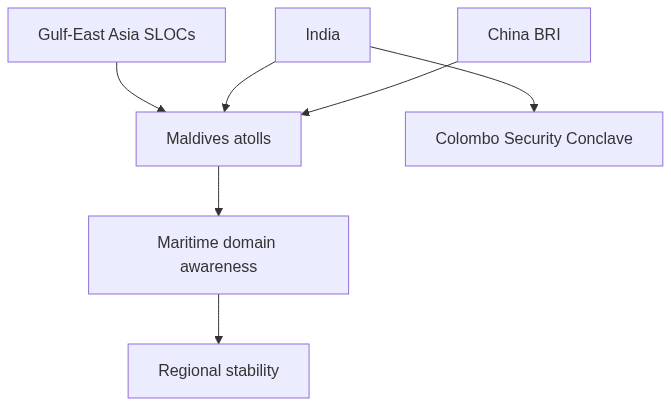
Conclusion
Maldives matters because the oil and container road runs past it, not because bilateral trade is huge. India’s maritime security needs a stable, non-aligned Male. That is a relationship that elections and Chinese credit can still swing.
Quick related
Students also ask
-
"Development and welfare schemes for the vulnerable, by its nature, are discriminatory in approach." Do you agree? Give reasons for your answer.
Next question on this syllabus topic (2023 · Q17). View answer →
-
Would a Chinese base in the Maldives cut off Indian oil?
It would not blockade the ocean by itself. It would degrade warning time and raise the cost of every crisis.
-
Is ‘India Out’ anti-India forever?
It is a Maldivian electoral coalition. Earlier swings went the other way. Policy has to survive both.
Same topic · past papers
UPSC has asked this before
These previous-year questions sit on the same topic. Open one to practise the earlier ask.
More from this topic
Q20 · UPSC Mains 2026 · GS II · 15 marks · Solution
"China's Belt and Road Initiative (BRI) has transformed South Asia from a regional space into a theatre of great power competition." Analyse the strategic implications of the BRI for India's security and regional influence in South Asia.
India and its Neighbourhood
China's Belt and Road Initiative has turned South Asia into a zone of great-power rivalry, not just a regional neighbourhood. Ports like Gwadar and Hambantota raise fears of maritime encirclement and pressure on Indian Ocean trade routes. CPEC through Pakistan-Occupied Kashmir directly challenges India's sovereignty and adds a two-front security worry. Debt-heavy Chinese projects in Sri Lanka and Maldives have pushed smaller neighbours to hedge between Beijing and New Delhi. India must respond with trusted connectivity—Chabahar, BIMSTEC, Neighbourhood First aid, and Indo-Pacific partnerships—so development does not come with strategic dependence on China.
Q19 · UPSC Mains 2025 · GS II · 15 marks · Solution
"Energy security constitutes the dominant kingpin of India's foreign policy, and is linked with India's overarching influence in Middle Eastern countries." How would you integrate energy security with India's foreign policy trajectories in the coming years?
India and its Neighbourhood
Imported crude and LNG make energy the hard core of India’s Middle East policy, alongside diaspora and ports. UAE CEPA, I2U2, IMEC and Chabahar are the diplomatic frame around tankers. Risks: Hormuz, Red Sea, Iran sanctions, OPEC+ and over-reliance on any one discount supplier. Future integration: diversified barrels and routes, Gulf green-hydrogen partnerships, naval sea-lane policy, multi-alignment among regional rivals. The kingpin should shrink as the energy mix greener; it cannot be wished away this decade.
Q9 · UPSC Mains 2025 · GS II · 10 marks · Solution
India-Africa digital partnership is achieving mutual respect, co-development and long-term institutional partnerships. Elaborate.
India and its Neighbourhood
The partnership runs on Pan-African e-Network heritage, ITEC training, IAFS, and newer DPI (payments, identity, document rails). Co-development means African adaptation and AU working groups, not a vendor dump. Respect means data under African law, unlike a back-doored hardware grid. Limits: power and connectivity, summit-without-follow-through, and China’s larger cable footprint. Score the relationship by live hospital and payment links.