
Revision summary
Corrupt practices are listed in Section 123 of the Representation of the People Act, 1951. Election petitions in the High Court and Section 8A disqualification by the President after the Election Commission’s opinion are separate, slow tracks. A member can sit through much of a term while the petition and the 8A file move. Lily Thomas made conviction-based disqualification immediate; the corrupt-practice route was not similarly tightened. Time-bound petitions and a single visible disqualification consequence would match the Act’s purpose.
Model answer
Copper italics in this answer — like this — are the key facts. Each one is unpacked in the Facts & figures rail.
Introduction
Corrupt practice under the Representation of the People Act, 1951, is meant to keep a tainted candidate out of the House. The procedure that converts a High Court finding into actual disqualification is slow, split across forums, and easy to game with appeals. Simplification is therefore a democratic need, not a drafting nicety.
Body
What the law already does
- Section 123 of the RPA lists corrupt practices: bribery, undue influence, appeal to religion or caste, booth capture, and expenditure beyond the prescribed limit.
- An election petition under Sections 80–100 lies in the High Court; if the returned candidate is found guilty, the election can be declared void.
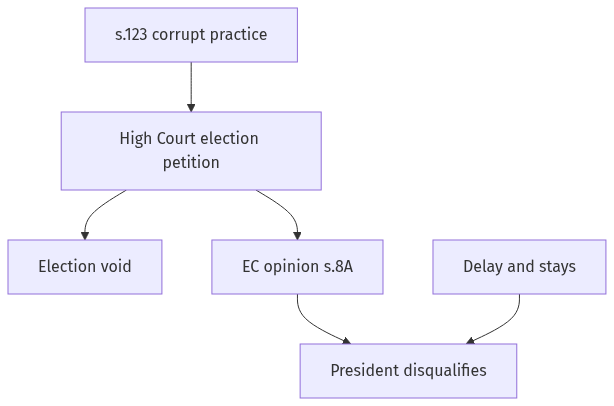
- Separate from the petition, Section 8A lets the President disqualify a person found guilty of a corrupt practice, after the opinion of the Election Commission, for a period that the Commission recommends.
- Section 8, by contrast, is the criminal-conviction route that Lily Thomas v. Union of India (2013) made immediate upon a two-year-plus sentence, which is why the corrupt-practice track looks even slower beside it.
Why the procedure needs simplification
- An election petition can run past a large part of the five-year term; a member who sits while the case crawls enjoys the fruits of the very practice the Act condemns.
- The High Court finding, the President’s order, and the Commission’s opinion are three clocks; stay orders and adjournments multiply them.
- Voters, rival candidates, and the Commission cannot read a single timeline; complexity itself becomes a shield.
- Model Code and expenditure cases often die as technical disputes rather than as clean findings of corrupt practice.
What simplification should look like
- A statutory outer limit for election petitions, with day-to-day hearing as the Supreme Court has already urged in principle.
- One disqualification consequence that follows a confirmed finding of corrupt practice, without a long second round unless a constitutional court stays it for recorded reasons.
- Publish the Section 8A calendar so the President–Commission step is not an invisible file.
- Recommendation: treat corrupt practice as seriously as the Lily Thomas conviction rule, or the RPA’s moral claim remains a paper threat.
Flow diagram
Conclusion
The RPA already names corrupt practices and gives High Courts and the President tools to disqualify. The procedure is too fragmented and slow for those tools to bite inside one Lok Sabha term. Simplification — time-bound petitions and a single, visible disqualification follow-through — is needed if the Act is to protect the purity of elections rather than the sitting member.
Quick related
Students also ask
-
How far do you think cooperation, competition and confrontation have shaped the nature of federation in India? Cite some recent examples to validate your answer.
Next question on this syllabus topic (2020 · Q3). View answer →
-
Is Section 8 the same as corrupt practice?
No. Section 8 is disqualification on criminal conviction. Corrupt practice is an election-law wrong under Section 123, with a distinct 8A follow-through.
-
Would faster disqualification weaken the right to appeal?
Appeal can remain. What simplification attacks is default delay, not a reasoned stay by a constitutional court.
Same topic · past papers
UPSC has asked this before
These previous-year questions sit on the same topic. Open one to practise the earlier ask.
-
2025 · Q1 · GS II · 10 marks
Discuss the 'corrupt practices' for the purpose of the Representation of the People Act, 1951. Analyze whether the increase in the assets of the legislators and/or their associates, disproportionate to their known sources of income, would constitute 'undue influence' and consequently a corrupt practice. -
2019 · Q11 · GS II · 15 marks
On what grounds a people's representative can be disqualified under the Representation of People Act, 1951? Also mention the remedies available to such person against his disqualification.(15).
More from this topic
Q15 · UPSC Mains 2026 · GS II · 15 marks · Solution
To what extent do pressure groups, social movements and corporate lobbies deepen pluralistic democracy in India by representing excluded interests? Analyse whether the growing convergence of corporate wealth and political power poses a threat to the autonomy of formal democratic institutions.
Governance and Policy
• Pluralism needs many competing groups so that no single interest dominates policy • Trade unions, farmer bodies and movements such as Chipko and Narmada Bachao Andolan have brought excluded voices into public debate • Movements delivered RTI, Forest Rights and Lokpal laws that give citizens lasting tools • Weak resources and FCRA and protest restrictions limit civil society reach • Corporate influence runs through party funding, lobbying, regulators and media ownership • The electoral bonds scheme was struck down in 2024 for violating citizens' right to information • Institutions such as the Supreme Court, CAG and the Election Commission still check capture, but risks remain • Reforms include funding transparency, a lobbying law, cooling-off periods and protection of dissent
Q12 · UPSC Mains 2026 · GS II · 15 marks · Solution
What is meant by judicial legislation? In this context, discuss the verdicts of the apex court allowing "passive euthanasia" and a "living will".
Governance and Policy
• Judicial legislation is court-made law that fills a legislative vacuum, using Articles 32, 141 and 142 • Vishaka, Prakash Singh and NALSA are common examples, and each invited later legislation • Gian Kaur (1996) denied a right to die but spoke of dying with dignity when death is imminent • Aruna Shanbaug (2011) permitted passive euthanasia with High Court supervision • Common Cause (2018) held the right to die with dignity to be part of Article 21 and recognised living wills • The 2023 modification simplified attestation, board composition and timelines • The tension is between dignity under Article 21 and the legislature's domain on a sensitive moral issue • A national statute on terminal illness would replace interim court guidelines
Q6 · UPSC Mains 2026 · GS II · 10 marks · Solution
Does India's tribal development policy reflect the aspirations for a socially grounded and equity-based governance? Justify your answer.
Governance and Policy
• Constitution: Fifth and Sixth Schedules create tribal self-rule, with Tribes Advisory Councils and autonomous district councils. • Law: PESA 1996 makes the Gram Sabha central and FRA 2006 recognises individual and community forest rights. • Welfare: DAPST, Article 275(1) grants, Eklavya schools, PM JANMAN and the sickle cell mission target the gap. • Weakness: mining, dams and forest clearance rules often override Gram Sabha consent. • Weakness: delayed PESA rules, FRA claim rejections and diverted funds blunt equity. • Security: LWE districts show the cost of land alienation and weak service delivery. • Verdict: strong legal design, uneven delivery, so equity is partial and conditional. • Way ahead: enforce consent, social audit, benefit-sharing through District Mineral Foundations.