
Revision summary
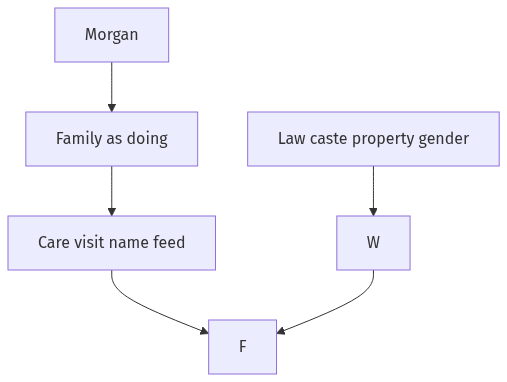
Morgan defined family as practices that display relatedness, not only as a co-resident group. The view fits diverse households, migration, and rites across houses. It makes gendered care visible as work done. It underplays law, property, and caste as closures on who may practise. Use it with Shah, Karve, and feminist political economy, not as a solo theory.
Model answer
Copper italics in this answer — like this — are the key facts. Each one is unpacked in the Facts & figures rail.
Introduction
- David Morgan shifted the sociology of family from a fixed institution to family practices: the activities through which people display relatedness. The view is powerful for contemporary diversity. It is weaker if it dissolves structure, law, and gender into a set of optional habits.
Body
What Morgan argued
- In Family Connections and later Family Practices, Morgan treated family as something people do: phoning, feeding, visiting, naming, and caring.
- Practices are historically situated, have an audience, and can be more or less intense.
- The approach fits later marriage, divorce, step-ties, friendship care, and households that do not match Parsons’s isolated nuclear type.
- It also fits Indian urban life where brothers do not co-reside but still perform joint rites and remittances.
Critical gains
- It avoids treating the census household as the whole of kinship, a warning A. M. Shah also gave in another vocabulary.
- It makes gender visible as who actually does the practice, not as a role label on a chart.
- It allows chosen kin without forcing them into a fake biological box.
Critical limits
- Property, law, and caste endogamy still organise who is allowed to practise family with whom. Practice theory can underplay that closure.
- Talcott Parsons and older functionalism over-fixed the group. Morgan should not over-unfix it into pure process.
- Feminist work on unpaid labour needs the practice idea, but also needs Marx on surplus and patriarchy as structure, not only as a habit.
- Cross-cultural use must not treat British late modernity as the world pattern. Karve’s regional systems still constrain practice in India.
Judgement
- Use Morgan to see doing. Keep descent, alliance, and law to see who may do.
Flow diagram
Conclusion
Morgan’s family practices correctly treat relatedness as activity and fit diverse households. A critical analysis keeps law, property, caste, and gendered labour as structures that decide whose practices count as family. The view is a necessary shift, not a complete theory of kinship.
Quick related
Students also ask
-
Does women's education help to eradicate patriarchal discriminations? Reflect with illustrations
Next question on this syllabus topic (2023 · Q5(e)). View answer →
-
Does Morgan say the family has ended?
No. He says the family as a single fixed group is a poor starting point. Practices continue.
-
Can friends be family on this view?
They can if care and display are done. Law and inheritance may still exclude them.
Same topic · past papers
UPSC has asked this before
These previous-year questions sit on the same topic. Open one to practise the earlier ask.
-
2025 · Q4(a) · Sociology GS 1 · 20 marks
Give an account of the recent trends of marriage in the Indian context. How are these different from traditional practices? -
2020 · Q5(d) · Sociology GS 1 · 10 marks
State the reasons for the various religious beliefs and practices in pre-modern societies. -
2017 · Q8(c) · Sociology GS 1 · 10 marks
Elaborate on various types of religious practices prevalent in India society
More from this topic
Q8(c) · UPSC Mains 2026 · Sociology GS 1 · 10 marks · Solution
Discuss the significance and limitations of 'intersectionality' in social research
Sociology
Intersectionality, coined by Kimberlé Crenshaw, examines how overlapping identities like race, class, and gender shape systemic oppression. Its significance in social research lies in capturing lived realities beyond single-axis frameworks and preventing reductive generalisations. However, limitations include methodological complexity, risks of infinite regress, and difficulties in operationalising fluid categories. Effective application requires balancing structural macro-analysis with micro-level lived experiences.
Q6(b) · UPSC Mains 2026 · Sociology GS 1 · 20 marks · Solution
Critically analyse the nature-nurture debate from different perspectives
Sociology
1. The nature-nurture debate explores whether biology or society primarily shapes human behavior
Q6(a) · UPSC Mains 2026 · Sociology GS 1 · 20 marks · Solution
Discuss the intellectual origins of sociology and its evolution as a distinct field of study
Sociology
Sociology arose in 19th-century Western Europe to make sense of massive upheavals caused by the Industrial and French Revolutions. Enlightenment thinkers laid the groundwork by championing reason, empirical observation, and human agency over traditional dogma. Auguste Comte gave the discipline its name, pushing for a positivist "physics of society" based on scientific laws. Émile Durkheim secured its academic legitimacy by defining "social facts" and using empirical methods to study human behavior. Max Weber introduced interpretive sociology, while Karl Marx focused on material conditions and class struggle. In the 20th century, Talcott Parsons advanced structural-functionalism to study systemic equilibrium. Later, conflict theories, the Frankfurt School, and postmodern critiques broadened the field to address power and marginalisation. Today, sociology continues to evolve by analyzing globalisation, digital shifts, and modern identity politics.