
Revision summary
Education raises literacy, delays marriage, and opens work and office for women. NFHS patterns, Phule’s schools, and Kerala’s female literacy illustrate the gain. Patriarchy continues through unpaid care, dowry as capital, honour, and caste. Bourdieu and Oakley explain why schooling can be absorbed without equality in the household. Education is necessary help, not eradication by itself.
Model answer
Copper italics in this answer — like this — are the key facts. Each one is unpacked in the Facts & figures rail.
Introduction
Women’s education raises skills, delayed marriage, and public voice. Patriarchy is a system of male control over property, labour, and sexuality. Education helps to reduce some discriminations. It does not by itself eradicate the system.
Body
Where education helps
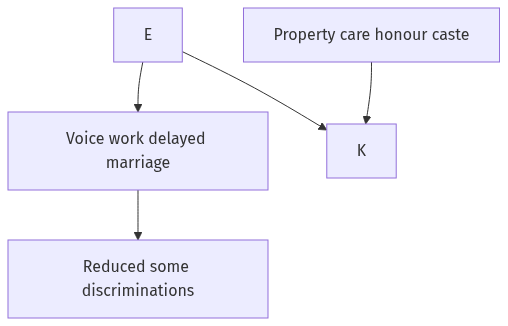
- Literacy and schooling correlate with lower fertility, later age at marriage, and higher use of health services, as National Family Health Survey rounds show.
- Educated women enter paid work and public office in larger numbers, which weakens the claim that the political and occupational world is male by nature.
- Savitribai Phule’s schools in Pune already treated girls’ literacy as equality, not as household polish.
- Kerala’s high female literacy sits with stronger indicators of women’s survival and schooling than many north Indian states.
- Legal awareness of the Hindu Succession amendments and of workplace sexual harassment law travels more easily through educated networks.
Where it does not eradicate
- Educated women still face the double day of paid work and unpaid care, which Ann Oakley and later time-use surveys record.
- Pierre Bourdieu’s cultural capital can become a dowry and marriage-market asset rather than an exit from the market.
- Honour violence, son preference, and occupational segregation persist among the educated, as seen in professional sex ratios and in campus and workplace harassment.
- Dalit and Muslim women face stacked exclusion. A generic girls’ enrolment drive does not erase caste and communal gates.
- Patriarchy reorganises: the educated daughter-in-law may be asked to manage a modern household without sharing property.
Reflection
- Education is a necessary condition for a large reduction of discrimination. It is not a sufficient condition for eradication.
- Land rights, workplace law, political reservation, and a change in unpaid care must travel with the school.
Flow diagram
Conclusion
Women’s education helps against patriarchal discrimination by delaying marriage, opening work and office, and spreading legal knowledge. Illustrations from Phule, Kerala, and NFHS support that help. Eradication fails where care, property, honour, and caste still organise the educated household. Schooling is necessary and not sufficient.
Quick related
Students also ask
-
What are the different dimensions of qualitative method? Do you think that qualitative method helps to gain a deeper sociological insight? Give reasons for your answer
Next question on this syllabus topic (2023 · Q6(a)). View answer →
-
If women are more educated, why does son preference continue?
Property, old-age support, and honour still run through sons in many groups. Schooling does not rewrite that account by itself.
-
Is Kerala proof that education ends patriarchy?
Kerala shows strong gains in survival and schooling. Household power, violence, and work segregation are not thereby finished.
Same topic · past papers
UPSC has asked this before
These previous-year questions sit on the same topic. Open one to practise the earlier ask.
-
2026 · Q5(c) · Sociology GS 1 · 10 marks
In what way can the concept of 'patriarchal bargain' be applied to the institution of marriage? Comment. -
2019 · Q3(b) · Sociology GS 1 · 20 marks
Are all world religions patriarchal ? Substantiate your answer with examples -
2017 · Q5(d) · Sociology GS 1 · 10 marks
Examine 'patriarchal bargain ' as gendered division of work in contemporary India
More from this topic
Q8(c) · UPSC Mains 2026 · Sociology GS 1 · 10 marks · Solution
Discuss the significance and limitations of 'intersectionality' in social research
Sociology
Intersectionality, coined by Kimberlé Crenshaw, examines how overlapping identities like race, class, and gender shape systemic oppression. Its significance in social research lies in capturing lived realities beyond single-axis frameworks and preventing reductive generalisations. However, limitations include methodological complexity, risks of infinite regress, and difficulties in operationalising fluid categories. Effective application requires balancing structural macro-analysis with micro-level lived experiences.
Q6(b) · UPSC Mains 2026 · Sociology GS 1 · 20 marks · Solution
Critically analyse the nature-nurture debate from different perspectives
Sociology
1. The nature-nurture debate explores whether biology or society primarily shapes human behavior
Q6(a) · UPSC Mains 2026 · Sociology GS 1 · 20 marks · Solution
Discuss the intellectual origins of sociology and its evolution as a distinct field of study
Sociology
Sociology arose in 19th-century Western Europe to make sense of massive upheavals caused by the Industrial and French Revolutions. Enlightenment thinkers laid the groundwork by championing reason, empirical observation, and human agency over traditional dogma. Auguste Comte gave the discipline its name, pushing for a positivist "physics of society" based on scientific laws. Émile Durkheim secured its academic legitimacy by defining "social facts" and using empirical methods to study human behavior. Max Weber introduced interpretive sociology, while Karl Marx focused on material conditions and class struggle. In the 20th century, Talcott Parsons advanced structural-functionalism to study systemic equilibrium. Later, conflict theories, the Frankfurt School, and postmodern critiques broadened the field to address power and marginalisation. Today, sociology continues to evolve by analyzing globalisation, digital shifts, and modern identity politics.