
Revision summary
CSR is the firm’s claimed duty beyond profit to community and nature. Climate and toxicity make that duty relevant because firms produce much of the harm. India’s section 135 and ESG reporting institutionalise spending and disclosure. Bhopal and offshoring of dirt show the limit of voluntary virtue. Regulation and a change in the energy base remain the core response.
Model answer
Copper italics in this answer — like this — are the key facts. Each one is unpacked in the Facts & figures rail.
Introduction
Corporate social responsibility is the claim that firms have duties beyond profit to workers, communities, and nature. In a world of climate disruption, toxic waste, and biodiversity loss, that claim is relevant as a limited tool. It is not a substitute for public regulation of production.
Body
Why it is relevant
- Environmental crises are produced in large part by industrial and extractive firms, so the same organisations are asked to internalise costs they once dumped.
- Archie Carroll’s pyramid placed legal and ethical duties beside philanthropy. Climate risk now sits inside the economic duty itself, because stranded assets and disasters hit the balance sheet.
- India’s Companies Act, 2013, section 135, made a spending mandate for large companies, and Schedule VII lists environment among eligible heads.
- The United Nations Global Compact and later ESG reporting give a common language for investors to compare firms.
Limits in a crisis
- CSR can be a public-relations budget beside a polluting core, which the Bhopal gas disaster of 1984 still illustrates as a failure of industrial duty.
- Voluntary codes do not bind competitors. A firm that cuts emissions can lose market share if law does not bind the rest.
- Andre Gunder Frank’s map of core and periphery still matters: dirty processes move to weaker regulators while CSR reports are written at headquarters.
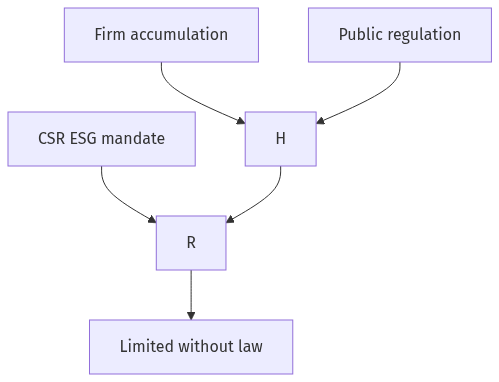
- Marx’s point on surplus remains: a firm exists to accumulate. CSR does not abolish that drive.
Examination
- Relevant as disclosure, local repair, and a political language that communities can use in court and in the press.
- Insufficient as the main response to climate and toxicity, which need state standards, liability, and a change in the energy base.
Flow diagram
Conclusion
CSR is relevant in environmental crisis because firms are central producers of harm and can be pressed to report and repair. It is not sufficient, because voluntary spending cannot replace binding rules and a change in accumulation. Use it as one lever beside law, not as the solution.
Quick related
Students also ask
-
Analyze critically David Morgan's views on family practices
Next question on this syllabus topic (2023 · Q5(d)). View answer →
-
Does section 135 stop pollution?
It mandates spending and reporting for eligible firms. Pollution control still depends on environmental law and enforcement.
-
Is ESG the same as CSR?
ESG is mainly an investor reporting frame. CSR is a broader duty talk, including philanthropy and local projects.
Same topic · past papers
UPSC has asked this before
These previous-year questions sit on the same topic. Open one to practise the earlier ask.
-
2024 · Q3(a) · Sociology GS 1 · 20 marks
How do you view and assess the increasing trend of digital ethnography and the use of visual culture in sociological research? -
2025 · Q6(b) · Sociology GS 1 · 20 marks
What do you understand by gender-based domestic division of labour? Is it undergoing a change in the wake of increasing participation of women in formal employment? Clarify your answer with illustrations -
2024 · Q5(e) · Sociology GS 1 · 10 marks
Critically examine the roles of science and technology in social change. What is your opinion on their increasing trend in 'online' education and teaching? -
2020 · Q3(a) · Sociology GS 1 · 20 marks
Capitalism has brought increasing informalisation of work in society.Substantiate your answer. -
2016 · Q5(c) · Sociology GS 1 · 10 marks
Is religion playing an important role in increasing fundamentalism? Give reasons for your answer.
More from this topic
Q8(c) · UPSC Mains 2026 · Sociology GS 1 · 10 marks · Solution
Discuss the significance and limitations of 'intersectionality' in social research
Sociology
Intersectionality, coined by Kimberlé Crenshaw, examines how overlapping identities like race, class, and gender shape systemic oppression. Its significance in social research lies in capturing lived realities beyond single-axis frameworks and preventing reductive generalisations. However, limitations include methodological complexity, risks of infinite regress, and difficulties in operationalising fluid categories. Effective application requires balancing structural macro-analysis with micro-level lived experiences.
Q6(b) · UPSC Mains 2026 · Sociology GS 1 · 20 marks · Solution
Critically analyse the nature-nurture debate from different perspectives
Sociology
1. The nature-nurture debate explores whether biology or society primarily shapes human behavior
Q6(a) · UPSC Mains 2026 · Sociology GS 1 · 20 marks · Solution
Discuss the intellectual origins of sociology and its evolution as a distinct field of study
Sociology
Sociology arose in 19th-century Western Europe to make sense of massive upheavals caused by the Industrial and French Revolutions. Enlightenment thinkers laid the groundwork by championing reason, empirical observation, and human agency over traditional dogma. Auguste Comte gave the discipline its name, pushing for a positivist "physics of society" based on scientific laws. Émile Durkheim secured its academic legitimacy by defining "social facts" and using empirical methods to study human behavior. Max Weber introduced interpretive sociology, while Karl Marx focused on material conditions and class struggle. In the 20th century, Talcott Parsons advanced structural-functionalism to study systemic equilibrium. Later, conflict theories, the Frankfurt School, and postmodern critiques broadened the field to address power and marginalisation. Today, sociology continues to evolve by analyzing globalisation, digital shifts, and modern identity politics.