
Revision summary
Science means systematic, public, criticisable knowledge, not only lab hardware. Positivists apply observation, measurement and comparison to social regularities. Limits include meaning, ethics of experiment, values and the double hermeneutic. Kuhn and feminists complicate even the natural-science side of the contrast. The judged answer is qualified yes: use the tools, drop the closed-system fantasy. Sociology remains a science of an open, interpreted world.
Model answer
Copper italics in this answer — like this — are the key facts. Each one is unpacked in the Facts & figures rail.
Introduction
Science is a public method of producing knowledge that is systematic, open to criticism, and in principle testable against the world. It is not a pile of laboratory instruments. The question is whether the methods that worked for physics and biology—controlled observation, measurement, comparison, law-seeking—can be applied to sociology. Auguste Comte and Emile Durkheim answered largely yes. Max Weber and later interpretive and critical traditions answered: only in part, and never as a copy of the natural-science laboratory.
Body
Why the methods can be applied
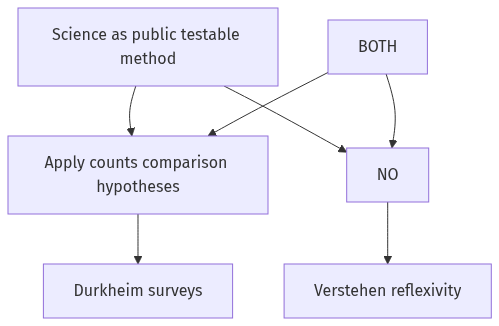
Society shows regularities. Birth, death, crime, voting and prices can be counted. Comparison across groups, as in Durkheim’s Suicide or in contemporary NFHS tables, is a cousin of Mill’s methods. Hypotheses, sampling, reliability and replication are not the property of chemistry. Karl Popper’s demand that claims be criticisable travels well. Without some natural-science discipline, sociology collapses into essayistic common sense. Demographic transition, network models and survey experiments in political sociology show that controlled reasoning is possible even when a full laboratory is not.
Why they cannot be copied wholesale
Human beings interpret the investigation, change their behaviour, and live inside values and power. The double hermeneutic, in Anthony Giddens’s phrase, has no analogue in the study of stones. Experiments on people raise ethics and artificiality; the classic laboratory of physics is rarely available. Meanings require Verstehen. Standpoint feminists and phenomenologists add that the knower is socially located. Thomas Kuhn reminded even natural science that paradigms are historical, so the contrast is not between a perfect physics and a failed sociology.
The reasoned conclusion is qualified applicability. Measurement, comparison, models and public criticism should be used wherever the object allows. Participant observation, historical interpretation and critique of categories are still scientific in a broad Weberian sense if they are systematic and honest. What cannot be applied is the fantasy of value-free prediction of a closed system. A village study that names its method and its limits is more scientific than a questionnaire that pretends to be physics. Sociology is a science of an open, meaningful world, not an inferior laboratory discipline.
Flow diagram
Conclusion
Natural-science methods of comparison, measurement and public testing can and should be used in sociology. They cannot be the whole method, because social objects interpret back and are value-laden. Science here means disciplined inquiry, not a borrowed laboratory coat.
Quick related
Students also ask
-
What do you understand by sustainable development? Discuss the elements of sustainable development as proposed in the UNDP's Sustainable Development Goals Report-2015
Next question on this syllabus topic (2025 · Q8(a)). View answer →
-
If methods cannot be fully applied, is sociology not a science?
It is a science in the sense of systematic public inquiry. It is not physics, and need not be.
-
Are qualitative methods unscientific?
They are unscientific only if they are unaccountable. Systematic ethnography can be more valid than a bad questionnaire.
Same topic · past papers
UPSC has asked this before
These previous-year questions sit on the same topic. Open one to practise the earlier ask.
-
2026 · Q4(c) · Sociology GS 1 · 10 marks
"The methods of natural sciences are inadequate in understanding the complex social phenomena." Discuss -
2026 · Q5(c) · Sociology GS 1 · 10 marks
In what way can the concept of 'patriarchal bargain' be applied to the institution of marriage? Comment.
More from this topic
Q8(c) · UPSC Mains 2026 · Sociology GS 1 · 10 marks · Solution
Discuss the significance and limitations of 'intersectionality' in social research
Sociology
Intersectionality, coined by Kimberlé Crenshaw, examines how overlapping identities like race, class, and gender shape systemic oppression. Its significance in social research lies in capturing lived realities beyond single-axis frameworks and preventing reductive generalisations. However, limitations include methodological complexity, risks of infinite regress, and difficulties in operationalising fluid categories. Effective application requires balancing structural macro-analysis with micro-level lived experiences.
Q6(b) · UPSC Mains 2026 · Sociology GS 1 · 20 marks · Solution
Critically analyse the nature-nurture debate from different perspectives
Sociology
1. The nature-nurture debate explores whether biology or society primarily shapes human behavior
Q6(a) · UPSC Mains 2026 · Sociology GS 1 · 20 marks · Solution
Discuss the intellectual origins of sociology and its evolution as a distinct field of study
Sociology
Sociology arose in 19th-century Western Europe to make sense of massive upheavals caused by the Industrial and French Revolutions. Enlightenment thinkers laid the groundwork by championing reason, empirical observation, and human agency over traditional dogma. Auguste Comte gave the discipline its name, pushing for a positivist "physics of society" based on scientific laws. Émile Durkheim secured its academic legitimacy by defining "social facts" and using empirical methods to study human behavior. Max Weber introduced interpretive sociology, while Karl Marx focused on material conditions and class struggle. In the 20th century, Talcott Parsons advanced structural-functionalism to study systemic equilibrium. Later, conflict theories, the Frankfurt School, and postmodern critiques broadened the field to address power and marginalisation. Today, sociology continues to evolve by analyzing globalisation, digital shifts, and modern identity politics.