
Revision summary
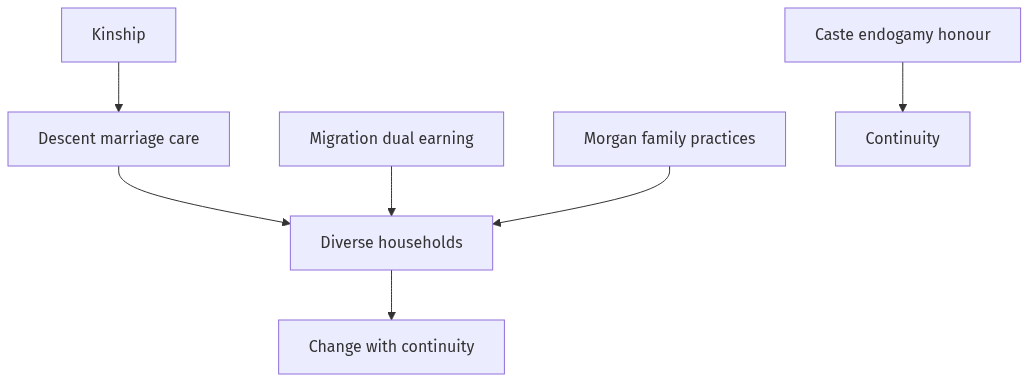
Kinship is relatedness through descent, marriage, and care, not only a joint house. Parsons’s isolated nuclear family does not describe Indian change. Later marriage, migration, divorce, and new parenthood forms diversify households. David Morgan’s practices and Karve’s regional systems are better tools than Morgan’s old stages. Gendered care and caste endogamy continue inside the new household types.
Model answer
Copper italics in this answer — like this — are the key facts. Each one is unpacked in the Facts & figures rail.
Introduction
Kinship is the organised recognition of relatedness through descent, marriage, and care. Patterns today are changing in law, residence, and everyday practice, but they are not disappearing. The assessment must name what is new without announcing the end of the family.
Body
What older models assumed
- Lewis Henry Morgan treated kinship as a classificatory system tied to stages of society. That evolutionary ladder is no longer used as a law of progress.
- Later anthropology, including Claude Levi-Strauss, treated alliance and the exchange of spouses as structure.
- Talcott Parsons described the isolated nuclear family as the form that fitted industrial society in the United States.
- Irawati Karve mapped North and South Indian kinship as different regional systems of descent, marriage, and household.
Patterns now visible
- Later marriage, lower fertility, and longer life change the span of generations living at once.
- Dual-earner households, migration, and urban housing shrink co-residence of joint kin without ending remittance and ritual obligation.
- Divorce, remarriage, single-parent households, and live-in arrangements, recognised in some Indian judgments, multiply forms of household.
- Chosen kin and friendship care appear where marriage is delayed or refused.
- David Morgan’s family practices shift attention from a fixed group to the activities of calling, visiting, and caring that make relatedness.
- Same-sex partnerships and assisted reproduction disturb the old identity of blood, marriage, and parenthood.
Indian specificities
- Joint household ideology remains strong even when brothers live in different cities and share a village house at rites.
- Gotra, clan, and caste endogamy still organise a large share of marriages, now with matrimonial sites as a new market.
- Matrilineal pockets such as the Khasi and the Nair past show that change is not a single path from joint to nuclear.
- A. M. Shah warned against treating the joint family as a simple census headcount of co-residence.
Assessment
- The direction is toward more diverse households and more negotiated practice, not toward the death of kinship.
- Gender remains central: care still falls heavily on women even when the chart of the household looks nuclear.
- Class splits the pattern. Secure professionals buy privacy. Migrant labour depends on village kin as social security.
- Global media spread companionate marriage ideals. Property and honour continue to discipline those ideals.
How to study the change
- Combine census household type with Morgan’s practices and with Karve’s regional map.
- Do not use Parsons’s isolated nuclear family as the Indian destination.
Flow diagram
Conclusion
Kinship today is more diverse in household form, more stretched by migration, and more visible as practice than as a single joint or nuclear type. Morgan’s evolutionary stages do not explain this. Regional systems, gender, and class do. Kinship is changing in pattern. It is not finished as a social institution.
Quick related
Students also ask
-
Do you think that common sense is the starting point of social research? What are its advantages and limitations? Explain
Next question on this syllabus topic (2023 · Q4(a)). View answer →
-
Has the Indian joint family ended?
Co-residence has declined in many cities. Ritual, property, and care obligations often continue across houses.
-
Is kinship only biology?
No. Law, marriage rules, and care practices make relatedness. Assisted reproduction makes that visible.
Same topic · past papers
UPSC has asked this before
These previous-year questions sit on the same topic. Open one to practise the earlier ask.
-
2021 · Q8(a) · Sociology GS 1 · 20 marks
Discuss the changing nature of kinship relations in the contemporary world. -
2023 · Q7(a) · Sociology GS 1 · 20 marks
Explain how economic globalization has brought changes in the patterns of employment in the 21st century
More from this topic
Q8(c) · UPSC Mains 2026 · Sociology GS 1 · 10 marks · Solution
Discuss the significance and limitations of 'intersectionality' in social research
Sociology
Intersectionality, coined by Kimberlé Crenshaw, examines how overlapping identities like race, class, and gender shape systemic oppression. Its significance in social research lies in capturing lived realities beyond single-axis frameworks and preventing reductive generalisations. However, limitations include methodological complexity, risks of infinite regress, and difficulties in operationalising fluid categories. Effective application requires balancing structural macro-analysis with micro-level lived experiences.
Q6(b) · UPSC Mains 2026 · Sociology GS 1 · 20 marks · Solution
Critically analyse the nature-nurture debate from different perspectives
Sociology
1. The nature-nurture debate explores whether biology or society primarily shapes human behavior
Q6(a) · UPSC Mains 2026 · Sociology GS 1 · 20 marks · Solution
Discuss the intellectual origins of sociology and its evolution as a distinct field of study
Sociology
Sociology arose in 19th-century Western Europe to make sense of massive upheavals caused by the Industrial and French Revolutions. Enlightenment thinkers laid the groundwork by championing reason, empirical observation, and human agency over traditional dogma. Auguste Comte gave the discipline its name, pushing for a positivist "physics of society" based on scientific laws. Émile Durkheim secured its academic legitimacy by defining "social facts" and using empirical methods to study human behavior. Max Weber introduced interpretive sociology, while Karl Marx focused on material conditions and class struggle. In the 20th century, Talcott Parsons advanced structural-functionalism to study systemic equilibrium. Later, conflict theories, the Frankfurt School, and postmodern critiques broadened the field to address power and marginalisation. Today, sociology continues to evolve by analyzing globalisation, digital shifts, and modern identity politics.