
Revision summary
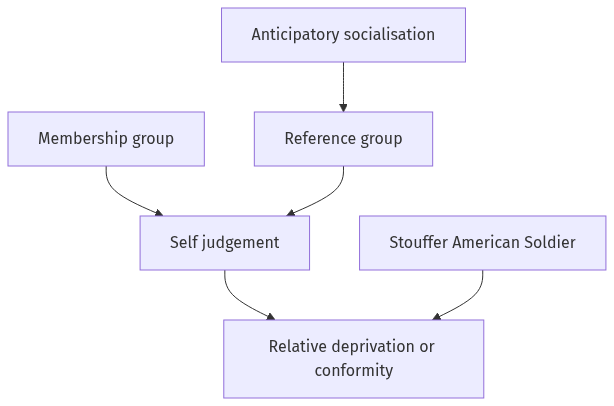
Merton’s reference group is the standard of comparison, not always the group of membership. Stouffer’s soldiers showed that satisfaction follows relative deprivation. Sanskritisation and career copying are Indian and occupational uses of the same idea. The model is widely applicable. It is not universal where groups are closed or comparisons are punished. Multiple conflicting reference groups limit any single-group version of the theory.
Model answer
Copper italics in this answer — like this — are the key facts. Each one is unpacked in the Facts & figures rail.
Introduction
Robert K. Merton developed reference group theory to show that people judge their own rewards by groups they use as standards, not only by groups they belong to. The model is widely useful. It is not universal if universal means that one group, one comparison, and one outcome fit every society.
Body
What the theory states
- A membership group is the group to which a person belongs. A reference group is the group used for comparison, imitation, or rejection.
- Anticipatory socialisation is the learning of a non-membership group’s norms in the hope of entry, as in a recruit copying officers.
- Relative deprivation, already visible in Samuel Stouffer’s The American Soldier, showed that satisfaction tracks comparison, not absolute pay.
- Merton linked this to anomie: when culturally approved goals are seen through a reference group that one cannot join, innovation and retreatism become likely.
Where it applies
- Career mobility, caste Sanskritisation as described by M. N. Srinivas, consumer status, and party identification all use reference groups.
- Positive and negative reference groups both work: a youth may copy a city professional and reject a stigmatised neighbourhood.
- The model travels because comparison is a general feature of stratified life, not a United States-only habit.
Limits on universality
- It assumes a relatively open field of visible groups and media images. In a tightly closed estate, comparison may be forbidden or fatal.
- It underplays material constraint: a landless labourer may know the landlord’s life and still lack any path of anticipatory entry.
- Multiple reference groups conflict. Gender, caste, and class pull in different directions, which Merton noted but did not fully theorise as intersection.
- Cross-cultural work must not treat the American enlisted man as the template for every comparison.
Flow diagram
Conclusion
Reference group theory is a powerful and widely applicable model of comparison, relative deprivation, and anticipatory socialisation. It is not a universal law that one group explains every judgement. It works where people can see other groups and can imagine movement. It weakens where closure, coercion, or conflicting standards block that imagination.
Quick related
Students also ask
-
What, according to Robert Michels, is the iron law of oligarchy? Do lions folly and foxes in Vilfredo Pareto's theory, essentially differ from each other? Substantiate
Next question on this syllabus topic (2023 · Q2(a)). View answer →
-
Is every membership group a reference group?
No. People often judge themselves by groups they do not belong to, and they may reject their own group.
-
Does the theory explain revolution?
It can explain anger when comparisons widen. It does not by itself explain organisation, the state, or class capacity.
Same topic · past papers
UPSC has asked this before
These previous-year questions sit on the same topic. Open one to practise the earlier ask.
-
2019 · Q6(b) · Sociology GS 1 · 20 marks
What are the theoretical models of societal power ? Which one of them is most applicable in advanced industrial societies ?
More from this topic
Q8(c) · UPSC Mains 2026 · Sociology GS 1 · 10 marks · Solution
Discuss the significance and limitations of 'intersectionality' in social research
Sociology
Intersectionality, coined by Kimberlé Crenshaw, examines how overlapping identities like race, class, and gender shape systemic oppression. Its significance in social research lies in capturing lived realities beyond single-axis frameworks and preventing reductive generalisations. However, limitations include methodological complexity, risks of infinite regress, and difficulties in operationalising fluid categories. Effective application requires balancing structural macro-analysis with micro-level lived experiences.
Q6(b) · UPSC Mains 2026 · Sociology GS 1 · 20 marks · Solution
Critically analyse the nature-nurture debate from different perspectives
Sociology
1. The nature-nurture debate explores whether biology or society primarily shapes human behavior
Q6(a) · UPSC Mains 2026 · Sociology GS 1 · 20 marks · Solution
Discuss the intellectual origins of sociology and its evolution as a distinct field of study
Sociology
Sociology arose in 19th-century Western Europe to make sense of massive upheavals caused by the Industrial and French Revolutions. Enlightenment thinkers laid the groundwork by championing reason, empirical observation, and human agency over traditional dogma. Auguste Comte gave the discipline its name, pushing for a positivist "physics of society" based on scientific laws. Émile Durkheim secured its academic legitimacy by defining "social facts" and using empirical methods to study human behavior. Max Weber introduced interpretive sociology, while Karl Marx focused on material conditions and class struggle. In the 20th century, Talcott Parsons advanced structural-functionalism to study systemic equilibrium. Later, conflict theories, the Frankfurt School, and postmodern critiques broadened the field to address power and marginalisation. Today, sociology continues to evolve by analyzing globalisation, digital shifts, and modern identity politics.