
Revision summary
Goffman reads everyday life as performance with front and back regions, teams, and face-work. The point is the shared definition of the situation, not a claim that all talk is false. Mead’s Me is made public on this stage. Asylums shows what happens when the back region is removed. The method is strong on encounters and weak as a full theory of class and the state.
Model answer
Copper italics in this answer — like this — are the key facts. Each one is unpacked in the Facts & figures rail.
Introduction
Erving Goffman treated everyday life as a set of performances in which people present a self before others. The dramaturgical perspective does not say that people are dishonest. It says that interaction needs staging, teams, and repair if a shared definition of the situation is to hold.
Body
Core tools
- In The Presentation of Self in Everyday Life, Goffman distinguished a front region, where the official performance runs, from a back region, where the team drops the script.
- Props, dress, setting, and manner are the equipment of the performance, as in a clinic, a classroom, or a shop floor.
- Impression management is the work of controlling what others can see. Face-work repairs slips so that embarrassment does not destroy the encounter.
- Teams collude to keep a definition of the situation, which is why a waiter and a cook may speak one language in the kitchen and another in the dining room.
Link to the self and to structure
- George Herbert Mead had already split the I and the Me. Goffman shows how the Me is staged in public, not only internalised as a generalised other.
- The perspective makes visible the labour of courtesy, deference, and stigma that surveys of attitude miss.
- Total institutions in Asylums show what happens when the back region is seized: the inmate cannot manage a separate self.
Everyday life it clarifies
- Office meetings, hospital rounds, and online profiles are front-stage work with curated biographies.
- Domestic workers and nurses do emotion work that Arlie Hochschild later named, which Goffman’s stage already prepared.
- Indian examples include the carefully managed public honour of a wedding, and the different speech used with an official and with kin.
- The limit is that dramaturgy explains the encounter better than it explains class or state power. Marx and Weber still supply the larger map.
Flow diagram
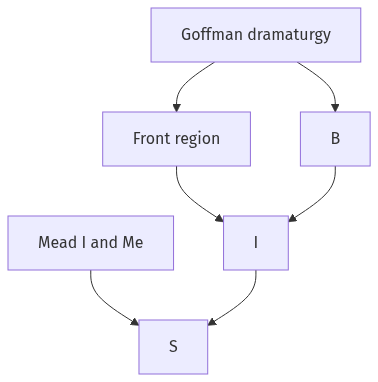
Conclusion
Dramaturgy enables the study of everyday life by treating interaction as staged work with fronts, backs, teams, and repair. It joins Mead’s self to public performance and makes courtesy and stigma researchable. It does not replace class analysis. It shows how unequal people still have to act together in the same room.
Quick related
Students also ask
-
Is reference group theory a universally applicable model? Elucidate
Next question on this syllabus topic (2023 · Q1(d)). View answer →
-
Does dramaturgy mean people are actors who lie?
No. It means interaction requires a presented self. Sincerity still uses a front.
-
Can it explain caste or class?
It can show how rank is performed in a room. It cannot replace Marx or Weber on property and status orders.
Same topic · past papers
UPSC has asked this before
These previous-year questions sit on the same topic. Open one to practise the earlier ask.
-
2017 · Q2(c) · Sociology GS 1 · 10 marks
Elaborate the main tenets of interpretative perspective in sociology -
2025 · Q5(b) · Sociology GS 1 · 10 marks
Does the structural-functionalist perspective on social stratification promote a status quo? Give reasons for your answer. -
2017 · Q1(b) · Sociology GS 1 · 10 marks
Examine ethnomethodological and phenomenological perspective as critique of positivism
More from this topic
Q8(c) · UPSC Mains 2026 · Sociology GS 1 · 10 marks · Solution
Discuss the significance and limitations of 'intersectionality' in social research
Sociology
Intersectionality, coined by Kimberlé Crenshaw, examines how overlapping identities like race, class, and gender shape systemic oppression. Its significance in social research lies in capturing lived realities beyond single-axis frameworks and preventing reductive generalisations. However, limitations include methodological complexity, risks of infinite regress, and difficulties in operationalising fluid categories. Effective application requires balancing structural macro-analysis with micro-level lived experiences.
Q6(b) · UPSC Mains 2026 · Sociology GS 1 · 20 marks · Solution
Critically analyse the nature-nurture debate from different perspectives
Sociology
1. The nature-nurture debate explores whether biology or society primarily shapes human behavior
Q6(a) · UPSC Mains 2026 · Sociology GS 1 · 20 marks · Solution
Discuss the intellectual origins of sociology and its evolution as a distinct field of study
Sociology
Sociology arose in 19th-century Western Europe to make sense of massive upheavals caused by the Industrial and French Revolutions. Enlightenment thinkers laid the groundwork by championing reason, empirical observation, and human agency over traditional dogma. Auguste Comte gave the discipline its name, pushing for a positivist "physics of society" based on scientific laws. Émile Durkheim secured its academic legitimacy by defining "social facts" and using empirical methods to study human behavior. Max Weber introduced interpretive sociology, while Karl Marx focused on material conditions and class struggle. In the 20th century, Talcott Parsons advanced structural-functionalism to study systemic equilibrium. Later, conflict theories, the Frankfurt School, and postmodern critiques broadened the field to address power and marginalisation. Today, sociology continues to evolve by analyzing globalisation, digital shifts, and modern identity politics.