
Revision summary
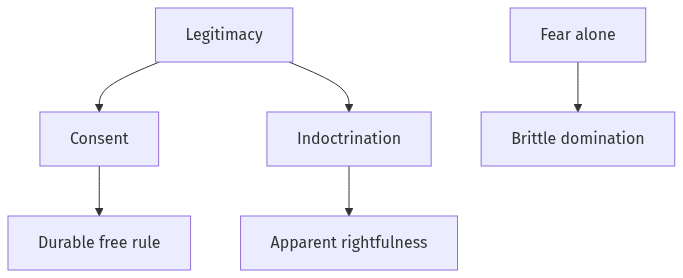
Legitimacy is the rightfulness of command, which Weber placed at the centre of political sociology. Consent, in Locke, Rousseau, and democratic procedures, authorises rule; Habermas ties modern legitimacy to public reason. Indoctrination manufactures belief through ideology, schooling, and propaganda, as Arendt showed in totalitarianism and as colonial missions also did. Gramsci’s hegemony and democratic propaganda show that manufactured consent can appear inside civil society, not only in dictatorships. Some legitimacy is essential to maintain political rule; consent is the form that remains compatible with freedom, while indoctrination is a costly counterfeit.
Model answer
Copper italics in this answer — like this — are the key facts. Each one is unpacked in the Facts & figures rail.
Introduction
Political rule can rest on habit, fear, or bread. It lasts as political rule when those who obey take the ruler to have a right to command. That is legitimacy. Max Weber made it the central sociological question. The further question is whether legitimacy acquired by consent and legitimacy manufactured by indoctrination are equally ‘essential’. They are both effective in different ways. Only consent, however, is essential to rule that can call itself political rather than merely successful domination.
Body
Consent
Locke and Rousseau treat consent as the moral source of authority. Elections and dissent are its modern forms. Beetham adds legality, justifiability, and expressed consent. Habermas ties modern legitimacy to public reason rather than to sacred kingship. India’s Emergency showed how quickly consent yields to ordinance, and how much electoral restoration mattered.
Indoctrination
Indoctrination manufactures the appearance of right. Plato’s noble lie, Arendt’s totalitarian ideology, fascist and Stalinist cults, and colonial civilising missions all make domination look rightful. Gramsci’s hegemony sits between a free yes and a gun. Market democracies can manufacture consent too, which is why the distinction is a matter of degree as well as of regime type.
Is legitimacy essential?
Yes. Pure coercion is brittle. Weber’s traditional, charismatic, and legal-rational types all answer the need for a story of right. Indoctrination can hold a regime until the story cracks, as wartime mobilisation and personality cults show. Consent holds it with less terror and more capacity to correct error, which is the open society in another key. Some legitimacy is essential to political rule as more than occupation. Consent is the form adequate to a free people; indoctrination is a counterfeit that still proves the need for legitimacy rather than for fear alone.
Flow diagram
Conclusion
Legitimacy is essential because no durable political order lives on fear alone. Consent authorises; indoctrination counterfeits. Both can keep a regime standing. Only consent, revisable in public, keeps rule political in the liberal and democratic sense. Examples from elections, Emergency, colonial missions, and totalitarian ideology all show the same need and the two opposed ways of meeting it.
Quick related
Students also ask
-
Explain briefly the role of Peasant Movements after 1857 and before independence
Next question on this syllabus topic (2025 · Q5(a)). View answer →
-
Can a dictatorship be legitimate?
It can be legitimate in Weber’s sense if subjects believe in tradition or in a leader’s gift. That is not the same as democratic rightfulness, but it explains durability.
-
Is every school curriculum indoctrination?
Civic education that remains open to criticism is formation of citizens. Indoctrination closes the possibility of saying the official story is false.
Same topic · past papers
UPSC has asked this before
These previous-year questions sit on the same topic. Open one to practise the earlier ask.
-
2024 · Q8(b) · PSIR GS 1 · 15 marks
"Relative deprivation is a major source of ethnic conflict." Elaborate the statement with relevant examples. -
2025 · Q6(b) · PSIR GS 1 · 15 marks
Examine the constitutional provisions and nature of advisory jurisdiction of Supreme Court of India. Evaluate your answer with relevant examples -
2021 · Q4(b) · PSIR GS 1 · 15 marks
Marx's concept of alienation is an essential part of the reality in capitalism. Explain
More from this topic
Q8(b) · UPSC Mains 2026 · PSIR GS 1 · 15 marks · Solution
Critically comment on the shifts in the functioning of the Indian Parliament in the last two decades
Indian Nationalism
This 15-mark answer analyses the transformation of the Indian Parliament over the past two decades, moving from a deliberative forum to an arena of executive assertion. It highlights declining debate hours, bypassing of Department-Related Standing Committees (DRSCs), and the rise of ordinance-making and bypassing of bicameral consensus through Money Bills. The critique incorporates Morris-Jones and Pratap Bhanu Mehta's insights on the hollowing out of institutions. The conclusion argues for systemic institutional reforms to restore Parliament's core constitutional role as a deliberative check on executive power.
Q7(a) · UPSC Mains 2025 · PSIR GS 1 · 20 marks · Solution
Enunciate the impediments to women's participation in local governance in the process of political decentralisation
Indian Nationalism
The 73rd and 74th Amendments reserved local seats for women, which is a structural opening, not yet equal participation. Sarpanch-pati proxy rule, unpaid care, and a male bureaucracy remain the everyday patriarchal impediments. Caste and class decide which women can act; Dalit women office-holders face additional violence and veto. Thin devolution of money and staff makes many local offices ceremonial, so participation has no policy content. Parties and seat rotation often transfer the reserved ticket to a household rather than building a woman’s public career.
Q7(b) · UPSC Mains 2025 · PSIR GS 1 · 20 marks · Solution
Caste remains a vital axis for political mobilisation in India. How would the caste census address the aspirations of people? Discuss
Indian Nationalism
Caste remains a mobilisation axis because it still structures dignity, land, and access to the state, as Kothari, Mandal, and bahujan politics show. Parties already count jatis; the demand is that the official Census should too, beyond SC and ST. Aspirations include fairer reservation design, targeting of welfare, and recognition after the unpublished 2011 SECC caste data. Risks include reification of identity and a pure percentage war that forgets class, gender, and Ambedkar’s horizon of annihilation. A democratic census would publish usable aggregates while protecting persons and keeping constitutional individual rights at the centre.