
Revision summary
Relative deprivation is the perceived gap between a group’s entitlement and its actual share, relative to others or to its past. Gurr linked that gap to political violence; ethnicity supplies a ready we–they organisation of the grievance. Conflict often follows blocked mobility or lost rank more than shared absolute poverty. Indian language and job conflicts, some insurgencies, and cases such as Sri Lanka illustrate the pattern. Elite strategy, state bias, and security dilemmas also matter; relative deprivation is a major source, not the only one.
Model answer
Copper italics in this answer — like this — are the key facts. Each one is unpacked in the Facts & figures rail.
Introduction
Relative deprivation is the gap between what a group believes it is entitled to and what it actually receives, measured against another group or against its own past. Ted Gurr made the idea central to the study of rebellion. The statement that it is a major source of ethnic conflict is strong and largely right, provided it is not treated as the only source.
Body
From comparison to conflict
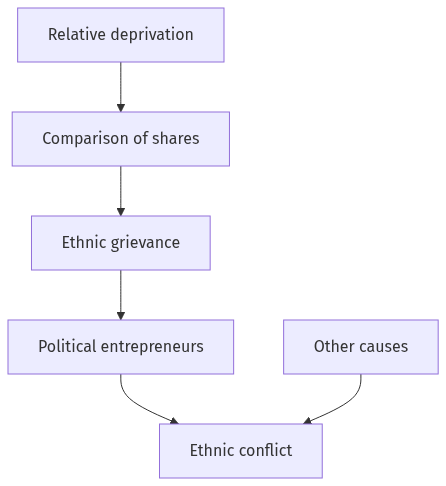
- Ethnic identity supplies a we–they map. Relative deprivation supplies the grievance: we have less office, less land, less respect, or less security than they do, or less than we had. Political entrepreneurs then organise fear and hope. Dahl’s polyarchy can absorb some of this through bargains. If the state is seen as captured by one ethnic bloc, legitimacy fails and obligation to a common authority weakens.
Absolute poverty alone does not always produce ethnic war. Groups that are poor together may not mobilise as ethnic enemies. Groups that are rising but blocked, or falling after privilege, often do. That is the relative in the term.
Examples
In India, language and job competition in states, the demand for reorganisation, and later caste-and-community conflicts over reservations show relative deprivation among groups who compare educational and public-employment shares. Kashmiri and some North-Eastern insurgencies mixed secessionist nationalism with the sense of political and economic slight. Hindu–Muslim violence has often followed rumours of displacement in towns where one community’s market position seemed to threaten another’s. Sri Lanka’s Tamil–Sinhala conflict followed competitive claims over language, university places, and the state. Northern Ireland and the former Yugoslavia showed similar comparison of status after political change.
Ambedkar’s account of caste is related but not identical: graded inequality can produce deprivation that is absolute as well as relative. Ethnic conflict in the North-East also involves land, insurgency networks, and Centre–state militarisation, which are not only feelings of gap.
Elaborate, do not reduce
- Relative deprivation is major because it explains timing: conflict often rises when expectations rise faster than delivery, or when a previously dominant group loses rank. It does not erase elite manipulation, colonial classifications, or security dilemmas. Gramsci would add that hegemony can keep deprivation from becoming conflict until a crisis of authority. A full elaboration therefore uses Gurr’s mechanism, illustrates it, and keeps a residual list of other causes.
Flow diagram
Conclusion
Relative deprivation is a major source of ethnic conflict because groups act on comparisons of entitlement and share, not only on absolute misery. Indian and comparative cases show the mechanism. Other causes remain. The statement should be accepted as a leading explanation, not as a complete one.
Quick related
Students also ask
-
Gram Sabha in the Panchayati Raj system is a forum which gives expression to the collective wisdom, aspirations, and the will of the people. Comment.
Next question on this syllabus topic (2024 · Q8(c)). View answer →
-
Is every reservation conflict ethnic conflict?
Caste and community conflicts over quotas are often relative-deprivation conflicts over public goods. Whether they are ‘ethnic’ depends on how groups are named; the mechanism of comparison is the same.
-
Can democracy reduce this source?
Power-sharing, fair recruitment, and credible courts can lower the gap or make it negotiable. If democracy is winner-take-all along ethnic lines, it can raise the gap.
Same topic · past papers
UPSC has asked this before
These previous-year questions sit on the same topic. Open one to practise the earlier ask.
-
2025 · Q4(c) · PSIR GS 1 · 15 marks
Do you think that legitimacy acquired by consent or manufactured by indoctrination is an essential element in maintenance of political rule? Justify your answer with relevant examples -
2026 · Q7(c) · PSIR GS 1 · 15 marks
Map the different types of ethnic conflicts that have emerged in 21st century India -
2025 · Q6(b) · PSIR GS 1 · 15 marks
Examine the constitutional provisions and nature of advisory jurisdiction of Supreme Court of India. Evaluate your answer with relevant examples
More from this topic
Q8(b) · UPSC Mains 2026 · PSIR GS 1 · 15 marks · Solution
Critically comment on the shifts in the functioning of the Indian Parliament in the last two decades
Indian Nationalism
This 15-mark answer analyses the transformation of the Indian Parliament over the past two decades, moving from a deliberative forum to an arena of executive assertion. It highlights declining debate hours, bypassing of Department-Related Standing Committees (DRSCs), and the rise of ordinance-making and bypassing of bicameral consensus through Money Bills. The critique incorporates Morris-Jones and Pratap Bhanu Mehta's insights on the hollowing out of institutions. The conclusion argues for systemic institutional reforms to restore Parliament's core constitutional role as a deliberative check on executive power.
Q7(a) · UPSC Mains 2025 · PSIR GS 1 · 20 marks · Solution
Enunciate the impediments to women's participation in local governance in the process of political decentralisation
Indian Nationalism
The 73rd and 74th Amendments reserved local seats for women, which is a structural opening, not yet equal participation. Sarpanch-pati proxy rule, unpaid care, and a male bureaucracy remain the everyday patriarchal impediments. Caste and class decide which women can act; Dalit women office-holders face additional violence and veto. Thin devolution of money and staff makes many local offices ceremonial, so participation has no policy content. Parties and seat rotation often transfer the reserved ticket to a household rather than building a woman’s public career.
Q7(b) · UPSC Mains 2025 · PSIR GS 1 · 20 marks · Solution
Caste remains a vital axis for political mobilisation in India. How would the caste census address the aspirations of people? Discuss
Indian Nationalism
Caste remains a mobilisation axis because it still structures dignity, land, and access to the state, as Kothari, Mandal, and bahujan politics show. Parties already count jatis; the demand is that the official Census should too, beyond SC and ST. Aspirations include fairer reservation design, targeting of welfare, and recognition after the unpublished 2011 SECC caste data. Risks include reification of identity and a pure percentage war that forgets class, gender, and Ambedkar’s horizon of annihilation. A democratic census would publish usable aggregates while protecting persons and keeping constitutional individual rights at the centre.