
Revision summary
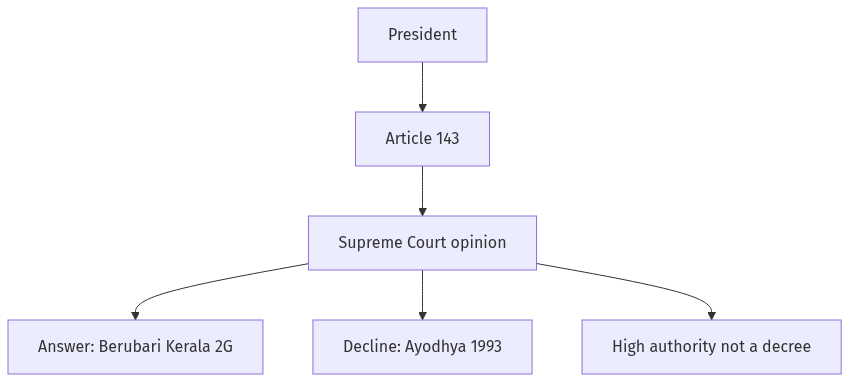
Article 143 lets the President refer questions of public importance to the Supreme Court for an opinion. Clause (1) is discretionary for the Court; clause (2) on certain treaty disputes requires a report. The opinion is not an ordinary decree, though it is politically and legally weighty. Kerala Education Bill and Berubari show the jurisdiction at its best as advance constitutional counsel. The Ayodhya reference shows the Court may refuse a question that is better left to a pending suit; 2G shows how an invited opinion can bind the inviter politically.
Model answer
Copper italics in this answer — like this — are the key facts. Each one is unpacked in the Facts & figures rail.
Introduction
Article 143 of the Constitution allows the President to refer a question of law or fact of public importance to the Supreme Court for its opinion. This is the advisory jurisdiction, borrowed from the Government of India Act tradition and from other Commonwealth references. It is a constitutional conversation between the head of state and the Court, not a third type of lawsuit.
Body
Provisions and nature
Article 143(1) covers questions of law or fact that have arisen or are likely to arise, of such a nature and of such public importance that it is expedient to obtain the Court’s opinion. Article 143(2) concerns disputes arising out of pre-constitutional treaties and similar instruments, where the Court shall report. Under 143(1) the Court has held that it may decline to answer, as it did in the Ayodhya reference (1993) on whether a temple existed, treating the question as unsuited to a judicial opinion while a title suit lay elsewhere.
The opinion is not an ordinary Article 141 decree, yet it is politically weighty. The President acts on Council advice, so the reference is an executive request. It can look like an attempt to outflank a state or a pending suit.
Examples and evaluation
Kerala Education Bill (1958) shaped Article 30. Berubari (1960) said cession of territory needs a constitutional amendment. Cauvery (1991) tested tribunals. The 2012 2G opinion bound the executive to a doctrine it had invited. The jurisdiction can prevent unconstitutional action in advance, but it thins fact-finding and can pull the Court onto the executive’s timetable. It is valuable for genuine legal questions and risky as a political device. The power to decline, used in the Ayodhya reference (1993), is the safety catch.
Flow diagram
Conclusion
Article 143 creates an advisory, not adversarial, jurisdiction. Its nature is an opinion to the President, authoritative yet distinct from a binding judgment in a suit. Examples from education, territory, water, and spectrum show both constitutional service and political temptation. The evaluation is that the jurisdiction is a useful spare tool, not a substitute for legislation or for a proper trial of facts.
Quick related
Students also ask
-
The recent developments in Indian Politics has not eroded the true spirit of federalism in India. Critically examine this statement with the help of appropriate illustrations
Next question on this syllabus topic (2025 · Q6(c)). View answer →
-
Is an advisory opinion binding law?
It is not a decree between parties. In practice later benches treat major opinions as highly persuasive, and governments ignore them at political peril.
-
Who really decides to refer?
The President acts on the aid and advice of the Union Council of Ministers, so the reference is an executive constitutional strategy.
Same topic · past papers
UPSC has asked this before
These previous-year questions sit on the same topic. Open one to practise the earlier ask.
-
2021 · Q8(b) · PSIR GS 1 · 15 marks
Examine the evolution of the jurisdiction of the Supreme Court of India as a constitutional court -
2025 · Q4(c) · PSIR GS 1 · 15 marks
Do you think that legitimacy acquired by consent or manufactured by indoctrination is an essential element in maintenance of political rule? Justify your answer with relevant examples -
2024 · Q8(b) · PSIR GS 1 · 15 marks
"Relative deprivation is a major source of ethnic conflict." Elaborate the statement with relevant examples.
More from this topic
Q7(b) · UPSC Mains 2026 · PSIR GS 1 · 15 marks · Solution
Highlight any five constitutional provisions that restrain the powers of the executive, and evaluate their effectiveness in current times
Federalism
This model answer examines five constitutional mechanisms designed to check executive overreach in India: parliamentary accountability, judicial review under Article 13 and 32, the President's suspensive veto, the federal distribution of powers under the Seventh Schedule, and constitutional bodies like the Election Commission. It analyses their formal design alongside contemporary challenges to their operational efficacy, such as declining parliamentary scrutiny, ordinance routes, and pressure on institutional autonomy. The synthesis underscores that while the textual architecture for executive restraint is robust, its real-world effectiveness depends on political morality and judicial vigilance.
Q6(c) · UPSC Mains 2026 · PSIR GS 1 · 15 marks · Solution
Evaluate the Centre-State relation with reference to Article 293 and analyze its implications for the Indian federal structure
Federalism
Article 293 empowers states to borrow within territory limits subject to Centre's consent if central loans are outstanding. This fiscal lever has triggered intense friction between the Union and opposition-ruled states over net borrowing ceilings and off-budget borrowings. While designed for macroeconomic stability, its centralized enforcement risks undermining the fiscal autonomy of states. The judiciary and Sarkaria-Punchhi commissions have repeatedly emphasized consultative fiscal federalism to resolve such tensions.
Q6(c) · UPSC Mains 2025 · PSIR GS 1 · 15 marks · Solution
The recent developments in Indian Politics has not eroded the true spirit of federalism in India. Critically examine this statement with the help of appropriate illustrations
Federalism
The spirit of Indian federalism is bargaining among units, not only the three Lists. GST created a shared tax forum that the Supreme Court treated as federal dialogue, while compensation and Union weight still skew the table. The 2019 J&K reorganisation is the strongest evidence of unilateral thinning of a constituent unit, even after judicial upholding. The farm laws showed Union overreach into the agrarian political economy; their repeal showed that protest and states can restore bargaining. The Fifteenth Finance Commission remains a constitutional federal mechanism, contested over 2011 population and cesses that bypass the divisible pool.