
Revision summary
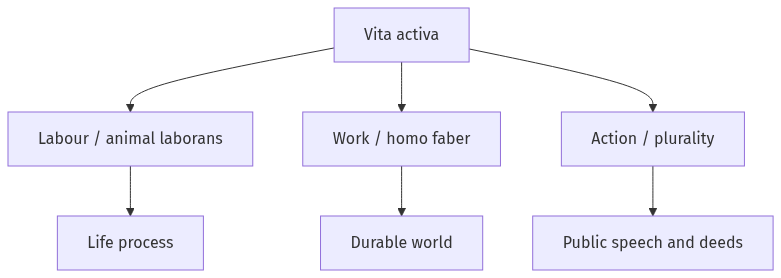
Arendt’s vita activa comprises labour, work, and action as distinct human activities. Labour is the cyclical metabolism of life; its typical figure is animal laborans, which modernity threatens to make universal. Work is homo faber’s fabrication of a durable world, necessary but dangerous when politics is treated as making a product. Action is political life among a plurality of unique equals, needing a public realm, speech, promise, and forgiveness. The rise of the social and of totalitarianism both destroy the space of action, which is her warning to modern democracy.
Model answer
Copper italics in this answer — like this — are the key facts. Each one is unpacked in the Facts & figures rail.
Introduction
Hannah Arendt in The Human Condition (1958) analysed the vita activa — the active life — as three activities: labour, work, and action. She was not writing a psychology of busyness. She was recovering a political anthropology. Human beings live among others. The highest worldly activity is action in a public space of speech and deeds, not the endless cycle of consumption.
Body
Labour
- Labour is the body’s activity that corresponds to life: food, care, the cycle of consumption. It never finishes. Arendt feared that modernity makes animal laborans typical: living standards rise while citizenship empties. Marx glorified labour as human essence; she thought that still left politics as management of life-processes rather than as a public world of unique persons.
Work
Work is homo faber building a durable world — a table, a law, a wall — with a beginning and an end. It gives human beings a home in the world and a stage on which they can appear before others. The danger is instrumentalism: persons as material for a product. Plato’s craftsman-king is, for her, politics mistaken for fabrication.
Action
Action is politics proper in her sense of the vita activa. It corresponds to plurality: equal and distinct persons. It needs speech and a public realm of memory. Promise and forgiveness remedy its unpredictability. The stylised Greek polis was such a space; totalitarianism, as Arendt showed in The Origins of Totalitarianism, destroys plurality and reduces humans to interchangeable bundles of reaction. A life of only labour is worldless; a life of only work can build cages. The rise of the social lets the household’s life-process invade the public. Bureaucracy administers labour while action shrinks to voting or to violence. Democracy must keep a public space where unique persons begin something new among equals.
Flow diagram
Conclusion
Vita activa is labour that keeps us alive, work that builds a world, and action that discloses who we are among others. Arendt’s political theory privileges action and plurality against a society of jobholders and against a craftsman’s state. Without that distinction, democracy becomes housekeeping on a national scale.
Quick related
Students also ask
-
Do you think that legitimacy acquired by consent or manufactured by indoctrination is an essential element in maintenance of political rule? Justify your answer with relevant examples
Next question on this syllabus topic (2025 · Q4(c)). View answer →
-
Does Arendt despise labour?
She treats labour as necessary to life. She despises a civilisation that knows only labour and consumption and therefore cannot act politically.
-
How does action differ from violence?
Violence is instrumental and mute in her sense. Action is speech among others. When politics becomes fabrication or force, the category of action has already been lost.
More from this topic
Q8(b) · UPSC Mains 2026 · PSIR GS 1 · 15 marks · Solution
Critically comment on the shifts in the functioning of the Indian Parliament in the last two decades
Indian Nationalism
This 15-mark answer analyses the transformation of the Indian Parliament over the past two decades, moving from a deliberative forum to an arena of executive assertion. It highlights declining debate hours, bypassing of Department-Related Standing Committees (DRSCs), and the rise of ordinance-making and bypassing of bicameral consensus through Money Bills. The critique incorporates Morris-Jones and Pratap Bhanu Mehta's insights on the hollowing out of institutions. The conclusion argues for systemic institutional reforms to restore Parliament's core constitutional role as a deliberative check on executive power.
Q7(b) · UPSC Mains 2025 · PSIR GS 1 · 20 marks · Solution
Caste remains a vital axis for political mobilisation in India. How would the caste census address the aspirations of people? Discuss
Indian Nationalism
Caste remains a mobilisation axis because it still structures dignity, land, and access to the state, as Kothari, Mandal, and bahujan politics show. Parties already count jatis; the demand is that the official Census should too, beyond SC and ST. Aspirations include fairer reservation design, targeting of welfare, and recognition after the unpublished 2011 SECC caste data. Risks include reification of identity and a pure percentage war that forgets class, gender, and Ambedkar’s horizon of annihilation. A democratic census would publish usable aggregates while protecting persons and keeping constitutional individual rights at the centre.
Q7(a) · UPSC Mains 2025 · PSIR GS 1 · 20 marks · Solution
Enunciate the impediments to women's participation in local governance in the process of political decentralisation
Indian Nationalism
The 73rd and 74th Amendments reserved local seats for women, which is a structural opening, not yet equal participation. Sarpanch-pati proxy rule, unpaid care, and a male bureaucracy remain the everyday patriarchal impediments. Caste and class decide which women can act; Dalit women office-holders face additional violence and veto. Thin devolution of money and staff makes many local offices ceremonial, so participation has no policy content. Parties and seat rotation often transfer the reserved ticket to a household rather than building a woman’s public career.