
Revision summary
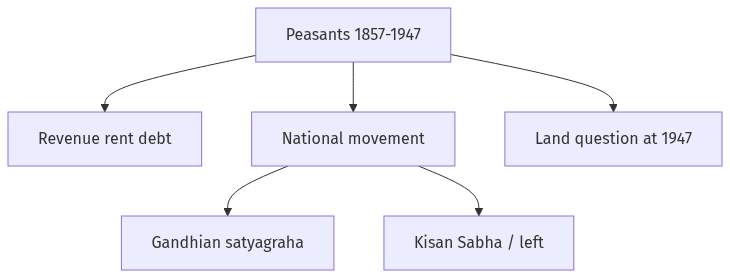
After 1857 the colonial property and revenue order produced Deccan, Pabna, indigo, and Malabar-type agrarian unrest. Gandhi’s Champaran and Kheda campaigns nationalised peasant grievances without making Congress a class party of the poor. Kisan Sabhas, Bardoli, Awadh, Tebhaga, and communist agrarian work pushed rent, occupancy, and landlordism onto the political agenda. Guha’s subaltern reading and Ambedkar’s caste caution both warn against treating ‘the peasantry’ as one subject. These movements expanded the national struggle and left land reform as a founding task of the republic.
Model answer
Copper italics in this answer — like this — are the key facts. Each one is unpacked in the Facts & figures rail.
Introduction
Between the Revolt of 1857 and Independence, Indian peasants were not a silent backdrop to elite nationalism. They fought rent, debt, plantation discipline, and the colonial state’s revenue. Their movements were local and often caste- or region-specific, yet they repeatedly forced the Indian National Congress and the left to take the agrarian question seriously.
Body
After 1857: revenue, rent, and the new property order
1857 itself had a large peasant and taluqdar face in Awadh. After its defeat, British rule tightened the legal order of zamindari, ryotwari, and money-lending. Deccan riots of 1875 against Marwari and Gujarati sahukars, the Pabna agrarian leagues of the 1870s in Bengal, and the Mappila outbreaks in Malabar showed a pattern: cash revenue, collapsing prices, and insecure occupancy. Ranajit Guha later read such episodes as peasant insurgency with its own political grammar, not as a mere appendix to Congress.
Indigo in 1859–60 and later plantation belts tied peasants to export agriculture. Punjab’s canal colonies created a different proprietary peasantry.
Twentieth-century mass agrarian politics
Champaran (1917) and Kheda (1918) brought Gandhi into peasant India. The 1920s–30s saw Awadh’s Kisan Sabha, Sahajanand Saraswati, Bardoli under Patel, and the 1921 Moplah rising. Tebhaga (1946–47) demanded a two-thirds crop share. Congress wanted a united front; the left wanted landlordism abolished. Ambedkar reminded that the peasant is caste-divided. The All India Kisan Sabha (1936) institutionalised the agrarian left. These struggles widened nationalism beyond the town and left land reform as an unfinished founding task.
Flow diagram
Conclusion
Peasant movements from 1857 to 1947 were struggles over revenue, rent, debt, and dignity. They entered the national movement on Gandhi’s terms and on the Kisan Sabha’s terms, never fully on one script. Independence inherited both their energy and their unfinished demand for land.
Quick related
Students also ask
-
Write a note on the Dalit perspective of Indian National Movement
Next question on this syllabus topic (2025 · Q5(b)). View answer →
-
Were peasant movements nationalist by nature?
They were first about land and survival. They became nationalist when colonial law and revenue were named as the enemy, which was often but not always the case.
-
Why did Congress hesitate on class war in the countryside?
It sought a broad anti-British coalition that included substantial peasants and some landlords, and it feared a split that the Raj could exploit.
Same topic · past papers
UPSC has asked this before
These previous-year questions sit on the same topic. Open one to practise the earlier ask.
-
2025 · Q1(e) · PSIR GS 1 · 10 marks
Explain briefly the elite theory of democracy
More from this topic
Q8(b) · UPSC Mains 2026 · PSIR GS 1 · 15 marks · Solution
Critically comment on the shifts in the functioning of the Indian Parliament in the last two decades
Indian Nationalism
This 15-mark answer analyses the transformation of the Indian Parliament over the past two decades, moving from a deliberative forum to an arena of executive assertion. It highlights declining debate hours, bypassing of Department-Related Standing Committees (DRSCs), and the rise of ordinance-making and bypassing of bicameral consensus through Money Bills. The critique incorporates Morris-Jones and Pratap Bhanu Mehta's insights on the hollowing out of institutions. The conclusion argues for systemic institutional reforms to restore Parliament's core constitutional role as a deliberative check on executive power.
Q7(b) · UPSC Mains 2025 · PSIR GS 1 · 20 marks · Solution
Caste remains a vital axis for political mobilisation in India. How would the caste census address the aspirations of people? Discuss
Indian Nationalism
Caste remains a mobilisation axis because it still structures dignity, land, and access to the state, as Kothari, Mandal, and bahujan politics show. Parties already count jatis; the demand is that the official Census should too, beyond SC and ST. Aspirations include fairer reservation design, targeting of welfare, and recognition after the unpublished 2011 SECC caste data. Risks include reification of identity and a pure percentage war that forgets class, gender, and Ambedkar’s horizon of annihilation. A democratic census would publish usable aggregates while protecting persons and keeping constitutional individual rights at the centre.
Q7(a) · UPSC Mains 2025 · PSIR GS 1 · 20 marks · Solution
Enunciate the impediments to women's participation in local governance in the process of political decentralisation
Indian Nationalism
The 73rd and 74th Amendments reserved local seats for women, which is a structural opening, not yet equal participation. Sarpanch-pati proxy rule, unpaid care, and a male bureaucracy remain the everyday patriarchal impediments. Caste and class decide which women can act; Dalit women office-holders face additional violence and veto. Thin devolution of money and staff makes many local offices ceremonial, so participation has no policy content. Parties and seat rotation often transfer the reserved ticket to a household rather than building a woman’s public career.