
Revision summary
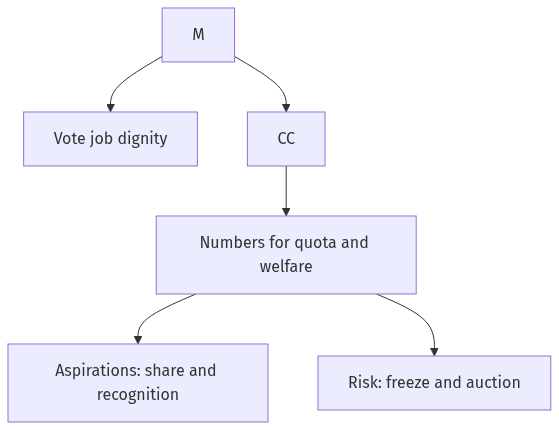
Caste remains a mobilisation axis because it still structures dignity, land, and access to the state, as Kothari, Mandal, and bahujan politics show. Parties already count jatis; the demand is that the official Census should too, beyond SC and ST. Aspirations include fairer reservation design, targeting of welfare, and recognition after the unpublished 2011 SECC caste data. Risks include reification of identity and a pure percentage war that forgets class, gender, and Ambedkar’s horizon of annihilation. A democratic census would publish usable aggregates while protecting persons and keeping constitutional individual rights at the centre.
Model answer
Copper italics in this answer — like this — are the key facts. Each one is unpacked in the Facts & figures rail.
Introduction
Caste remains a vital axis of Indian political mobilisation because it still organises marriage, land, dignity, and the queue for the state. Parties speak the language of development; they count jatis at the booth. A caste census is demanded as the statistical twin of that politics: if caste is how power is lived, the republic should know the numbers on which quotas, schemes, and tickets rest.
Body
Mobilisation
From the Non-Brahmin movement and Periyar through Lohia’s backward-caste socialism, the Mandal moment of 1990, and the BSP’s bahujan project under Kanshi Ram and Mayawati, caste has been a language of both hierarchy and revolt. Upper-caste consolidation, OBC federations, and Dalit assertion are modern ways of claiming the vote, the job, and the police station, not pre-modern leftovers. Every alliance in Bihar or Uttar Pradesh remains a caste arithmetic.
Aspirations are a share of education and jobs, protection from atrocity, and dignity in temples and streets. Rajni Kothari still holds: politics processes caste; it does not erase it. Parties already count jatis at every booth; the demand is that the official Census should too.
What a caste census is asked to do
The last full caste count was 1931, apart from SC and ST. The 2011 SECC caste table was not released. Advocates say Indra Sawhney’s ceiling, the Rohini fragmentation of OBC quotas, and welfare targeting fly blind without numbers. The census is asked to rebalance reservation, check elite jati capture, and recognise a structure the republic otherwise names only at elections.
Risks and a democratic handling
A census can freeze identities and turn justice into a percentage auction that forgets class and gender inside a jati. Ambedkar wanted annihilation of caste, not its eternal administration. Used as a tool of honest equality, with private records and public aggregates, the count can still be a first step of seeing. Mobilisation will not wait for the table; the table may civilise it or intensify it. A democratic handling therefore keeps constitutional individual rights at the centre even while it counts groups for welfare and representation.
Flow diagram
Conclusion
Caste mobilises because it still distributes power. A caste census is asked to match that fact with public knowledge, so that reservation and welfare rest on evidence rather than on the loudest federation. It can serve equality if it is a tool of justice; it will harm equality if it becomes a permanent auction of percentages without a horizon beyond caste.
Quick related
Students also ask
-
Objective Resolution of the Constituent Assembly.
Next question on this syllabus topic (2024 · Q5(b)). View answer →
-
Does a caste census strengthen caste?
It can, if politics stops at percentages. It can also weaken unjust monopoly if it reveals who actually captures benefits and who remains unseen.
-
Is SC/ST counting already a caste census?
It is a partial one. The political demand is to count OBCs and others with the same official seriousness, because mobilisation already does.
Same topic · past papers
UPSC has asked this before
These previous-year questions sit on the same topic. Open one to practise the earlier ask.
More from this topic
Q8(b) · UPSC Mains 2026 · PSIR GS 1 · 15 marks · Solution
Critically comment on the shifts in the functioning of the Indian Parliament in the last two decades
Indian Nationalism
This 15-mark answer analyses the transformation of the Indian Parliament over the past two decades, moving from a deliberative forum to an arena of executive assertion. It highlights declining debate hours, bypassing of Department-Related Standing Committees (DRSCs), and the rise of ordinance-making and bypassing of bicameral consensus through Money Bills. The critique incorporates Morris-Jones and Pratap Bhanu Mehta's insights on the hollowing out of institutions. The conclusion argues for systemic institutional reforms to restore Parliament's core constitutional role as a deliberative check on executive power.
Q7(a) · UPSC Mains 2025 · PSIR GS 1 · 20 marks · Solution
Enunciate the impediments to women's participation in local governance in the process of political decentralisation
Indian Nationalism
The 73rd and 74th Amendments reserved local seats for women, which is a structural opening, not yet equal participation. Sarpanch-pati proxy rule, unpaid care, and a male bureaucracy remain the everyday patriarchal impediments. Caste and class decide which women can act; Dalit women office-holders face additional violence and veto. Thin devolution of money and staff makes many local offices ceremonial, so participation has no policy content. Parties and seat rotation often transfer the reserved ticket to a household rather than building a woman’s public career.
Q6(a) · UPSC Mains 2025 · PSIR GS 1 · 20 marks · Solution
Parliamentary Committees are a strong tool of Parliamentary Democracy. It provides for the opportunity for cross-pollination of ideas among members of the Parliament. Discuss
Indian Nationalism
Parliamentary committees are the efficient working form of Indian parliamentary democracy, where bills, grants, and CAG reports can be examined in detail. Department-related Standing Committees mix Lok Sabha and Rajya Sabha members across ministries; PAC, Estimates, and COPU are the financial core. Cross-pollination happens because the whip is weaker, witnesses bring expertise, and members may agree on technical text they would never concede in the well of the House. The tool fails when bills are not referred, demands are guillotined, or ordinances replace debate. Committees strengthen democracy only if the House and the executive treat their reports as more than annual ritual.