
Revision summary
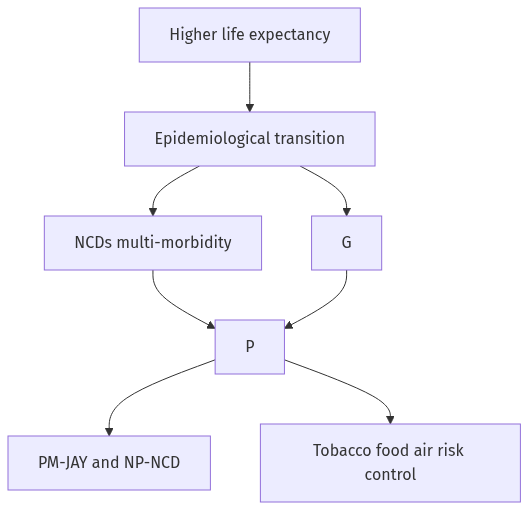
Rising life expectancy shifted India’s burden toward non-communicable disease, multi-morbidity and old-age care. Healthy life expectancy lags years lived; out-of-pocket chronic care can impoverish households. Infections and antimicrobial resistance remain, so the system must handle a double burden. Steps are Health and Wellness Centre screening, essential NCD drugs, PM-JAY, elderly programmes, and control of tobacco, diet and air pollution. Geriatric, mental-health and palliative capacity must grow at primary level, not only in metros.
Model answer
Copper italics in this answer — like this — are the key facts. Each one is unpacked in the Facts & figures rail.
Introduction
Indians now live longer than a generation ago because of vaccines, safer births, and control of many infections. Life expectancy rose; the disease mix shifted. Hospitals built for diarrhoea and tuberculosis now also face diabetes, cancer, dementia, and long COVID-type aftercare. That is a newer health challenge, not a simple victory.
Body
Newer challenges from longer lives
- Epidemiological transition: non-communicable diseases (diabetes, hypertension, heart disease, stroke, chronic lung disease, cancers) now cause a large share of death and disability.
- Multi-morbidity: an older person often has two or three conditions; a single vertical programme does not fit.
- Mental health and dementia: longer life without social support raises depression, isolation and care needs that families still carry unpaid.
- Geriatric and palliative care are thin outside a few cities; most primary health centres were not designed for them.
- Out-of-pocket cost: long treatment for cancer or dialysis can impoverish even when the first infection was prevented.
- Healthy life expectancy lags years lived: people survive but with pain, disability and poor nutrition in old age.
- Infections have not vanished: TB, dengue, antimicrobial resistance sit on top of the NCD pile, so the system must do both.
Steps
- Primary care first: screen blood pressure, sugar and common cancers at Health and Wellness Centres / Ayushman Arogya Mandirs; do not wait for a tertiary bed.
- Ayushman Bharat – PM-JAY for hospital cover of the poor, plus State schemes; pair with free essential NCD drugs at the clinic.
- National Programme for Prevention and Control of Non-Communicable Diseases (earlier NPCDCS) needs staff, diagnostics and referral that actually function.
- Healthy ageing: National Programme for Health Care of the Elderly, home-based care, and pensions that buy food and medicines.
- Risk factors: tobacco, trans-fat, air pollution, and inactivity need tax, FSSAI labelling, and city design—not only hospital bills.
- Human resources: geriatric, oncology, mental-health and mid-level provider posts; task-sharing so a doctor is not the only door.
- Data and surveillance: civil registration of cause of death, and NCD registers, so policy follows burden.
Flow diagram
Conclusion
- Longer life is a development gain. It creates a second burden: chronic disease, old-age care and catastrophic cost. The response is primary screening, affordable medicines, insurance for the poor, and healthy-ageing services—not only more tertiary towers.
Quick related
Students also ask
-
Discuss in detail the photochemical smog emphasizing its formation, effects and mitigation. Explain the 1999 Gothenburg Protocol.
Next question on this syllabus topic (2022 · Q7). View answer →
-
Did infectious disease stop being a problem?
No. TB, vector-borne disease and antimicrobial resistance continue. Longer life added NCDs on top.
-
Is more tertiary hospitals the main step?
They treat late disease. Screening, drugs and elderly care at primary level prevent impoverishment.
Same topic · past papers
UPSC has asked this before
These previous-year questions sit on the same topic. Open one to practise the earlier ask.
More from this topic
Q17 · UPSC Mains 2026 · GS III · 15 marks · Solution
What are the challenges to solid waste management in India? Discuss the governmental policy framework on solid waste management. Discuss the success/failure cases of Delhi and Indore cities highlighting the salient features of their solid waste management initiatives.
Indian Economy
• Rapid urbanization has made solid waste management a critical environmental and public health crisis in India. • Key challenges include lack of source segregation, inadequate processing infrastructure, reliance on unprotected informal workers, and financially weak urban local bodies. • The policy framework relies on the SWM Rules 2016, Swachh Bharat Mission (Urban), and Plastic Waste Management Rules 2016. • Indore succeeded through 100% source segregation, zero dump-site remediation, and strict enforcement with digital monitoring. • Delhi failed due to overloaded legacy landfills (Ghazipur, Bhalswa), lack of decentralization, and fragmented municipal governance. • A successful transition requires moving to a circular economy focused on source segregation, decentralized processing, and polluter accountability.
Q16 · UPSC Mains 2026 · GS III · 15 marks · Solution
What is Agentic Artificial Intelligence (AI)? Explain its working. Describe its applications with suitable examples. Discuss the advantages, risks and challenges associated with agentic AI systems.
Indian Economy
Agentic Artificial Intelligence represents an advanced paradigm where AI systems operate with autonomy, setting goals and executing complex workflows without constant human prompts. Unlike traditional generative AI that merely responds to queries, agentic AI uses perception, planning, memory, and tool-use to achieve multi-step objectives. Its applications span across autonomous software engineering, supply chain optimization, and automated financial trading. While offering massive productivity gains and dynamic problem-solving, these systems pose significant risks including lack of transparency, alignment failures, security vulnerabilities, and ethical dilemmas. Governance frameworks and robust guardrails are essential to harness their potential safely.
Q15 · UPSC Mains 2026 · GS III · 15 marks · Solution
Mention salient features of 'Mission Drishti'. Discuss the imaging techniques used in the satellite launched on 3rd May 2026. Why is it being considered world's first satellite of its kind?
Indian Economy
Mission Drishti represents a major leap in India's space-based Earth observation capabilities, launched on 3rd May 2026. The mission employs advanced multi-spectral and hyperspectral imaging techniques to capture high-resolution data across various atmospheric and terrestrial layers. It is hailed as a global first due to its unique integration of real-time onboard edge computing with quantum encryption for secure data transmission. The satellite significantly enhances resource management, disaster response, and strategic surveillance. It aligns with India's policy of leveraging space technology for sustainable development and national security.