
Revision summary
Post-Cold War hyper-globalisation has waned: WTO strain, export controls, vaccine nationalism, and war. Sovereign nationalism is industrial policy, data and energy security, and minilateral clubs of States. Interdependence continues under political licence, not as a religion of efficiency. India’s PLI, strategic oil and DPI diplomacy sit inside this shift. Climate and pandemics still require more than one flag.
Model answer
Copper italics in this answer — like this — are the key facts. Each one is unpacked in the Facts & figures rail.
Introduction
The post-Cold War era was marked by hyper-globalisation—open markets, cross-border supply chains, capital mobility and faith in institutions such as the WTO. However, this model has weakened under geopolitical conflict, supply-chain vulnerabilities and protectionism. The emerging order is therefore witnessing a renewed assertion of sovereign nationalism, where States seek greater control over trade, technology, resources, borders and national security.
Body
Waning of globalisation
- Trade and institutional fragmentation: The post-Cold War assumption of ever-deeper economic integration has weakened as geopolitical rivalry increasingly shapes trade.
- Example: WTO dispute-settlement paralysis reflects the difficulty of maintaining common global trade rules amid great-power rivalry.
- Protectionism: States are increasingly prioritising domestic industries and employment over unrestricted market access.
- Example: America First policies and higher tariffs demonstrate the return of economic nationalism.
- Supply-chain vulnerability: COVID-19 exposed the risks of excessive dependence on concentrated global manufacturing networks.
- Example: Disruptions in medicines, semiconductors and other critical goods encouraged countries to diversify supply chains.
- Security-driven globalisation: Trade and technology are increasingly viewed through the lens of national security.
- Example: Export controls on semiconductors and green technologies demonstrate that strategic technologies are no longer treated simply as global commodities.
- Migration and borders: Rising migration concerns have strengthened territorial and political nationalism, particularly in Europe and the US.
Rise of sovereign nationalism
- Economic sovereignty: States are using industrial policy to develop domestic productive capacity and reduce strategic dependence.
- Example: India's Production Linked Incentive (PLI) schemes represent sovereign industrial policy aimed at strengthening domestic manufacturing.
- Supply-chain sovereignty: Countries are moving from efficiency-based sourcing towards politically secure supply chains.
- Example: Friend-shoring shifts production towards trusted political partners rather than simply choosing the cheapest global supplier.
- Technological sovereignty: Control over semiconductors, AI, data and digital infrastructure has become an element of national power.
- Example: Data localisation, semiconductor policies and export controls reflect the growing emphasis on technological sovereignty.
- Resource sovereignty: States are securing critical minerals and energy supplies required for strategic and green transitions.
- Example: Competition for lithium, copper and other critical minerals has encouraged strategic bilateral arrangements.
- Strategic nationalism in geopolitics: Territorial disputes, wars and security competition have strengthened the primacy of national interest.
- Example: The Ukraine conflict and Red Sea disruptions demonstrated that energy, food and maritime supply chains remain deeply connected to national security.
- Rise of minilateralism: Instead of relying exclusively on universal institutions, States increasingly cooperate through smaller strategic groupings.
- Example: Quad, I2U2, IMEC and BRICS reflect cooperation among sovereign States around specific strategic interests.
India’s position
- Strategic autonomy: India is neither returning to autarky nor accepting unrestricted dependence; it is pursuing selective partnerships based on national interest.
- Example: India combines Russian oil, US technology, Gulf capital and African partnerships while maintaining strategic autonomy.
- Atmanirbhar Bharat: Domestic capacity-building has become an important element of India's response to global vulnerabilities.
- Example: PLI schemes seek to strengthen domestic manufacturing while retaining engagement with global markets.
- Selective engagement with globalisation: India continues to use global trade, technology and institutions while protecting sensitive sectors.
- Example: India's cautious position on agricultural issues at the WTO reflects the attempt to balance global integration with domestic interests.
- DPI diplomacy: India's Digital Public Infrastructure has become an instrument of international cooperation and influence, showing that sovereignty and global cooperation can coexist.
But sovereign nationalism is not complete de-globalisation
- Interdependence survives: Semiconductors, energy, finance and supply chains remain globally interconnected.
- Climate and pandemics transcend borders: No State can independently manage climate change, pandemics or other transnational challenges.
- Therefore, the emerging order is better described as selective interdependence under sovereign control rather than complete economic isolation.
Thus, the post-Cold War world is becoming a site of sovereign nationalism not because globalisation has disappeared, but because States increasingly decide the terms and limits on which they will remain interdependent.
Flow diagram
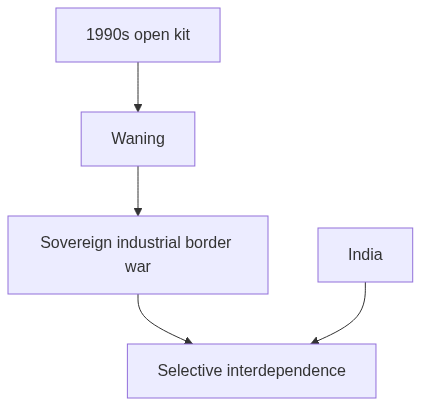
Conclusion
The world is moving from globalisation driven primarily by efficiency to globalisation conditioned by security and sovereignty. Tariffs, friend-shoring, PLI, technological controls and strategic autonomy demonstrate the renewed role of the nation-state. Yet complete de-globalisation is neither possible nor desirable. The emerging order is therefore best understood as a “marketplace with walls”—greater sovereign control combined with selective and strategic interdependence.
Quick related
Students also ask
-
What are environmental pressure groups? Discuss their role in raising awareness, influencing policies and advocating for environmental protection in India.
Next question on this syllabus topic (2025 · Q15). View answer →
-
Is globalisation over?
As a political faith, it is weaker. As cargo, data and students, it continues under thicker State conditions.
-
Is Atmanirbhar the same as isolation?
Officially it is capacity at home plus selective trade. In practice each tariff must be judged on whether it builds capacity or only rents.
Same topic · past papers
UPSC has asked this before
These previous-year questions sit on the same topic. Open one to practise the earlier ask.
-
2016 · Q13 · GS II · 12 marks
Has the Indian governmental system responded adequately to the demands of Liberalization, Privatization and Globalization started in 1991? What can the government do to be responsive to this important change? -
2016 · Q17 · GS II · 12 marks
"The broader aims and objectives of WTO are to manage and promote international trade in the era of globalization. But the Doha round of negotiations seem doomed due to differences between the developed and the developing countries." Discuss in the Indian perspective.
More from this topic
Q15 · UPSC Mains 2026 · GS II · 15 marks · Solution
To what extent do pressure groups, social movements and corporate lobbies deepen pluralistic democracy in India by representing excluded interests? Analyse whether the growing convergence of corporate wealth and political power poses a threat to the autonomy of formal democratic institutions.
Governance and Policy
• Civil society groups and grassroots movements go beyond periodic elections to channel marginalized voices into policy spaces. • Social movements on tribal rights and environmental protection have successfully forced the state to create protective legislation. • Representation is uneven due to a severe resource asymmetry between well-funded corporate lobbies and unorganized labor. • Some interest groups act as elite fronts, subverting public welfare for narrow sectarian gains. • Corporate financial dominance through opaque funding creates severe risks of policy capture and quid pro quo corruption. • Strengthening transparency in political funding and reinforcing regulatory autonomy are essential to safeguard democratic governance.
Q12 · UPSC Mains 2026 · GS II · 15 marks · Solution
What is meant by judicial legislation? In this context, discuss the verdicts of the apex court allowing "passive euthanasia" and a "living will".
Governance and Policy
• Judicial legislation occurs when courts create binding rules to fill policy voids caused by legislative inaction. • The Supreme Court legalized passive euthanasia under Article 21, recognizing the right to die with dignity. • The *Common Cause* (2018) judgment permitted the withdrawal of life support for terminally ill patients with strict medical safeguards. • A living will is an advanced medical directive allowing individuals to pre-state their treatment preferences before incapacitation. • The Supreme Court simplified living will procedures in 2023, replacing complex magistrate approvals with basic notary attestation. • While court guidelines provide immediate relief, they underscore the need for a comprehensive parliamentary statute on end-of-life care. • Codifying these judicial norms through formal legislation ensures democratic legitimacy, ethical debate, and administrative clarity.
Q6 · UPSC Mains 2026 · GS II · 10 marks · Solution
Does India's tribal development policy reflect the aspirations for a socially grounded and equity-based governance? Justify your answer.
Governance and Policy
• India's tribal policy balances constitutional protections with socio-economic development goals. • Fifth and Sixth Schedules provide decentralized autonomy and safeguard tribal lands. • Articles 275(1) and 335 ensure grants-in-aid and reservations to bridge gaps. • PESA (1996) and FRA (2006) mark shifts toward rights-based and culturally sensitive governance. • Gram sabhas are empowered over minor forest produce and community forest rights. • Implementation is hindered by forced displacement without consent and bureaucratic inertia. • True equity requires empowering local institutions rather than relying solely on welfare delivery.