
Revision summary
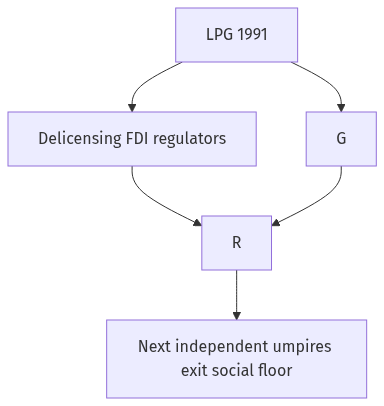
LPG asked the State to regulate and cushion, not to licence every investment. India delicensed industry, cut tariffs, created SEBI, TRAI, CCI and similar bodies, and used some disinvestment. Factor markets, full PSU reform, district inspections and farm marketing lagged. WTO-era patents and farm talks show unfinished globalisation politics. Further response needs independent regulators, bankruptcy and exit, State-level ease, and portable social security.
Model answer
Copper italics in this answer — like this — are the key facts. Each one is unpacked in the Facts & figures rail.
Introduction
The 1991 crisis forced India to cut the licence raj, welcome more foreign capital, and join a more open world market. Liberalization, privatization and globalization (LPG) asked the governmental system to shift from a controlling owner to a regulator, a competition umpire, and a social-safety provider. The response has been real but uneven: the Union opened many product markets; land, labour, farms, and some public monopolies still run on an older grammar.
Body
What 1991 demanded of government
- Delicense industry, lower peak tariffs, and let the rupee find a market rate so that firms, not the licence committee, decide investment.
- Reduce the State's role as owner where private capital can compete, and use disinvestment both for efficiency and for fiscal space.
- Accept global rules, later including the WTO (1995), and build regulators who are not the old producing ministry in a new name.
- Protect the poor with targeted transfers, because prices and jobs would shift faster than the old planning model allowed.
Where the system did respond
- The New Industrial Policy, 1991, ended most industrial licensing. Peak customs duties fell over the 1990s and 2000s. FDI caps were raised in many sectors through the DIPP/DPIIT route.
- Independent regulators appeared: SEBI (given statutory force in 1992), TRAI, CERC, IRDAI, and the Competition Commission under the Competition Act, 2002, replacing the old MRTP control mindset.
- Disinvestment and strategic sales moved some public firms toward the market; a Disinvestment Commission and later a department gave the file a home.
- Tax reform, convertibility on the current account, and a more professional RBI-government dialogue improved macro management compared with 1991.
- Trade policy used export promotion, SEZs, and later GST design work (still incomplete in 2016) to match a globalised production chain.
- Social response was not absent: MGNREGA, RTE, and a shift toward Direct Benefit Transfer tried to cushion those whom LPG did not automatically lift.
Where the response was not adequate
- Factor markets lagged product markets. Labour statutes stayed fragmented; land acquisition remained politically explosive after the 2013 Act; farm marketing in many States still ran through old mandi law.
- Privatization often meant selling minority shares, not a hard budget for remaining PSUs. Bank recapitalisation without a bankruptcy code (the Insolvency and Bankruptcy Code, 2016, was only just born) left sick capital stuck.
- Ease of doing business at the district window — inspections, power, contract enforcement — did not match the 1991 speech in many States.
- Globalisation brought WTO disputes on agriculture, patents (mailbox and then product patents from 2005), and services. India adapted the Patents Act but still struggles to speak with one trade-and-livelihood voice.
- Inequality, informal jobs, and regional concentration of investment show that LPG was not matched by equal State capacity in education, skilling and urban land.
What government can still do to stay responsive
- Finish a national bankruptcy-to-exit path, recast remaining PSUs as commercial boards or sell where the State has no strategic need, and stop using banks as a second budget.
- Build State-level factor reform: simpler labour codes, time-bound land and building permission, and power that is billed and paid.
- Keep independent regulators genuinely independent of the line ministry, with published orders and appellate tribunals that work.
- Use WTO and FTA talks to open what India can compete in, while defending food security, public health TRIPS flexibilities, and a services agenda (Mode 4) that matches India's strength.
- Pair openness with portable social security, skilling, and logistics so that a worker and a small firm can enter the global chain without a licence tout.
- Cooperative federalism: LPG now lives in GST-type bargains, State industrial policy, and city land. The Union cannot liberalise on paper while States remain inspector raj.
Flow diagram
Conclusion
The governmental system did respond to 1991 by delicensing, building regulators, cutting tariffs and adding some social floors. It has not responded adequately on factor markets, true privatization, district-level ease, and equal human capital. Responsiveness now means independent umpires, exit for sick firms, State-level reform, and social security that travels with the worker in an open economy.
Quick related
Students also ask
-
"Traditional bureaucratic structure and culture have hampered the process of socio-economic development in India." Comment.
Next question on this syllabus topic (2016 · Q14). View answer →
-
Did 1991 abolish the public sector?
No. It reduced industrial licensing and invited private capital. Many strategic and loss-making PSUs remained; disinvestment was gradual and often partial.
-
Why are States central to LPG now?
Land, labour implementation, power and urban permission sit largely with States. Union tariff cuts cannot offset an inspector raj at the factory gate.
Same topic · past papers
UPSC has asked this before
These previous-year questions sit on the same topic. Open one to practise the earlier ask.
-
2025 · Q10 · GS II · 10 marks
"With the waning of globalization, post-Cold War world is becoming a site of sovereign nationalism." Elucidate. -
2016 · Q17 · GS II · 12 marks
"The broader aims and objectives of WTO are to manage and promote international trade in the era of globalization. But the Doha round of negotiations seem doomed due to differences between the developed and the developing countries." Discuss in the Indian perspective.
More from this topic
Q15 · UPSC Mains 2026 · GS II · 15 marks · Solution
To what extent do pressure groups, social movements and corporate lobbies deepen pluralistic democracy in India by representing excluded interests? Analyse whether the growing convergence of corporate wealth and political power poses a threat to the autonomy of formal democratic institutions.
Governance and Policy
• Pluralism needs many competing groups so that no single interest dominates policy • Trade unions, farmer bodies and movements such as Chipko and Narmada Bachao Andolan have brought excluded voices into public debate • Movements delivered RTI, Forest Rights and Lokpal laws that give citizens lasting tools • Weak resources and FCRA and protest restrictions limit civil society reach • Corporate influence runs through party funding, lobbying, regulators and media ownership • The electoral bonds scheme was struck down in 2024 for violating citizens' right to information • Institutions such as the Supreme Court, CAG and the Election Commission still check capture, but risks remain • Reforms include funding transparency, a lobbying law, cooling-off periods and protection of dissent
Q12 · UPSC Mains 2026 · GS II · 15 marks · Solution
What is meant by judicial legislation? In this context, discuss the verdicts of the apex court allowing "passive euthanasia" and a "living will".
Governance and Policy
• Judicial legislation is court-made law that fills a legislative vacuum, using Articles 32, 141 and 142 • Vishaka, Prakash Singh and NALSA are common examples, and each invited later legislation • Gian Kaur (1996) denied a right to die but spoke of dying with dignity when death is imminent • Aruna Shanbaug (2011) permitted passive euthanasia with High Court supervision • Common Cause (2018) held the right to die with dignity to be part of Article 21 and recognised living wills • The 2023 modification simplified attestation, board composition and timelines • The tension is between dignity under Article 21 and the legislature's domain on a sensitive moral issue • A national statute on terminal illness would replace interim court guidelines
Q6 · UPSC Mains 2026 · GS II · 10 marks · Solution
Does India's tribal development policy reflect the aspirations for a socially grounded and equity-based governance? Justify your answer.
Governance and Policy
• Constitution: Fifth and Sixth Schedules create tribal self-rule, with Tribes Advisory Councils and autonomous district councils. • Law: PESA 1996 makes the Gram Sabha central and FRA 2006 recognises individual and community forest rights. • Welfare: DAPST, Article 275(1) grants, Eklavya schools, PM JANMAN and the sickle cell mission target the gap. • Weakness: mining, dams and forest clearance rules often override Gram Sabha consent. • Weakness: delayed PESA rules, FRA claim rejections and diverted funds blunt equity. • Security: LWE districts show the cost of land alienation and weak service delivery. • Verdict: strong legal design, uneven delivery, so equity is partial and conditional. • Way ahead: enforce consent, social audit, benefit-sharing through District Mineral Foundations.